“I tried stainless steel, everything stuck.” If I had a euro for every time a patient told me that, I could buy a complete cookware set. It’s the number one concern when I recommend switching to 18/10 stainless steel. People are afraid it will stick. And to be honest: if you heat a stainless steel pan poorly and throw an egg on it, yes, it will stick. But that’s not the material’s fault. It’s the temperature’s fault.
There is a physical phenomenon known since 1756, described by a German physician named Johann Gottlob Leidenfrost, which explains exactly why food sticks or doesn’t stick to a hot metal surface. And once you understand this phenomenon, cooking with stainless steel becomes as simple as with a non-stick pan, except you’re no longer eating microplastics.
The Leidenfrost effect: physics at the service of cooking
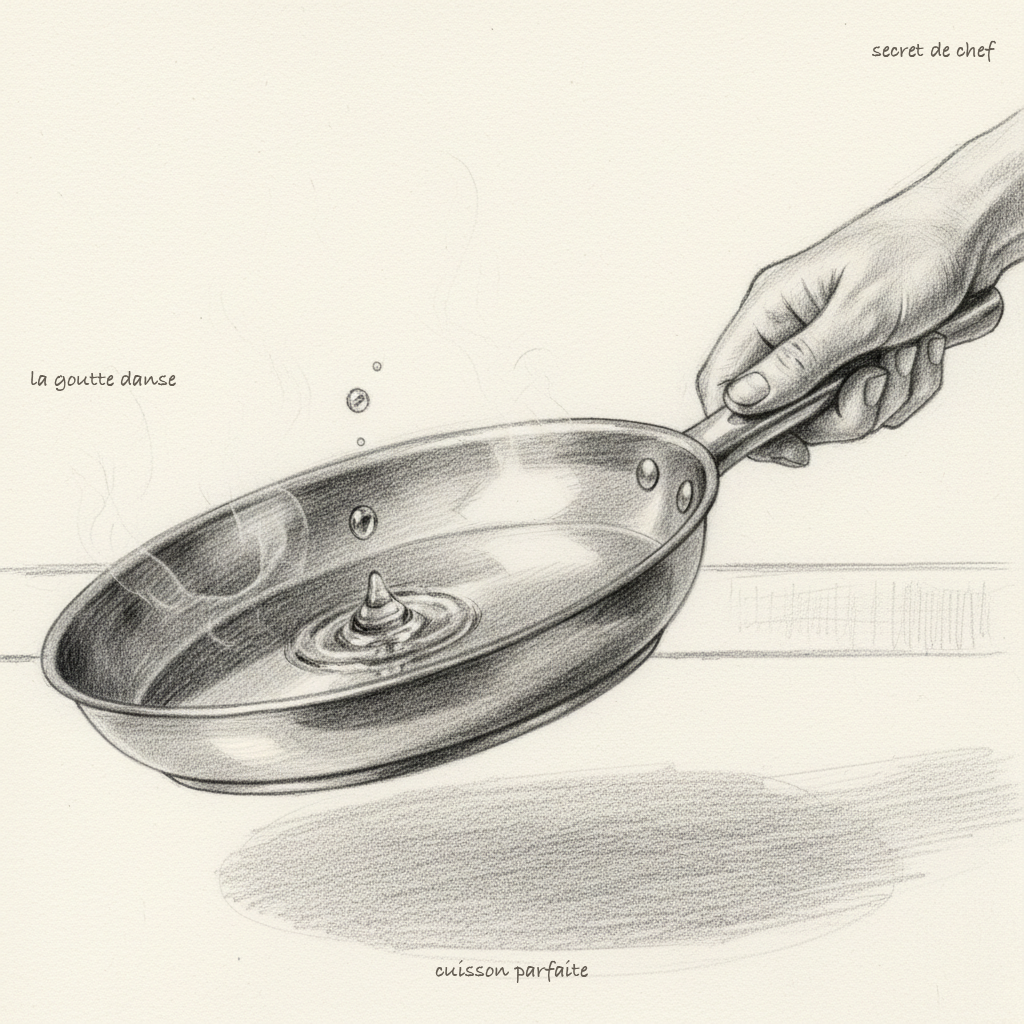
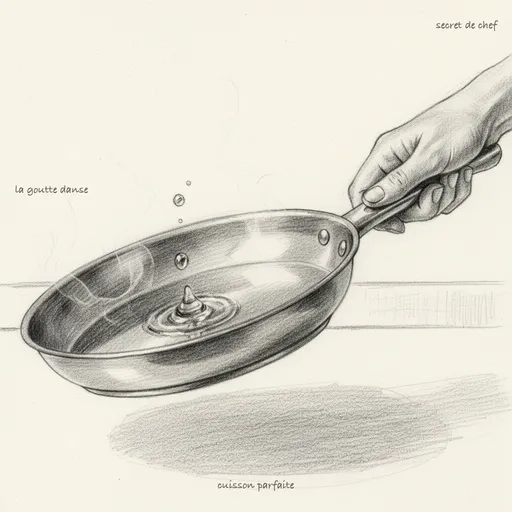
When a drop of water falls on a very hot surface, it doesn’t evaporate immediately. It transforms into a small ball that floats and dances on the surface, as if it were levitating. It’s not magic, it’s thermodynamics. At a certain temperature, the surface of the drop in contact with the metal evaporates instantly and forms a vapor cushion that isolates the rest of the drop. This is exactly what happens with food: when the pan is at the right temperature, a thin layer of vapor forms between the food and the metal, and nothing sticks.
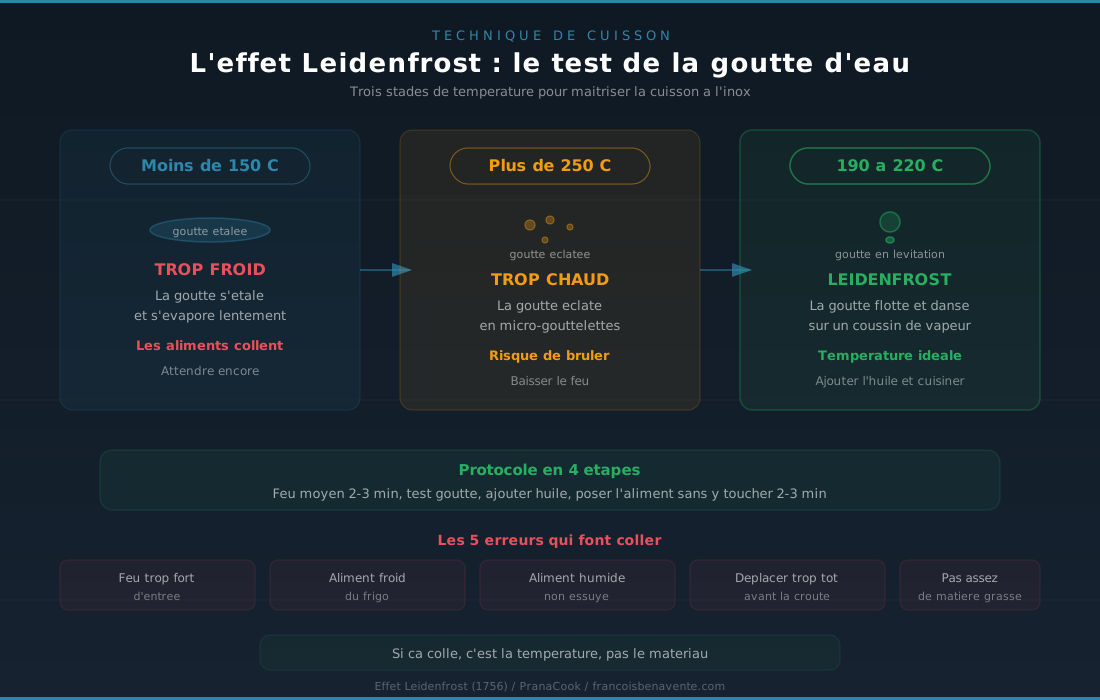
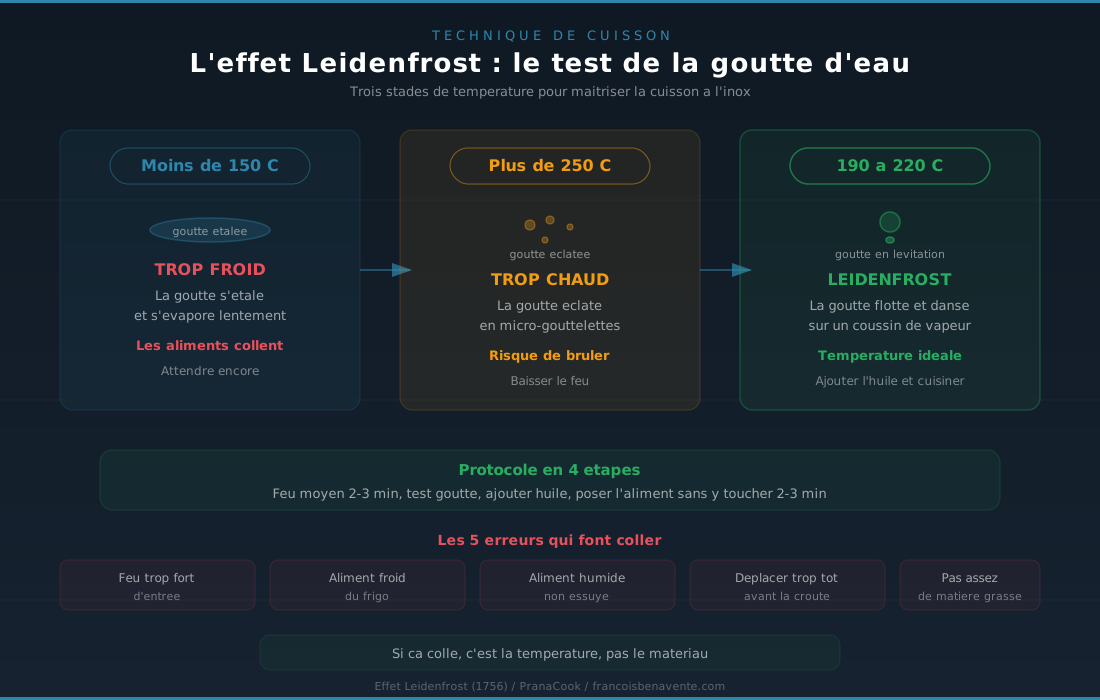
The Leidenfrost point for water on stainless steel is around 190 to 220 degrees. Below that, water (and food) spreads and adheres to the surface. Above 250 degrees, drops burst into microdroplets that evaporate too quickly, and you risk burning the food. The ideal window is between these two extremes, and the water drop test allows you to find it with precision.
The water drop test: how to use it
This is the most useful technique you’ll learn in the kitchen this year. It replaces all timers, all thermometers, all guesswork. And it costs nothing.
Place your stainless steel pan on the heat, at medium power. Not full blast. Medium. Wait two to three minutes without doing anything. No fat, no food, just the pan and the heat. Then, with your fingertips, spray a few drops of water on the surface.
Three possible scenarios. First scenario: the water spreads into a puddle and evaporates slowly with bubbles. It’s too cold. The pores of the steel are still open, if you place food now, it will stick to them. Wait another minute and try the test again.
Second scenario: the drops burst immediately into dozens of microdroplets that disappear in a second. It’s too hot. Lower the heat by one notch, wait 30 seconds, and try the test again.
Third scenario: the drop transforms into a perfect ball that glides and rolls across the surface like a mercury ball. It dances, it moves, it stays intact for several seconds. This is the Leidenfrost point. This is it. Add your oil and start cooking.
The complete protocol in 4 steps
First step: preheating at medium heat, 2 to 3 minutes, empty pan. Patience is key. Never put your pan on high heat to “save time”: you’ll overshoot the Leidenfrost point and everything will burn.
Second step: water drop test. When the drop dances, you’re in the zone.
Third step: add your fat. Olive oil, coconut oil, clarified butter, duck fat, it doesn’t matter. The oil should heat quickly and start to “shimmer,” meaning to ripple slightly. If it smokes, it’s too hot, lower the heat.
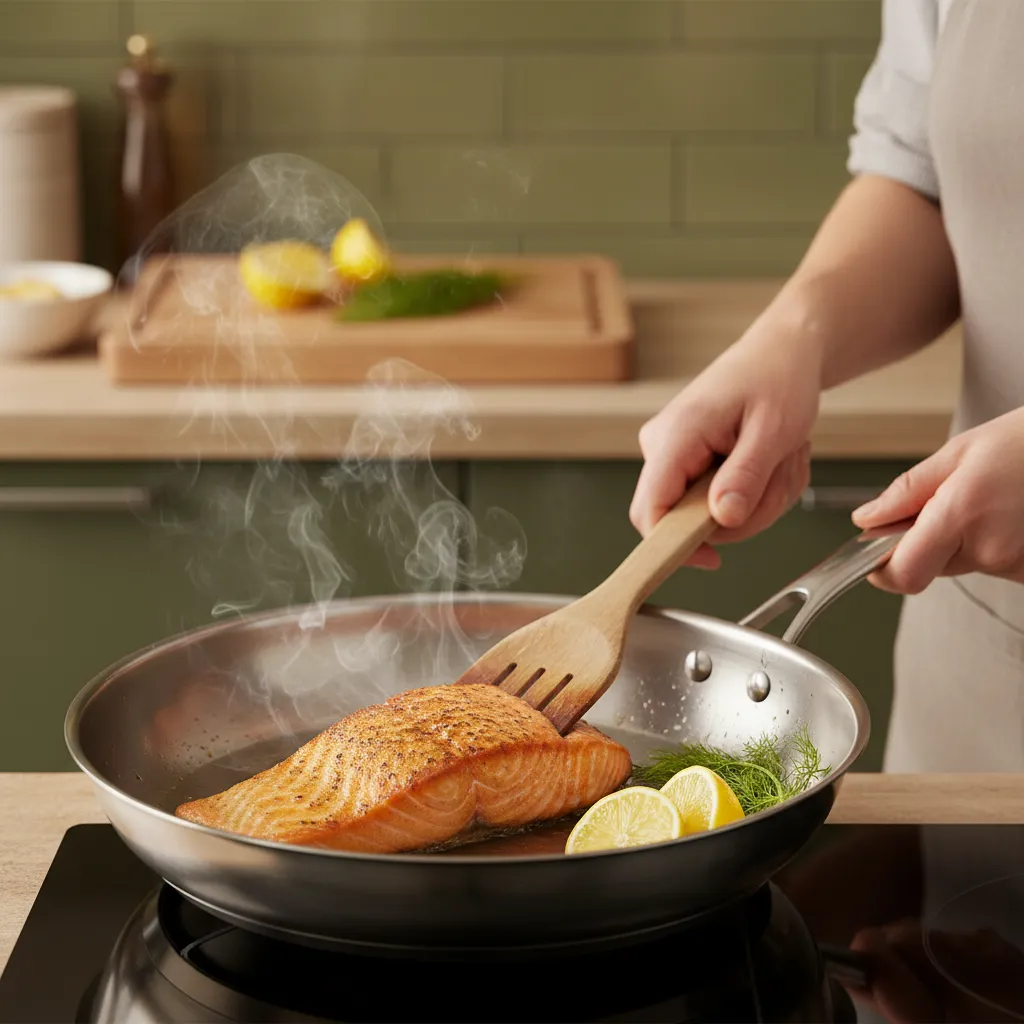
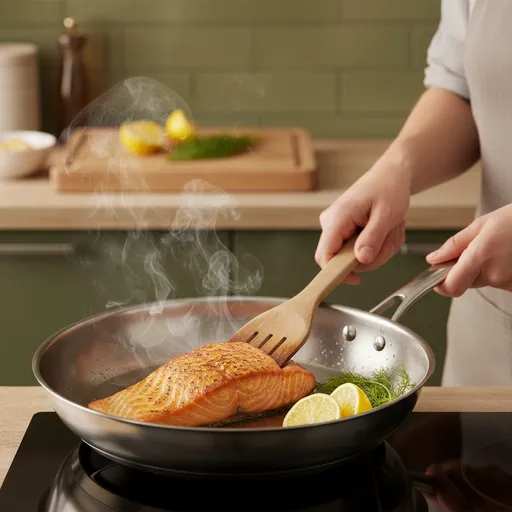
Fourth step: place the food and don’t touch it for 2 to 3 minutes. This is where most people fail. They place the chicken, salmon, or egg, and 30 seconds later they try to move it. It’s too early. The food needs time to form a Maillard crust, a thin caramelized coating that acts as a natural non-stick layer. When this crust is formed, the food releases on its own. If you pull on it before, you tear off the crust and it sticks.
The 5 mistakes that cause sticking (and how to avoid them)
Mistake number one: heat too high from the start. You want to go fast, you put the heat on high, and in two minutes your pan is at 300 degrees. Everything burns, everything sticks, and you conclude that “stainless steel doesn’t work.” Medium heat is your best friend. Always.
Mistake number two: cold food from the fridge. When you place a steak at 4 degrees on a pan at 200 degrees, the thermal shock causes the temperature at the contact surface to drop. The Leidenfrost zone is lost, and the food sticks. Take your proteins out of the fridge 15 to 20 minutes before cooking them. This is a basic rule that even Michelin-starred chefs follow.
Mistake number three: wet food. Water on the surface of food creates a barrier that prevents the Maillard reaction from forming. Result: no crust, no natural release. Always pat your meat and fish dry with paper towels before placing them in the pan. For vegetables, a cold water rinse followed by good drying is enough. The potato trick: rinse it in cold water to remove surface starch, dry it well, and it will never stick again.
Mistake number four: moving the food too early. This is the most common mistake. When food is ready to be flipped, it tells you: it releases on its own. If you try to slide your spatula under a salmon fillet after 30 seconds and it resists, it’s not ready. Wait more. Patience is the only technical skill required for cooking with stainless steel.
Mistake number five: not enough fat. Oil isn’t just a lubricant. It creates a thermal interface between the metal surface and the food. No need to drown the pan, but a tablespoon spread over the entire surface is the minimum. In gentle cooking, you can reduce the amount. In searing, be generous.
The deglaze: your best friend for cleaning
When you’ve finished cooking and there are browned bits stuck to the bottom of the pan, don’t panic. These bits are residues of the Maillard reaction, and they’re packed with flavor. Put the pan back on the heat, pour a splash of water (or wine, broth, vinegar), and watch: the residues release instantly when the liquid touches them. This is deglazing, a classic French cooking technique that cleans your pan in 10 seconds while creating an extraordinary cooking sauce.
For more stubborn cases, coarse salt with white vinegar forms a perfect soft abrasive. You pour, you rub with paper towel, and the stainless steel becomes mirror-like again. Stainless steel fears absolutely nothing: scrubbing sponge, stainless steel wool, metal brush, dishwasher, baking soda. Try doing that with a non-stick pan and you’ll throw it in the trash.
Cooking with stainless steel: a technique that becomes second nature
I won’t lie to you: the first two times you cook with stainless steel, you might have some failures. That’s normal. You’ve spent years cooking without thinking about temperature because Teflon did the job for you. Stainless steel asks you to relearn a gesture: how to read heat. To feel when the pan is ready, to listen to the sizzle that changes when the temperature is right, to watch the oil shimmer.
This is exactly what the PranaCook source says: “You learn to read the heat, to listen to the surface, to adjust your technique.” And after three or four cookings, it becomes a reflex. You don’t even need the water drop test anymore: you recognize the right temperature by sound, sight, instinct. It’s a return to more conscious cooking, more attentive, more present. In naturopathy, we would call it mindful eating: the same principle that applies to chewing also applies to cooking.
For those who want to go further and understand how cooking method affects nutrients, I’ve written a detailed article on gentle cooking and vitamin preservation. Because cooking well with stainless steel also means knowing at what temperature to cook to preserve what food has best.
The real non-stick coating is temperature
The kitchenware industry pulled off a marketing feat: convincing us that to prevent food from sticking, we needed an artificial surface, a chemical coating, a synthetic polymer. The reality is that the world’s best non-stick coating is physics. A cushion of water vapor between the metal surface and the food, formed naturally by the Leidenfrost effect. No chemistry, no plastic, no PFAS. Just thermodynamics.
To equip yourself with quality stainless steel, PranaCook offers cookware designed for healthy everyday cooking.
“Simplicity is the ultimate sophistication.” Leonardo da Vinci. And cooking with stainless steel is exactly that: returning to the simplicity of a material that doesn’t lie.
To go further
- Gentle cooking: preserving nutrients that heat destroys
- 18/10 stainless steel: why a naturopath only cooks with it
- Pan, pot, wok: which tool for healthy cooking
- Endocrine disruptors in the kitchen: what your cookware is hiding from you
Healthy recipe: Scrambled eggs with stainless steel: Apply the water drop technique.
Laisser un commentaire
Sois le premier à commenter cet article.