import { Image } from ‘astro:assets’; import schema1 from ’../../../assets/schemas/schema-herbalisme-vs-phytotherapie.svg’; import schema2 from ’../../../assets/schemas/schema-emonctoires-plantes-marchesseau.svg’; import schema3 from ’../../../assets/schemas/schema-3-cures-herbalisme.svg’;
When a Chamois Knows More Than Your Pharmacist
“Nature sets the example. A chamois bitten by a viper purges itself by grazing on spurge, which it does not normally eat. The wolf does the same with bistort root. Finally, cats and dogs eat herbs which, depending on their species, produce expectoration, vomiting, or defecation.” This observation by botanist P. Schauenberg, featured in Pierre-Valentin Marchesseau’s Booklet N.44, raises a dizzying question. If an animal wounded by a viper instinctively knows which plant to graze to purge itself, why has man lost this intelligence? Herbalism, this ancient art of using food plants to support the organism’s self-healing processes, represents the naturopathic answer to this question. And this answer has nothing to do with what you’ll find in a phytotherapy dictionary.
Marchesseau expressed it with disarming clarity: “In our era when chemistry reigns, simple plants are always present and heal more reliably than original synthetic products obtained in the laboratory.” Yet you must know how to use them. For between herbalism and phytotherapy, there is a philosophical gulf that most modern practitioners don’t even suspect.
Herbalism Is Not Phytotherapy
Open any medical herbal dictionary and you’ll find an identical pattern: opposite each illness, the plant supposed to cure it. Bronchitis? Water cress, Melilot officinalis. Kidney stones? Parsley, Carline thistle, Pilosella. Eczema? Fumitory, Black nightshade, Blackthorn. Marchesseau spent entire pages demonstrating the absurdity of this approach by comparing three different dictionaries. For the same condition, the three works prescribe completely different plants. “These multiplicities and divergences are disconcerting,” he noted with biting irony.
But the worst part is not the incoherence. The worst part is the underlying logic. Modern phytotherapy, born from the writings of Henri Leclerc in 1922, reproduces exactly the reasoning of allopathic medicine: identify a symptom, then seek the substance that will make it disappear. “Truth compels us to say that all these phytotherapists behave like perfect allopaths,” Marchesseau wrote. “They seek to suppress the symptoms whose nature they cannot appreciate, much less their value, and they unscrupulously use more or less toxic plants.”
Marchesseau identified three fundamental errors made by classical phytotherapy. First, the immoderate use of anti-symptomatic plants, antipyretics, antisudorifics, antidiarrheics, which hinder natural elimination. Second, the toxicity of most plants used, from Aconite (of which 2 to 4 grams suffice to kill a man) to Belladonna to Hemlock. Third, purely superficial care, limited to only the visible effects of diseases, without seeking to reach their deep and real causes.
Herbalism sits at the opposite end of this approach. The naturopath is not a phytotherapist. “Being neither a doctor nor a healer, he does not practice therapy,” Marchesseau stated. “He knows that most diseases, 80 percent, represent spontaneous efforts of the organism to heal itself and that he has no reason to intervene directly at the level of emunctory activities.” Herbalism is characterized by its art of using food plants in preference to others, with the aim of activating the emunctories if necessary, and of acting only very rarely with medicinal plants, taking care to choose the least toxic ones.
The Terrain First: The Vision of Carton and Hippocrates
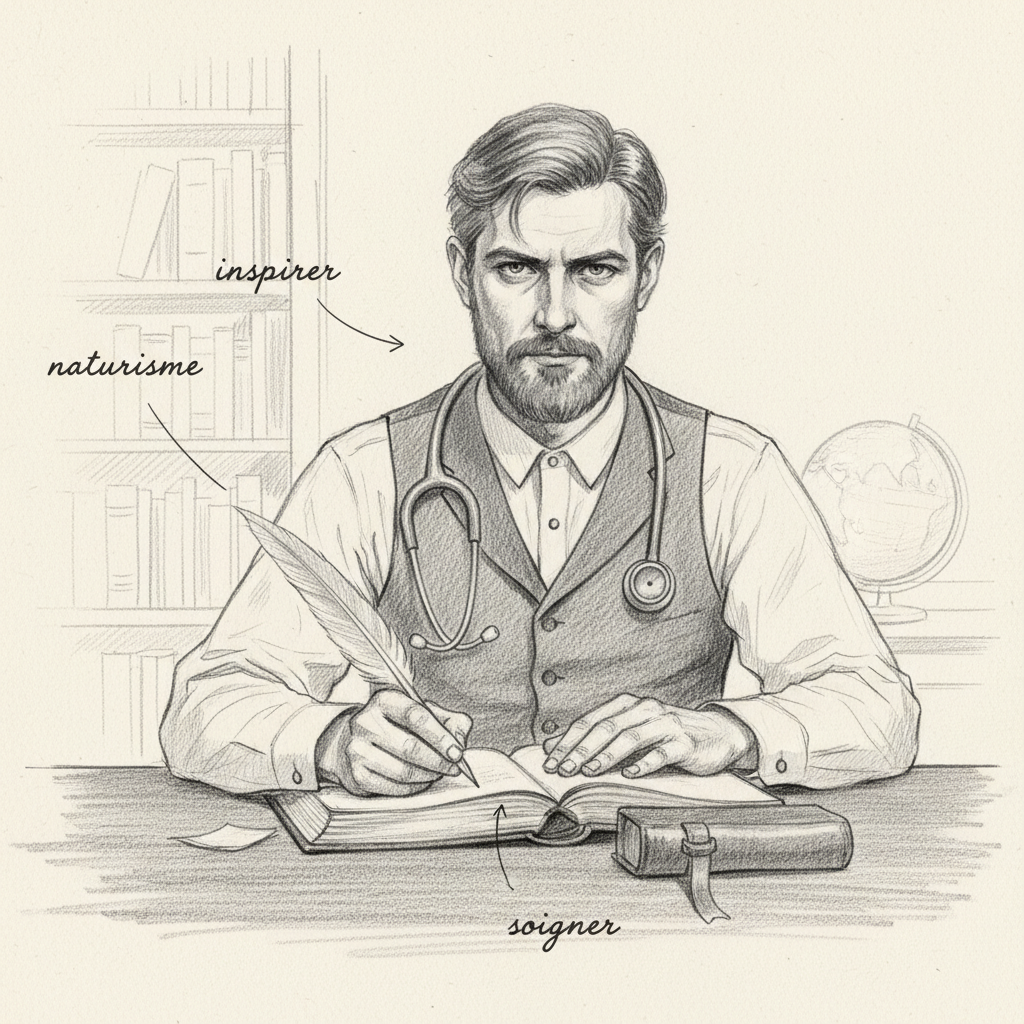
To understand herbalism, one must go back to the source. And that source is Hippocrates, reread through the lens of Dr. Paul Carton. “All diseases are cured by means of some evacuation, through the mouth, through the anus, through the bladder, or through some emunctory.” This Hippocratic principle, Carton had placed at the center of his naturist method. For him, the doctor’s role was not to fight disease, but to accompany vital force in its work of elimination.
“It is nature that cures disease; medicine is the art of imitating nature’s curative processes.” This quote from Hippocrates, which Carton cited tirelessly, sums up the entire philosophy of herbalism. The plant is not a medicine. It is an ally of the terrain. It does not fight the symptom: it accompanies the emunctory in its drainage work.
Carton compared our organism to an energy transformer functioning in three stages: intake, transformation, elimination. Energies enter through three routes: digestive, respiratory, and cutaneous. The digestive route is the most important, because it requires the most transformation work and produces the most waste. “Digestion is a struggle,” Carton would repeat. A constant struggle between the body and what it absorbs. When this struggle is lost, food stagnates, ferments, putrefies, and waste enters the blood.
The hierarchy of emunctories according to Carton is enlightening: the intestines first, then the kidneys, then the skin, finally the lungs. The intestines eliminate food debris and collect waste rejected by the liver. The kidneys excrete heavy acids through urine. The skin evacuates through sweat urea, uric acid, and mineral salts. The lungs are the fastest route for pH regulation through the exhalation of CO2. Herbalism fits into this logic: choosing the plant suited to the emunctory that needs to be solicited.
The Forgotten Etymology: When “Vegetable” Meant “Force”
Before diving into the inventory of plants, let’s make a detour through Dr. Bertholet and his reflection on vegetarianism. For herbalism cannot be fully understood without this forgotten etymology.
“Vegetables are the great ladder that unites the earth with the heavens, and how sweet and easy it is to climb.” This phrase by Jean-Antoine Gleizes, considered the modern father of vegetarianism, opens an unsuspected perspective. When one searches for the original meaning of the word “vegetable,” one discovers that the Latin verb vegeto means to give movement, to increase, to cause to be born, to develop, to strengthen. As for the adjective vegetus, it means vigorous, lively, strong, in good health, powerful, ardent.
Etymology is sometimes a very striking science. It invites us to understand that our ancestors recognized vegetables as a source of strength and full health. Dr. Bonnejoy noted a considerable number of famous figures known for their vegetarianism and quest for truth: Pythagoras, Buddha, Zoroaster, Orpheus, Homer, Plato, Socrates, Seneca, Marcus Aurelius, Virgil, Horace.
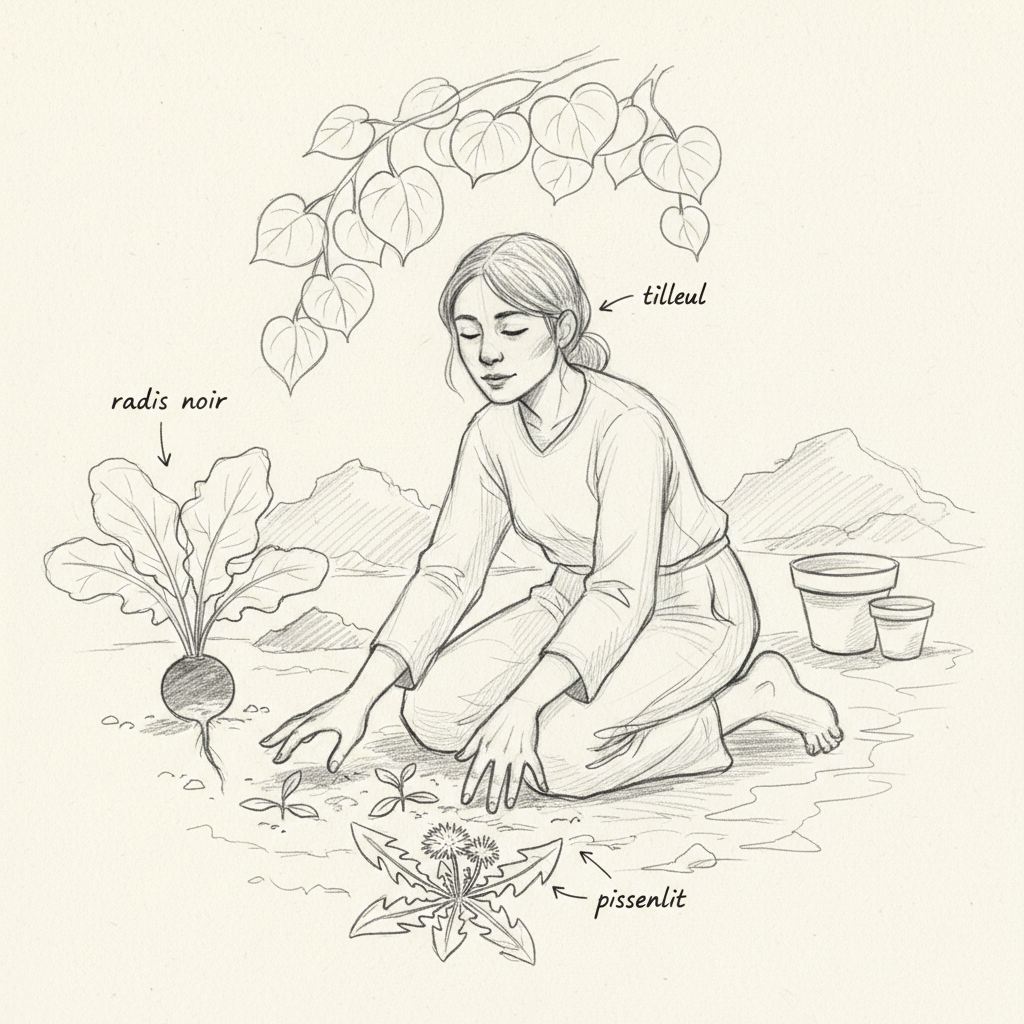
For Bertholet, the healthy man is one who consumes foods subjected to the same light, topographic, and caloric constraints as he is. Herbalism naturally fits into this vision: seasonal garden plants, cultivated locally, are the first allies of the terrain. No need to seek exotic plants with supposed miraculous virtues when the black radish in your garden does the job.
Marchesseau’s Inventory: Plants by Emunctory
Let us now enter the heart of the matter. Marchesseau classified plants by emunctory circuit, always distinguishing between food plants, which he prioritized, and medicinal plants, which he used only as a last resort.
The hepato-biliary-intestinal circuit represents, according to Marchesseau, “the complete organic circuit of the most important apparatus for eliminating mucus, at a rate of more than one liter of bile per day.” Black radish is the first recommendation. A powerful detergent that presents no drawbacks or contraindications, it is taken raw, by chewing the root thoroughly or by extracting its juice with a juicer. The dose during a cure period: a glass of juice twice a day. Marchesseau insisted on avoiding syrups with cane sugar or alcohol tinctures: “Fresh products and cold extracts” are always superior.
Artichoke comes next. Everything interests Marchesseau in this plant: leaves, stems, roots, fleshy heads. All contain oxidases and peroxidases, powerful deflocculants of overloaded tissues. But be careful: “cooked artichoke loses most of these qualities.” It is eaten raw, without salt, or in cold infusion: 200 grams of fresh substance finely chopped for one liter of water at 40 degrees, maintained for three hours. Upon waking, drink a large glass of this cold, unsweetened drink, for two to three weeks.
Fennel, known to the Egyptians, is eaten raw at a rate of 100 grams per day. Chervil, the base of “fines herbes,” is consumed raw and finely chopped in salad, 20 to 30 grams twice a day. Garlic, “the queen of detergent plants,” is ideally taken in cold dried powder, one teaspoon in the salad per meal.
For medicinal plants that drain the gallbladder, Marchesseau retains only wild linden sapwood, mint, and dandelion, always in raw powder in a glass of warm water.
The renal circuit gives pride of place to onion, “one of the best known diuretics.” Raw, sliced into strips, infused in one liter of water at low temperature for three hours, it yields a remarkable drink. Leek, whose broth is “known since time immemorial for making the sick urinate,” can be consumed as a monodietary for eight days mixed with onions stewed. Asparagus, wrongly accused of tiring the kidneys, is actually a powerful diuretic with no danger or contraindication, whose stem can be juiced raw to drink fresh juice as an aperitif. As for renal medicinal plants, Marchesseau cites couch grass, cherry stalks, birch, and goldenrod.
Capital note: “The best diuretic agent is distilled water,” according to Marchesseau, who recommends Dr. Hanish’s cure: one to two days of dry fasting, followed on the third day by two to three liters of distilled water. This is the “renal shower” of the Germans.
The lungs and skin are the emunctories for which Marchesseau uses the fewest plants. He prefers breathing exercises and sudation baths. “So take herbal teas based on leaves or bark to sweat and breathe, but do not forget, above all, the baths and exercises which are the major factors for activating the skin and lungs.” For expectoration, he recommends mullein, eucalyptus, Scots pine, and licorice. For sudation, violet, elder, sassafras, and borage.
The Superfoods of Revitalization
After detoxification comes revitalization. And this is where food plants reveal all their nutritional power.
The carrot is, for Marchesseau, an absolute marvel. Rich in carotene, iron phosphate, glutamine, and lecithin, it represents, according to G. Knap, the “miraculous cement to consolidate the entire organic structure.” This modest vegetable, a veritable universal remedy, always succeeds where everything else has failed, provided it is taken as a monodietary: four bowls of carrot puree per day, or one to two liters of raw juice. Marchesseau reported “true resurrections during difficult convalescence periods.”
Lemon receives lengthy treatment where Marchesseau corrects an error by Dr. Carton. Carton thought lemon was demineralizing due to its acids. Marchesseau nuances this: lemon is dangerous only for the “sub-vital,” thin, chilly people who metabolize it poorly. In others, the acids transform into carbon dioxide to be exhaled and the minerals alkalize the blood. One liter of lemon juice provides approximately one gram of calcium and 0.30 gram of phosphorus: it is a basic food despite its acidic taste. But the cure must always be conducted with caution and progression, beginning with a quarter of a lemon and increasing to the threshold of individual tolerance. And never in the sub-vital.
Onion is a major revitalizer through its silica content (15 to 18 percent), its glucokinase which stimulates the pancreas, and its soluble calcium in high doses. Dr. Lindgreen even discovered antibiotic properties in it through its crotonaldehyde.
Blackcurrant offers extraordinary richness in vitamin C (218 milligrams per 100 grams of fresh fruit) and iron. It drives away fatigue, gives strength, and activates hepato-renal function.
Pollen, finally, with its 20 to 30 percent protein and its 40 to 45 percent amino acids, its range of vitamins and minerals, represents a “prodigious” revitalizer. Take one tablespoon fifteen days per quarter for adults, never cooked, preferably blended with honey.
Warning and Conclusion
Marchesseau set a non-negotiable rule: no course of medicinal laxative plants should be extended beyond three weeks without the advice of a competent hygienist. Doses must be calculated according to individuals and reduced progressively. The herbalist must always accompany the use of plants with rectal showers, a hot-water bottle on the liver in the evening, abdominal massage, and daily physical exercise.
“One could, in naturopathy, do without plants,” Marchesseau concluded. “But they remain practical especially for stimulating the hepato-vesicular-intestinal apparatus and the kidneys. Rectal showers and distilled water cures would suffice, but an abundance of means does no harm, especially when the means prove to be without danger.”
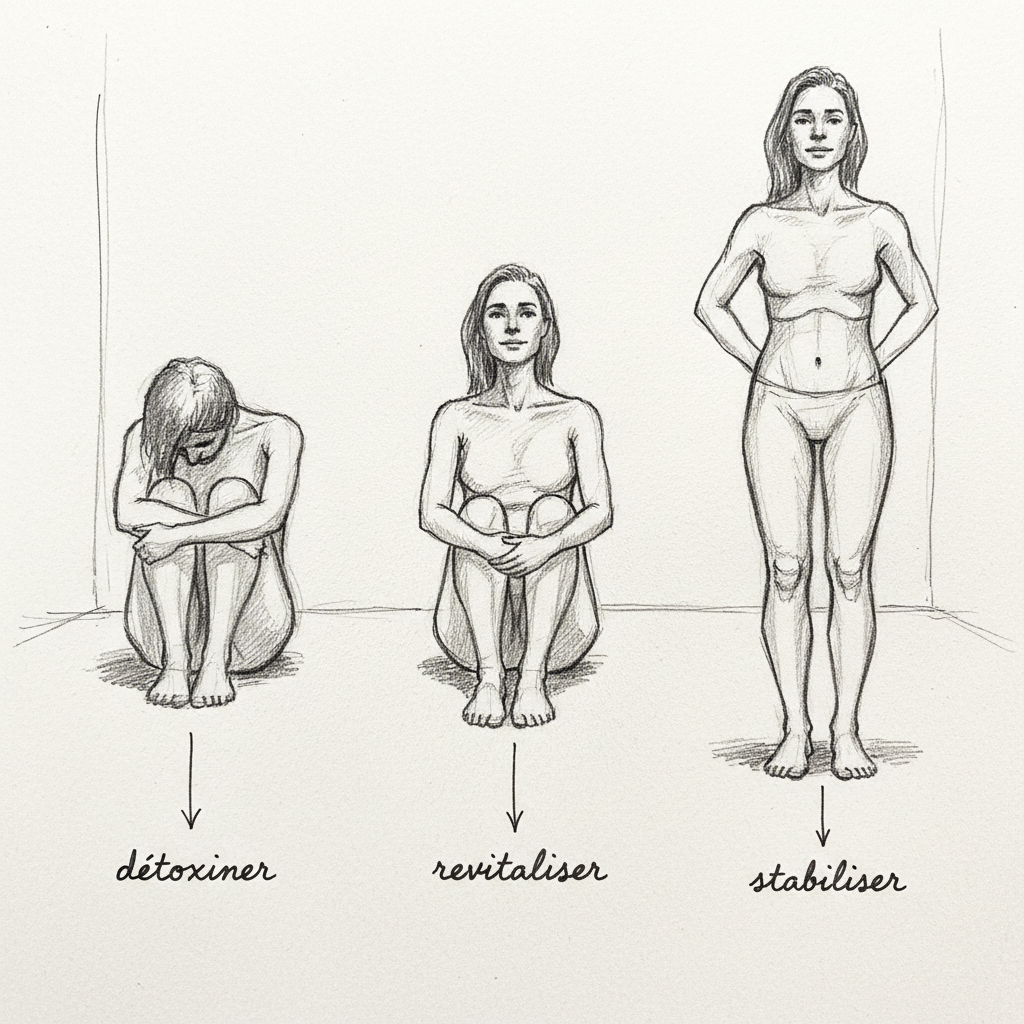
The synthesis comes down to one sentence: “Detoxification, revitalization, and stabilization are the three stages of the vital hygiene cure.” Plants, in the first phase, are “drainage agents” through their action on the emunctories. In the second, they become “nutrients” through their vitamins, minerals, and diastases. In the third, in the form of essential oils, they normalize the terrain like “natural antibiotics” without danger.
Reading Carton, Marchesseau, and Bertholet requires the ability to read between the lines. Herbalism is not a collection of recipes. It is an art of listening: listening to the body, listening to the seasons, listening to that instinctive intelligence that Schauenberg’s chamois never lost, but which modern man, blinded by his chemistry and his plant dictionaries, has ultimately forgotten. “All the secret of medicine resides in the elimination function, inherent in every living organism, and which manifests itself spontaneously, without the aid of any remedy. But in subjects overloaded, without vitality, or aging, it is good to assist this function. This is the art of the hygienist.”
Sources: P.V. Marchesseau, De l’usage des plantes en naturopathie, Booklet N.44, Collection Art-Sante-Connaissance Initiatique. Paul Carton, La Doctrine d’Hippocrate. Dr Bertholet, Naturaneo course, Spiritualite et vegetarisme. P. Schauenberg, cited by Marchesseau.


Laisser un commentaire
Sois le premier à commenter cet article.