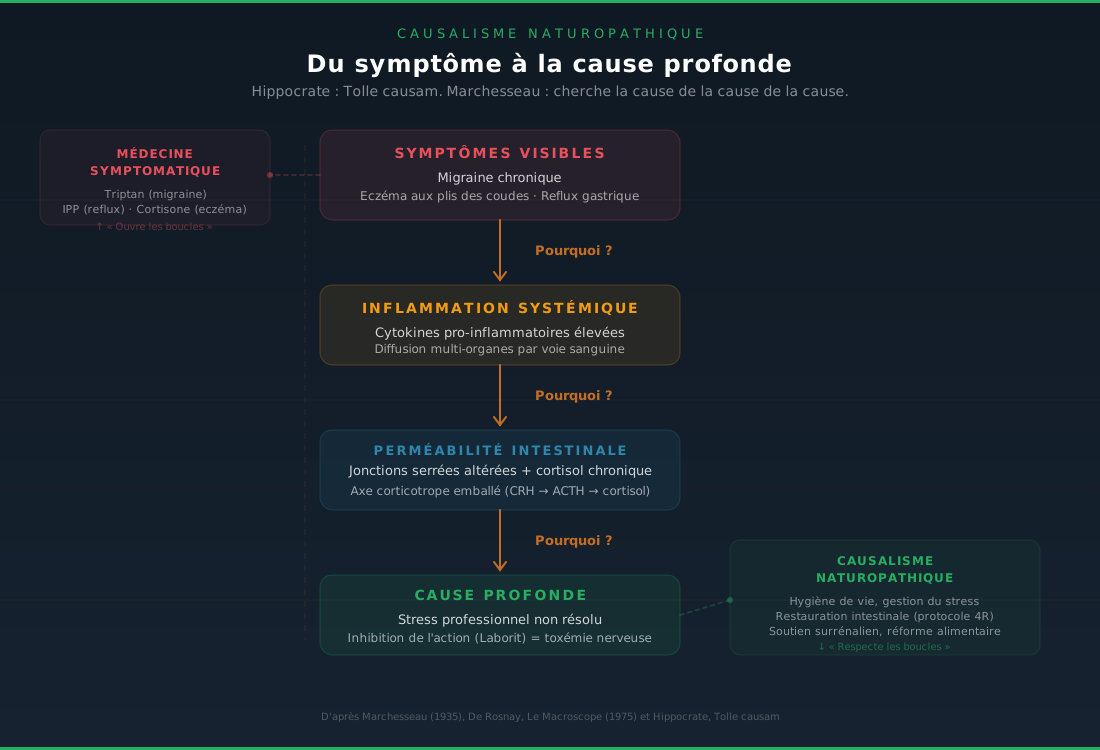
Sophie is 42 years old. She came to consult with me about chronic migraines. Two to three episodes per week for eight months. Her primary care doctor prescribed Triptan. Her gastroenterologist added a PPI for the reflux that appeared in the meantime. Her dermatologist gave her cortisone for the eczema that settled in her elbow creases. Three specialists, three prescriptions, zero connection between the symptoms.
First naturopathy appointment. I ask her to tell me about her typical week. Her diet. Her sleep. Her stress. In twenty minutes, the chain unravels: permanent professional stress, cortisol running wild, intestinal permeability collapsing, systemic inflammation climbing. Migraine, eczema, reflux. Three symptoms, one cause only.
That day, I told her: “Your body doesn’t have three problems. It has one single imbalance that speaks three languages.”
This idea that the micro and macro are linked, that the imbalance of a microscopic intestinal membrane can generate manifestations throughout the entire organism, is not the intuition of an inspired naturopath. It is a principle that Pascal established 350 years ago, that cybernetics demonstrated in the twentieth century, and that fractal biology confirms every day. And it is exactly the foundation of Marchesseau’s causalism: to trace back from the visible to the invisible, from the symptom to the root, from the infinitely large to the infinitely small.
”A nothing in relation to infinity, a whole in relation to nothing”
In 1670, Blaise Pascal’s Pensées appear. Fragment 72 (Brunschvicg numbering), or 199 in the Lafuma edition, contains one of the most vertiginous texts ever written about the human condition. Pascal describes a mite, the mite invisible to the naked eye, and imagines entire universes within this atom of matter. Suns, planets, lands populated with animals, and within these animals other mites, and within these mites other worlds, and so on to infinity. Two hundred years before the electron microscope.
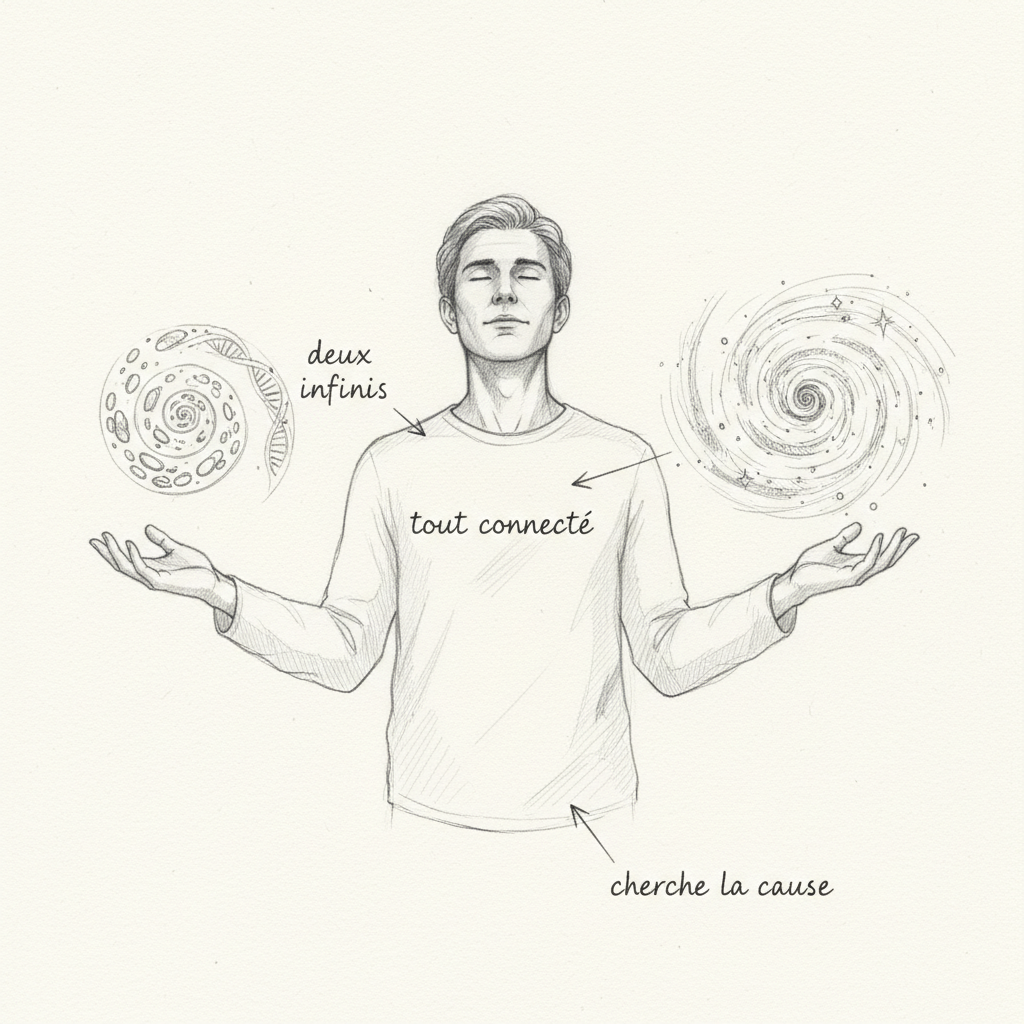
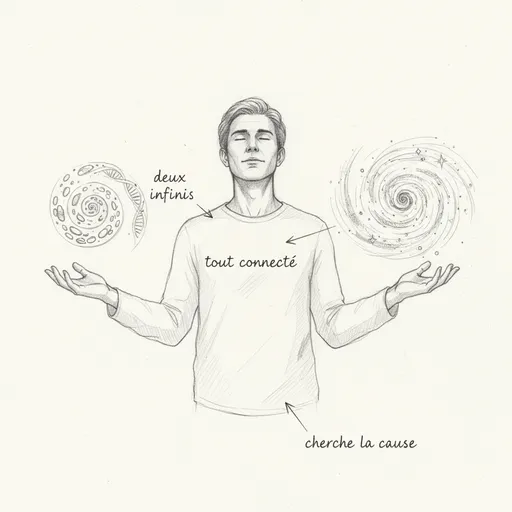
Man, writes Pascal, is “suspended between two abysses.” Between the infinitely large that he cannot embrace and the infinitely small that he cannot reach. “A nothing in relation to infinity, a whole in relation to nothing, a middle between nothing and everything.” Pascal’s greatness lies in having understood that these two infinities are not separated. They contain each other mutually. The atom carries within it the structure of the cosmos, and the cosmos reproduces the logic of the atom.
Pascal does not invent this intuition. It goes back to Hermes Trismegistus and the Emerald Tablet, whose founding formula has traversed the centuries: “What is below is like what is above, and what is above is like what is below.” Principle of correspondence between levels of reality. Principle of analogy between the microcosm and the macrocosm. A ninth-century alchemist and a seventeenth-century geometer say exactly the same thing: the small and the large reflect each other.
Barjavel, in Ravage (1946), takes the poetry further: “The infinitely small and the infinitely large penetrate and merge with each other.” What Pascal guessed through philosophy, what the alchemists sensed through analogy, a Franco-American mathematician will prove through numbers. His name is Benoît Mandelbrot.
When the cell reproduces the organism
In 1975, Mandelbrot forges a word that will upset the sciences: fractal. From the Latin fractus, broken. In 1982, he publishes The Fractal Geometry of Nature, in which he demonstrates that nature is not Euclidean. “Clouds are not spheres, mountains are not cones, coastlines are not circles, bark is not smooth, and lightning does not travel in a straight line.”
The principle of the fractal is self-similarity: a structure that repeats identically at all scales of observation. Zoom as much as you want: you find the same pattern. And the human body is a fractal machine.
Your lungs first. The trachea divides into two bronchi, which divide into bronchioles, which divide into alveolar ducts, across 23 levels of branching. Result: 70 to 100 square meters of exchange surface compacted into a volume of just a few liters. Your blood vessels next. The aorta branches into arteries, arterioles, capillaries, according to the same fractal scheme. Your neurons too: dendritic arborization, axons, synapses. Your intestinal villi: folds within folds within folds, which transform a 7-meter tube into an exchange surface of 250 square meters.
The principle is always the same: maximum surface area in minimal volume. And the consequence for health is immense. If the body is fractal, what happens at the cellular scale repeats itself at all higher scales. A microscopic inflammation of the intestinal membrane does not remain microscopic. It “fractalizes” into systemic inflammation. Sophie’s eczema on her elbows, her migraine, her reflux: three manifestations of the same inflammatory pattern repeated at different scales. Exactly what Pascal described: worlds within the mite.
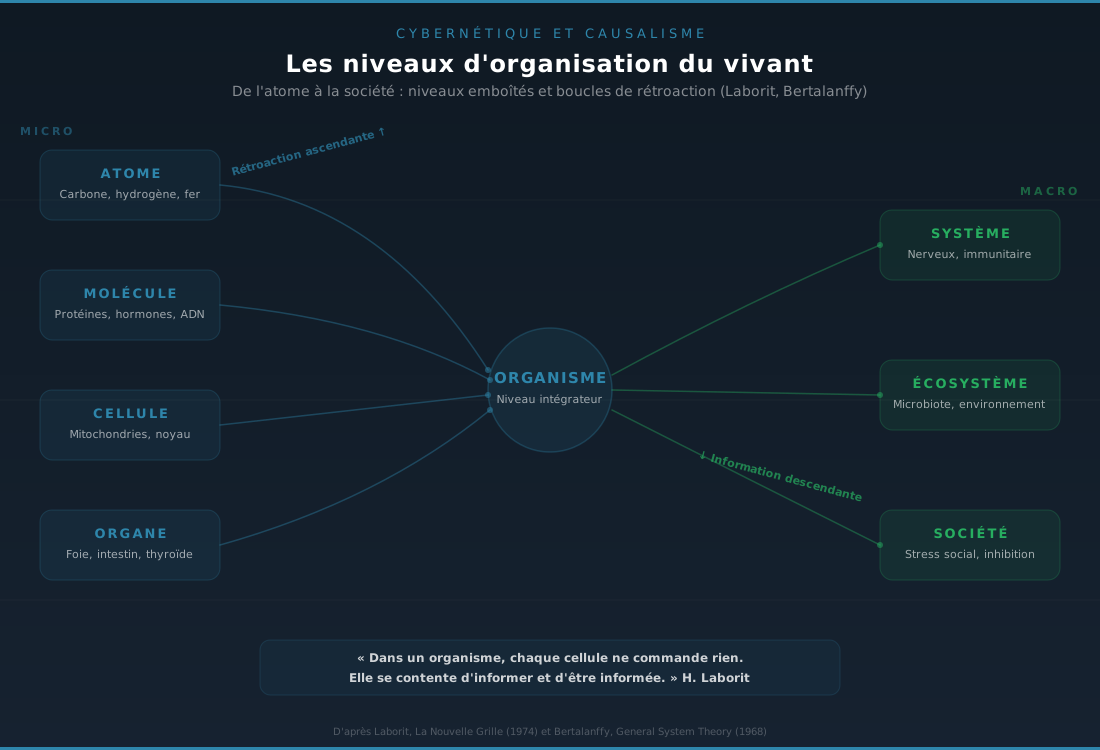
Feedback loops: from internal environment to homeostasis
In 1865, Claude Bernard lays the first stone. In his Introduction to the Study of Experimental Medicine, he writes: “All vital mechanisms, however varied they may be, have only one purpose: to maintain the unity of the conditions of life in the internal environment.” This internal environment is the terrain of naturopaths. The fluid in which cells bathe. Claude Bernard has just given vitalism a physiological foundation.
In 1932, Walter Cannon invents the word “homeostasis” to designate this tendency of the body to maintain its internal constants. Temperature, blood pH, blood glucose oscillate constantly, but always return to their set point. How? Through feedback loops.
It is Norbert Wiener who formalizes all this in 1948 with Cybernetics. The word comes from the Greek kubernêtês, the pilot. Cybernetics is the science of piloting, regulation, control through information. The central principle: negative feedback. A biological thermostat. Temperature rises, the body sweats. Blood glucose elevates, the pancreas secretes insulin. TSH rises, the thyroid produces more T3 and T4, which in turn inhibit the production of TSH by the pituitary. Closed loop. Automatic regulation.
The thyroid axis is a textbook case. The hypothalamus secretes TRH, which stimulates the pituitary, which secretes TSH, which stimulates the thyroid, which produces T4 and T3. And these thyroid hormones report back to hypothalamus and pituitary that there is enough. If you know how to read a complete thyroid panel, you see cybernetics at work in every value. The corticotropic axis works the same way: CRH, ACTH, cortisol, negative feedback. Like blood glucose: insulin and glucagon in permanent opposition.
In 1975, Joël de Rosnay publishes The Macroscope: Toward a Global Vision. A foundational book. De Rosnay distinguishes three instruments: the microscope to see the infinitely small, the telescope to see the infinitely large, and the macroscope to see the infinitely complex. “The roles are reversed: it is no longer the biologist who observes the cell, it is the cell that watches the organism that houses it.”
De Rosnay formulates ten commandments of the systemic approach. The second is explosive: “Do not open the regulatory loops.” In other words: when you intervene on a living system, do not cut the feedback circuits. Do not suppress fever systematically. Do not eliminate inflammation without understanding why it is there. Do not put a stopper on an emunctory that is trying to evacuate. This is exactly what symptomatic medicine does. And it is exactly what naturopathy refuses to do.
Henri Laborit and the levels of organization of life
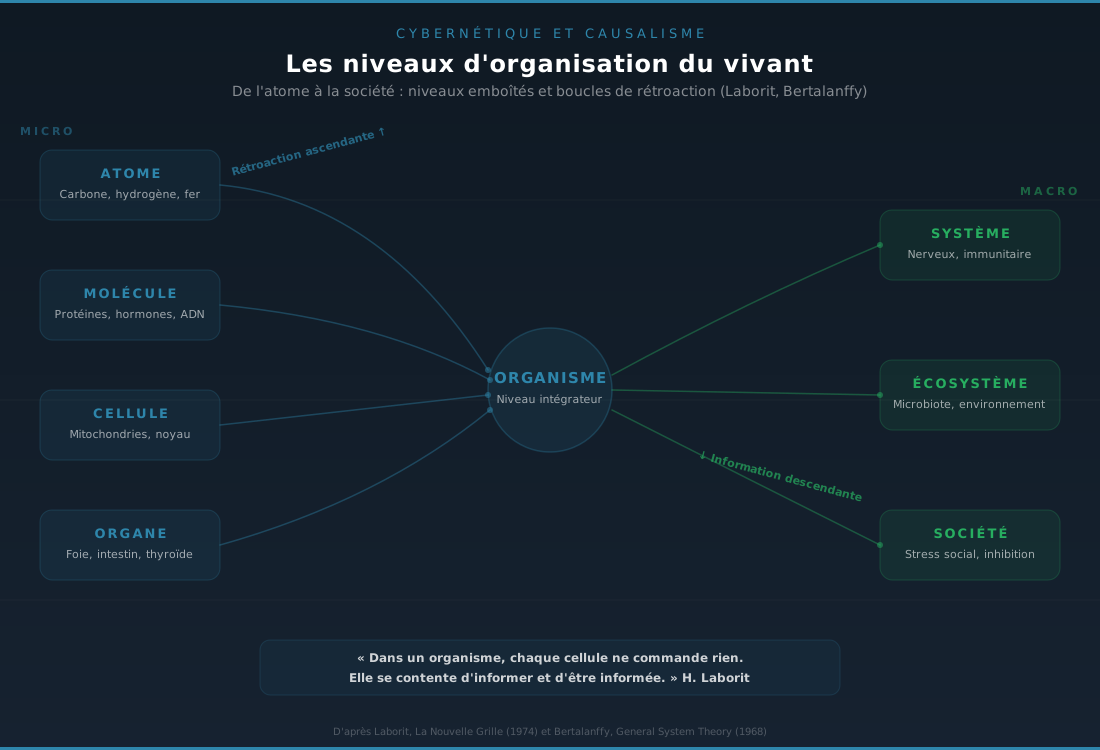
Henri Laborit marked the twentieth century as few French scientists have done. Surgeon in the Navy, discoverer of the first neuroleptic, unclassifiable neurobiologist, philosopher of complexity. In 1974, he publishes The New Grid, a work in which he describes life as a nesting of organizational levels. Atom, molecule, organelle, cell, organ, system, organism, society. Each level contains the previous ones and is contained by the following ones. Each level has its own laws, but none can be understood in isolation.
Laborit writes: “In a living organism, each cell commands nothing. It simply informs and is informed.” Power does not exist in a biological system. There is only information circulating between levels. And this circulation is pure cybernetics. “The only reason for being of a being is to be, that is, to maintain its structure.”
In 1979, Laborit publishes The Inhibition of Action (Masson). The work describes what happens when an organism can neither flee nor fight in the face of aggression. When action is blocked, the action inhibition system (AIS) activates. Cortisol runs wild. And a pathogenic cybernetic loop sets in place: CRH stimulates ACTH, which stimulates cortisol, which activates AIS, which sustains CRH. Closed loop, but this time in positive feedback: the system runs away instead of regulating itself.
Laborit’s chronic stress is exactly what Marchesseau calls “nervous toxemia.” It is not temporary stress. It is prolonged action blockage that disrupts the three homeostatic networks: nervous, immune, endocrine. The three networks that the adrenal glands attempt to maintain in balance. When Laborit shows that a rat that can neither flee nor fight develops ulcers, high blood pressure and tumors, he proves experimentally what naturopaths have affirmed since Hippocrates: the terrain does everything, and the imbalance of one level reverberates on all the others.
The three networks converge toward the same conclusion. The autonomic nervous system regulates vascular tone and digestion. The immune system monitors tissue integrity. The endocrine system coordinates metabolism. And the three communicate constantly through crossed feedback loops. Touch one, and you disturb the other two. This is why stress (nervous) disrupts the thyroid (endocrine) and favors infections (immune).
”Seek the cause of the cause of the cause”
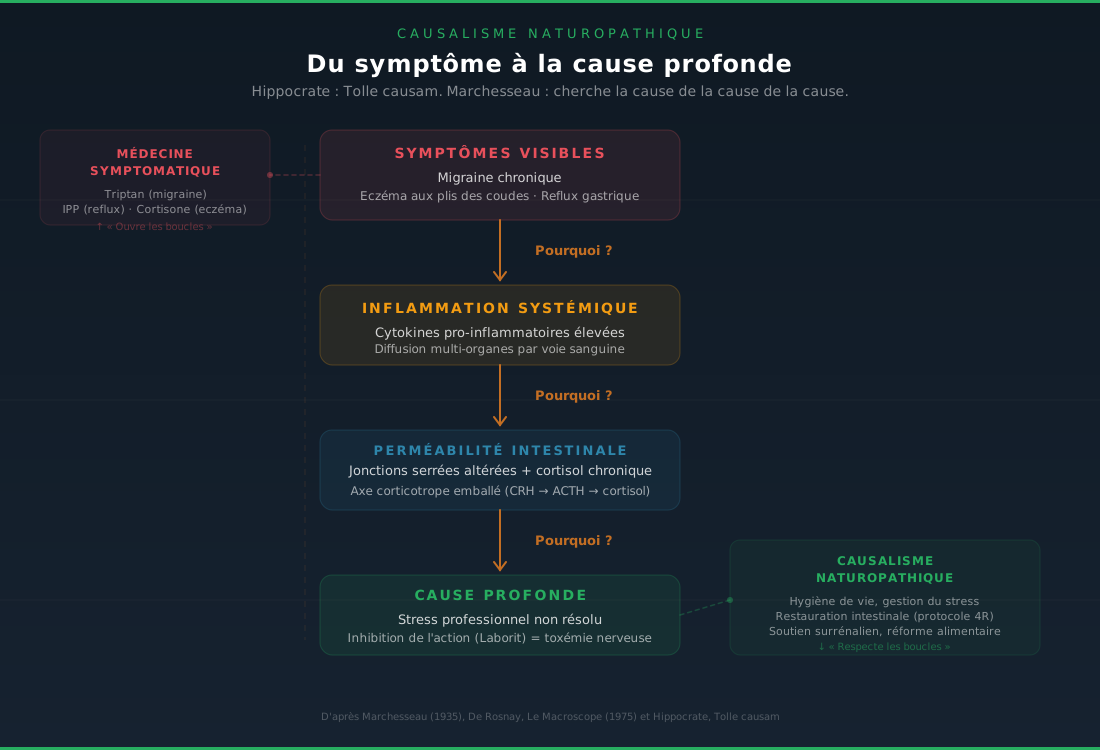
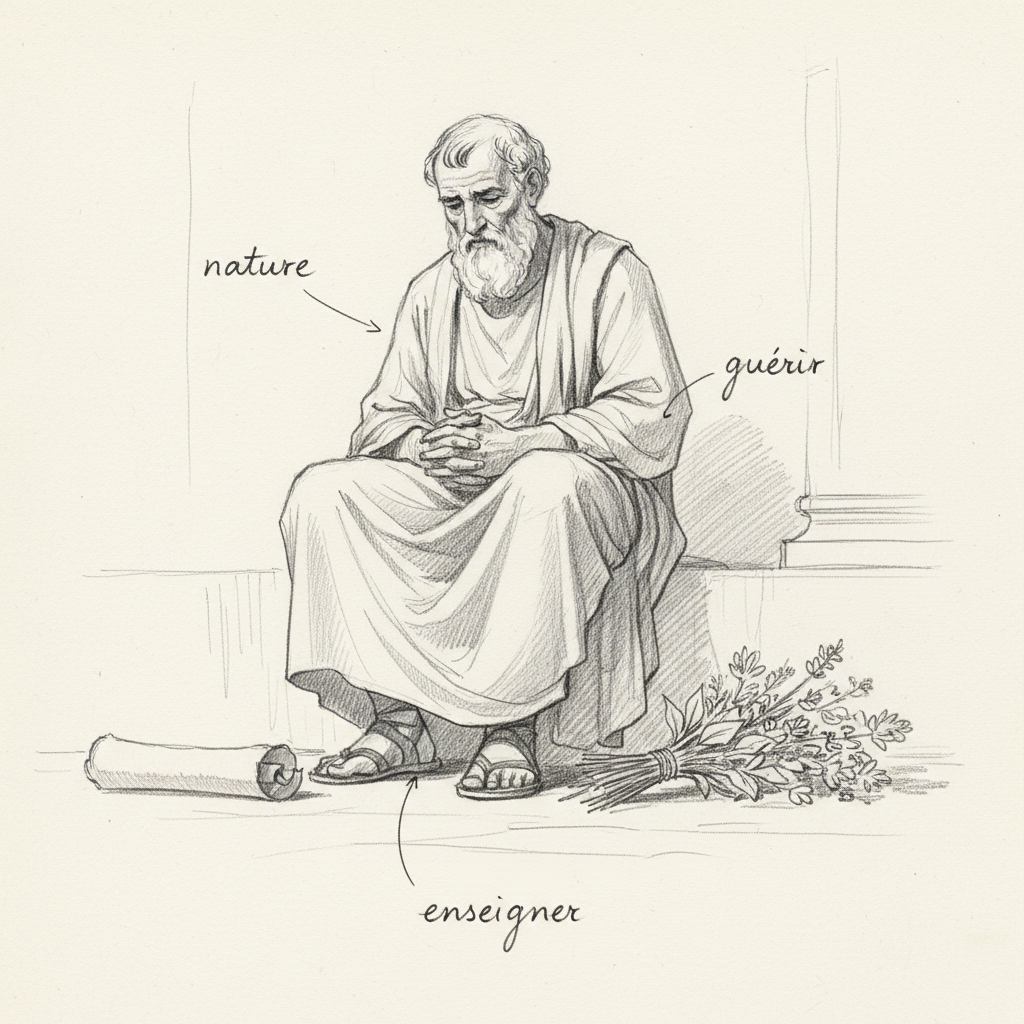
Hippocrates formulated it in two words: Tolle causam. Treat the cause. Not the symptom. And this cause itself has a cause, which has a cause. Three levels according to naturopathic tradition: the physical cause (what you eat, how you move, how you sleep), the psychosomatic cause (your blocked emotions, your chronic stress, your action inhibition), and the existential cause (the meaning you give to your life, your relationship to the world).
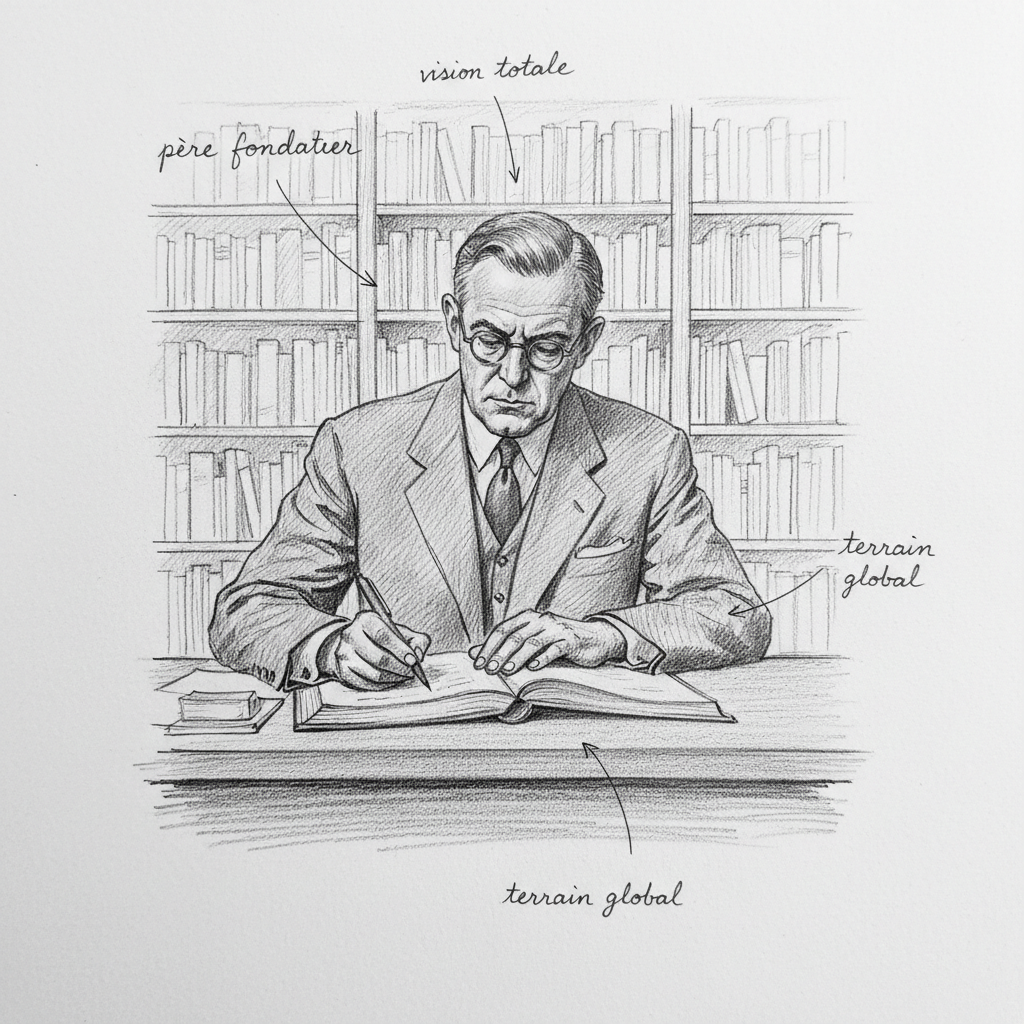
Pierre-Valentin Marchesseau, founder of French naturopathy in 1935, systematizes this principle under the name of causalism. One of the five pillars of orthodox naturopathy, along with vitalism, holism, humoralism and hygienism. Causalism consists of never fighting the apparent symptom. The symptom is not the enemy. It is the messenger. Fever, inflammation, diarrhea, skin eruption are attempts by the body to regulate itself, to return to homeostasis. Suppressing them chemically means opening De Rosnay’s regulatory loops.
At the heart of Marchesseau’s causalism is toxemia. Metabolic waste products (molecular level, microscopic) accumulate in the humors (tissue level), overflow the emunctories (organ level), and affect the entire organism (macroscopic level). Sludge that clogs the liver and intestines. Crystals that irritate the kidneys and joints. The vitality equation summarizes it all: Vitality = Vital force - Toxemia.
When Marchesseau says “trace back to the cause,” he describes exactly what Bertalanffy, Laborit and De Rosnay model. Levels of organization nested where the imbalance of one level reverberates on all others through feedback loops. Toxemia is not a metaphor. It is a description, before its time, of multi-level dysfunction couched in cybernetic terms.
Antoine Béchamp, in his head-on opposition to Pasteur, had laid down the principle: “The microbe is nothing, it is the terrain that is everything.” If the internal environment is in balance, the body can handle it. If the regulatory loops are intact, the organism defends itself. If Salmanoff’s capillartherapy restores circulation, it is because it reopens the loops that clogging had closed.
What modern science confirms every day
The intuitions of Pascal, Marchesseau and Laborit are intuitions no longer. Twenty-first century biology confirms them through four converging pathways.
The gut-brain axis first. Microscopic bacteria, invisible to the naked eye, organisms a thousandth of a millimeter, modify your mood, your cognition, your behavior. 95 percent of serotonin is produced in the intestine, not in the brain. The microbiota communicates with the central nervous system through the vagus nerve, cytokines, bacterial metabolites. The infinitely small (a bacterium) modifies the infinitely large (the behavior of a human being). Pascal would have loved it.
Epigenetics next. Your lifestyle (macro) modifies the expression of your genes (micro). DNA methylation, modifications of histones are reversible. What you eat, how you move, what you feel inscribes itself directly on molecular machinery. Epigenetics is scientific proof of causalism: correcting lifestyle at the macroscopic level modifies the most microscopic mechanisms of the cell. Diet, sleep, movement are not “supplements” to treatment. They are the treatment. They act at the most fundamental level of gene expression.
Psychoneuroimmunology third. Robert Ader and Nicholas Cohen demonstrated in 1975 that the immune system can be conditioned, exactly like Pavlov’s dog. Thought (macro) modifies cellular immunity (micro). Candace Pert, in Molecules of Emotion (1997), showed that opioid receptors are not only in the brain but throughout the body. Emotions are not “in the head.” They are in every cell. Pert wrote: “The body is the unconscious.”
Mitochondria finally. Cellular metabolism (micro) determines the overall energy of the organism (macro). If your mitochondria malfunction, you have no more energy, you no longer regenerate your tissues, you age prematurely. The micro commands the macro. And vice versa: prolonged stress (macro) impairs mitochondrial function (micro). The loop is complete. The two infinities communicate constantly.
The naturopath with a macroscope
Back to Sophie. What I did that day in consultation is exactly what De Rosnay describes: using a “macroscope” to see the interactions between levels. The migraine (visible symptom, macroscopic) is the emergence of a deep systemic imbalance: unresolved stress, corticotropic axis running wild, chronic cortisol, altered intestinal permeability, inflammation diffusing to all levels. Three specialists looked under the microscope. Each saw their piece. The naturopath looks through the macroscope. He sees the system.
Hippocrates understood this 2,500 years ago. Pascal formalized it 350 years ago. Claude Bernard physiologized it 160 years ago. Wiener, Laborit and De Rosnay modeled it 50 years ago. Mandelbrot proved it mathematically. And Marchesseau made it the pillar of a health practice: causalism.
The body is not an addition of organs. It is a fractal system regulated by nested feedback loops, from gene to behavior, from mitochondrion to social life. Each level contains the others. Each disruption reverberates on all levels. And each correction propagates in both directions as well.
Pascal was right: we are “a middle between nothing and everything.” And naturopathy is the art of reading simultaneously the two infinities. From gene to ecosystem. From mitochondrion to entire life. From the infinitely small to the infinitely large.
“Do not open the regulatory loops.” Joël de Rosnay.
Or better yet, Hippocrates: Primum non nocere. First, do no harm.
To go further
If causalism interests you, start by understanding toxemia according to Marchesseau, then the vitality equation that flows from it. The article on Laborit and action inhibition perfectly completes the cybernetic dimension. And if you want to see the terrain from the angle of physics, Vincent’s bioelectronics will show you how to measure the state of your internal environment.
Laisser un commentaire
Sois le premier à commenter cet article.