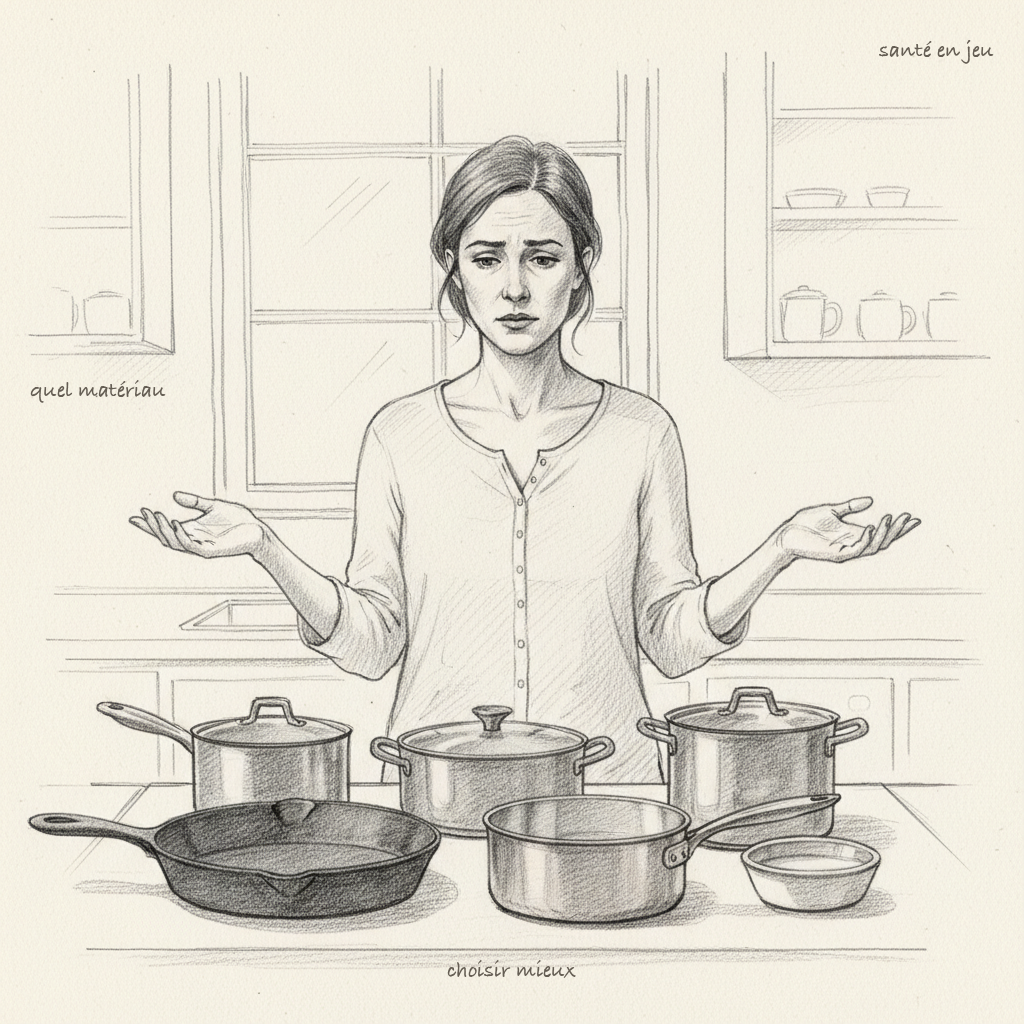
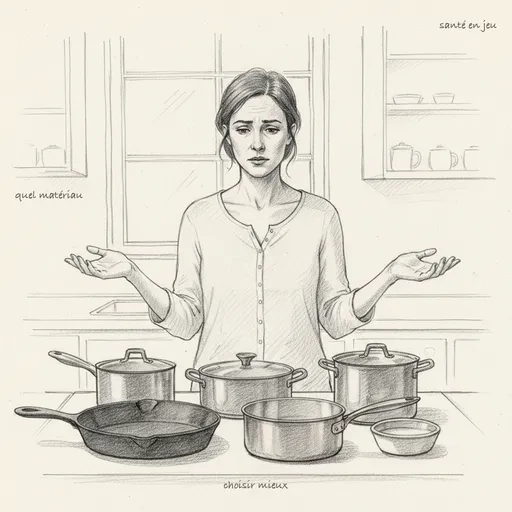
Marc sent me a message last month with a photo of his kitchen. On his countertop: a scratched Teflon pan, a dented aluminum pot, a cracked ceramic casserole, a rusty carbon steel wok, and an enameled cast iron Dutch oven whose enamel was chipping off. “I want to switch to healthy cooking,” he wrote, “but I don’t know where to start. What do I replace first? What do I keep?”
It’s a question I’m receiving more and more often since I’ve been discussing endocrine disruptors in the kitchen. People are becoming aware that their utensils are not neutral, but they’re lost facing the market’s offerings. Cast iron, ceramic, copper, aluminum, stainless steel, carbon steel, titanium, stone: each material has its supporters, its arguments, and its marketing. Difficult to find your way when you’re neither a chemist nor a metallurgist.
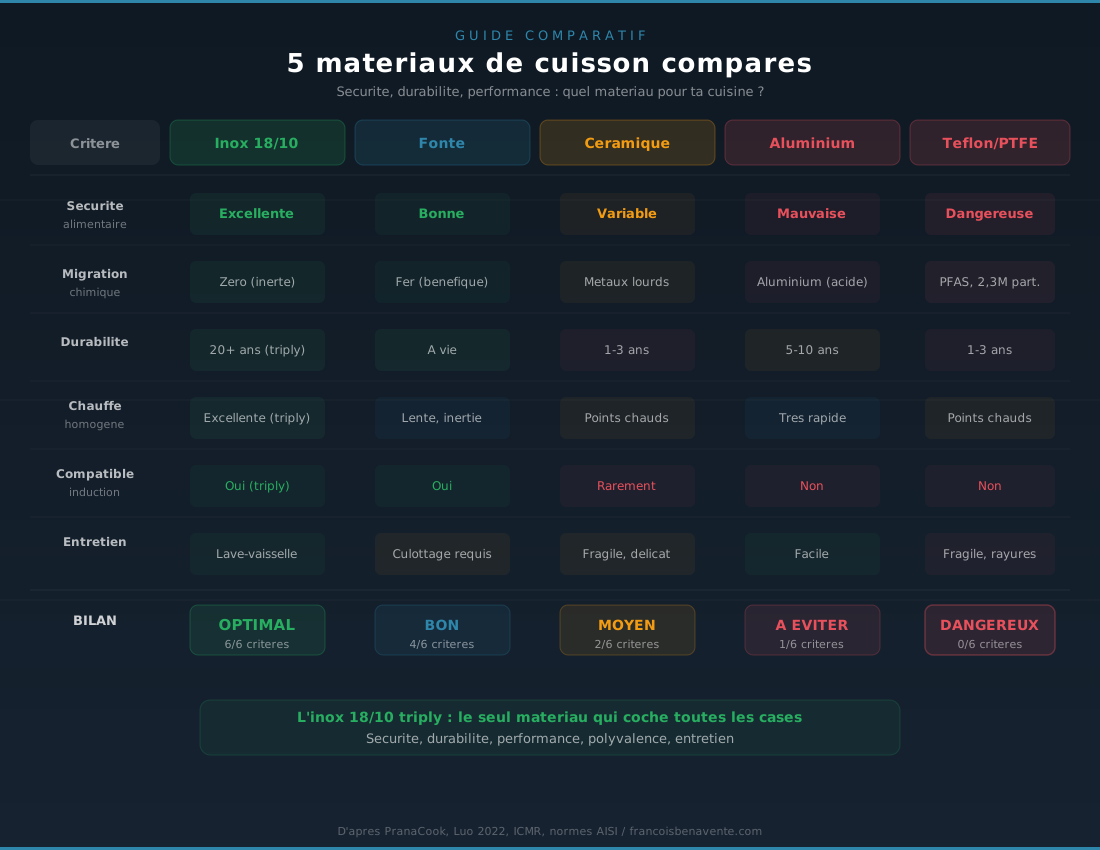
So let’s keep it simple. Let’s take the five most common materials, compare them on six objective criteria, and see which one really deserves your trust.
The 5 cooking materials face to face
Stainless steel 18/10 triply: the top of the class
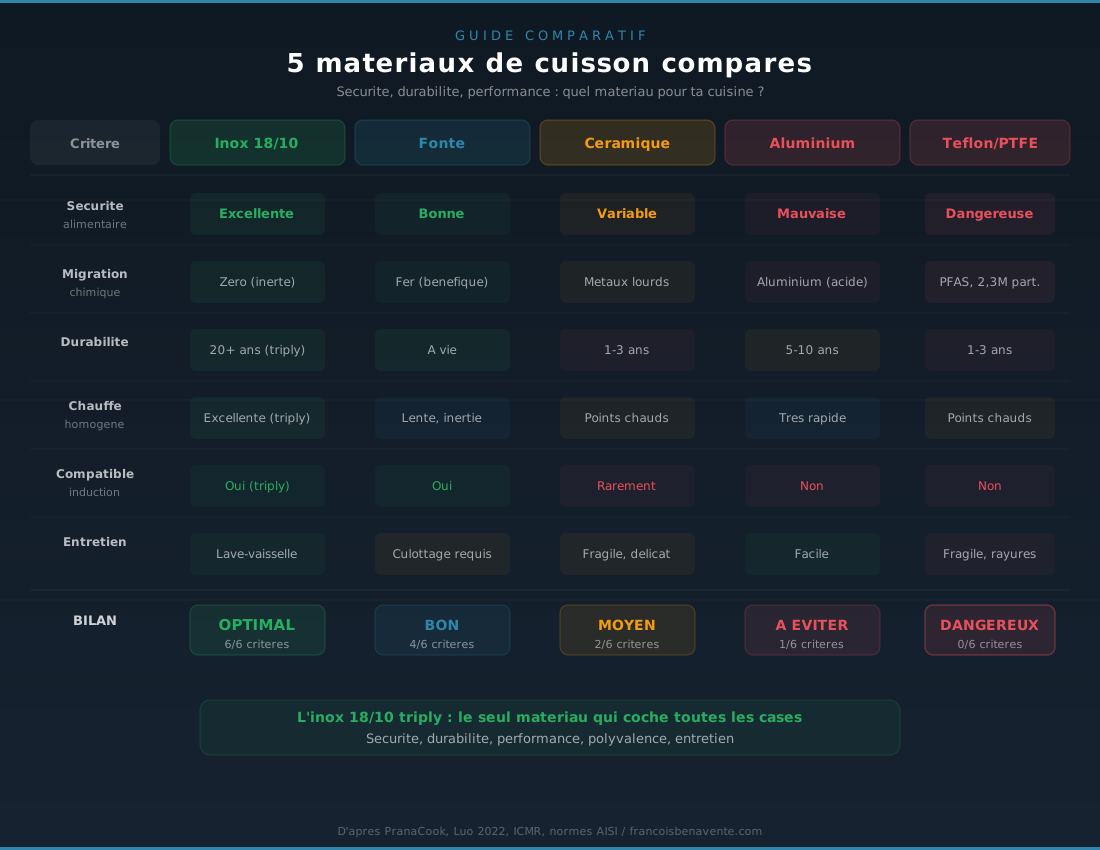
Stainless steel 18/10 comes out ahead on all six criteria. Excellent food safety: it is chemically inert, releases no substances into food, even when in contact with acids at high temperatures. Zero migration. Durability of 20 years and beyond for a triply stamped pan. Homogeneous thermal conductivity thanks to the aluminum core. Induction compatible thanks to the magnetic outer layer. Minimal maintenance: it goes in the dishwasher and withstands any type of cleaning.
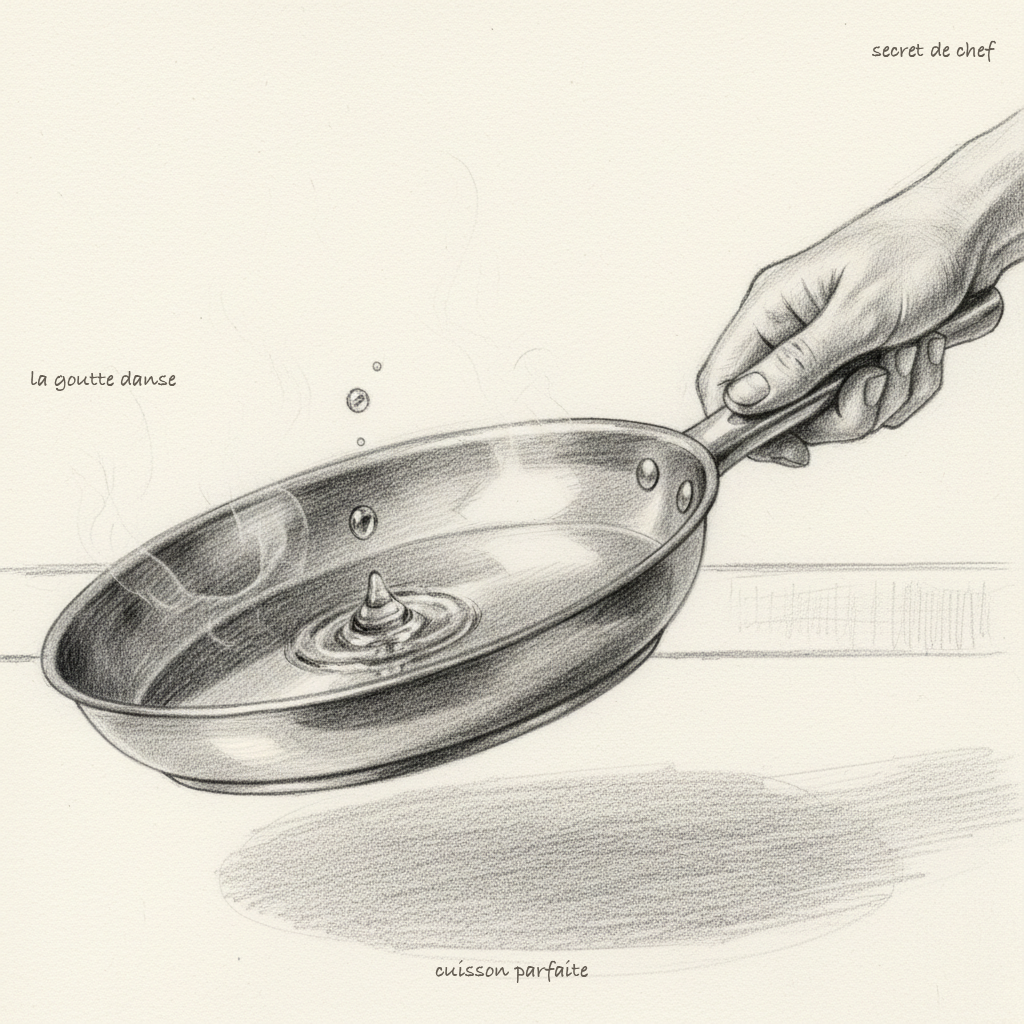
The only criticism that can be made of stainless steel is that it requires mastering the preheating technique to prevent food from sticking. But once you understand the water droplet test, this objection disappears. It’s a material that requires a learning curve of a few days in exchange for a lifetime of healthy cooking.
In terms of use, triply stainless steel is the most versatile material. Pan for searing, pot for sauces and grains, Dutch oven for soups and braising, wok for quick stir-fries. It does everything, it handles everything, it doesn’t wear out.
Cast iron: the honorable veteran
Raw cast iron is an ancestral material that deserves respect. It is safe, durable, and, uniquely among cooking materials, it contributes iron to food. For people with iron deficiency, cooking in cast iron can help improve iron status, especially for long cooking of acidic dishes like tomato sauces.
Cast iron also has remarkable thermal inertia: once hot, it stays hot for a long time, making it ideal for braising, stews, and long, low-temperature cooking. It’s the material of choice for osso buco, chicken in a pot, or homemade bread.
But cast iron has its limits. It is heavy; a 26 cm casserole easily weighs 4 to 5 kilos. It heats slowly and unevenly: the center heats before the edges, creating hot spots if you’re not careful. It requires regular seasoning to maintain its protective surface. And it’s not directly compatible with induction cooktops without a certain thickness.
“The tool is nothing without the hand that guides it.” Robert Masson
Raw cast iron is an excellent complement to triply stainless steel. It excels in a specific register, that of long cooking and simmering, but it cannot replace it for quick everyday cooking. My advice: keep your cast iron casserole for Sundays and dishes that simmer, but use triply stainless steel for everything else.
Ceramic: the green marketing trap
Ceramic has become the darling of organic shops and “zero waste” influencers. Its main argument: no PTFE, no PFAS, a smooth white surface that evokes purity. The reality is more nuanced, and I’ve already discussed it in the article on endocrine disruptors.
The ceramic coating is a thin layer deposited by a chemical process called sol-gel. This layer is fragile by nature: thermal shocks, scratches, daily wear degrade it in a few months. After a year of use, most ceramic pans have lost their non-stick properties and show micro-cracks that expose the underlying layer, usually aluminum or alloys containing heavy metals.
Its lifespan of 1 to 3 years makes it a disposable purchase that generates waste, which is paradoxical for a product sold as ecological. Amortized over its annual cost, a 40-euro ceramic pan replaced every 18 months costs more than an 80-euro triply stainless steel pan that lasts 20 years. Not to mention the environmental cost of manufacturing and recycling.
Aluminum: the toxic conductor
Aluminum is a fantastic thermal conductor. That’s why it’s used as the core in triply utensils: its conductivity allows homogeneous heat distribution. The problem is when it’s in direct contact with food.
Aluminum is a recognized neurotoxic whose migration into food increases when in contact with acidic substances (tomato, lemon, vinegar, wine) and during long cooking at high temperatures. Aluminum foil packets, disposable containers, bare aluminum pans are all vectors of daily contamination.
In a well-designed stainless steel triply utensil, aluminum is trapped between two layers of stainless steel and never touches food. We benefit from its exceptional thermal conductivity without any risk of migration. This is a perfect illustration of engineering at the service of health: using the properties of a material while neutralizing its risks.
Teflon: public enemy number one
I won’t go into detail again on Teflon; the article on endocrine disruptors in the kitchen covers the subject in depth. But in summary: 2.3 million microparticles per scratch (Flinders, 2024), PFAS with a half-life of 5 to 8 years in the body, toxic fumes above 170 degrees (ICMR), a lifespan of 1 to 3 years, and total incompatibility with a natural health approach.
Teflon is the only material on this list that scores zero on all six criteria. Zero safety (active migration), zero durability (disposable), zero performance (hot spots on low-end models), zero induction compatibility (except specific models), zero maintenance (doesn’t tolerate metal, aggressive dishwashing, or brushes). It’s a material with only one advantage: it doesn’t stick. But as we saw with the Leidenfrost effect, stainless steel doesn’t stick either when you master the temperature.
Which utensil for which use
In healthy cooking, each utensil shape corresponds to a specific type of cooking. Understanding this correspondence allows you to choose the right tool for each situation and optimize both taste and nutrient preservation.
The pan (28 cm, low sides) is the most used utensil. Searing meat and fish, omelets, sautéed vegetables, crepes. It must allow rapid temperature rise and homogeneous diffusion. Triply stainless steel is the best choice: it heats quickly, evenly, and allows the water droplet test to master searing.
The pot (18-20 cm, high sides, with lid) is for sauces, grains, poached eggs, reheating. The temperature is generally moderate and the risk of sticking is low. Triply stainless steel is ideal; cast iron is unnecessarily heavy for this use.
The Dutch oven (24-26 cm, large capacity, with lid) is the utensil for soups, stews, braising, pasta. It’s the only use where cast iron can rival stainless steel thanks to its thermal inertia. For long cooking, raw cast iron is even a relevant choice if you’re not bothered by its weight.
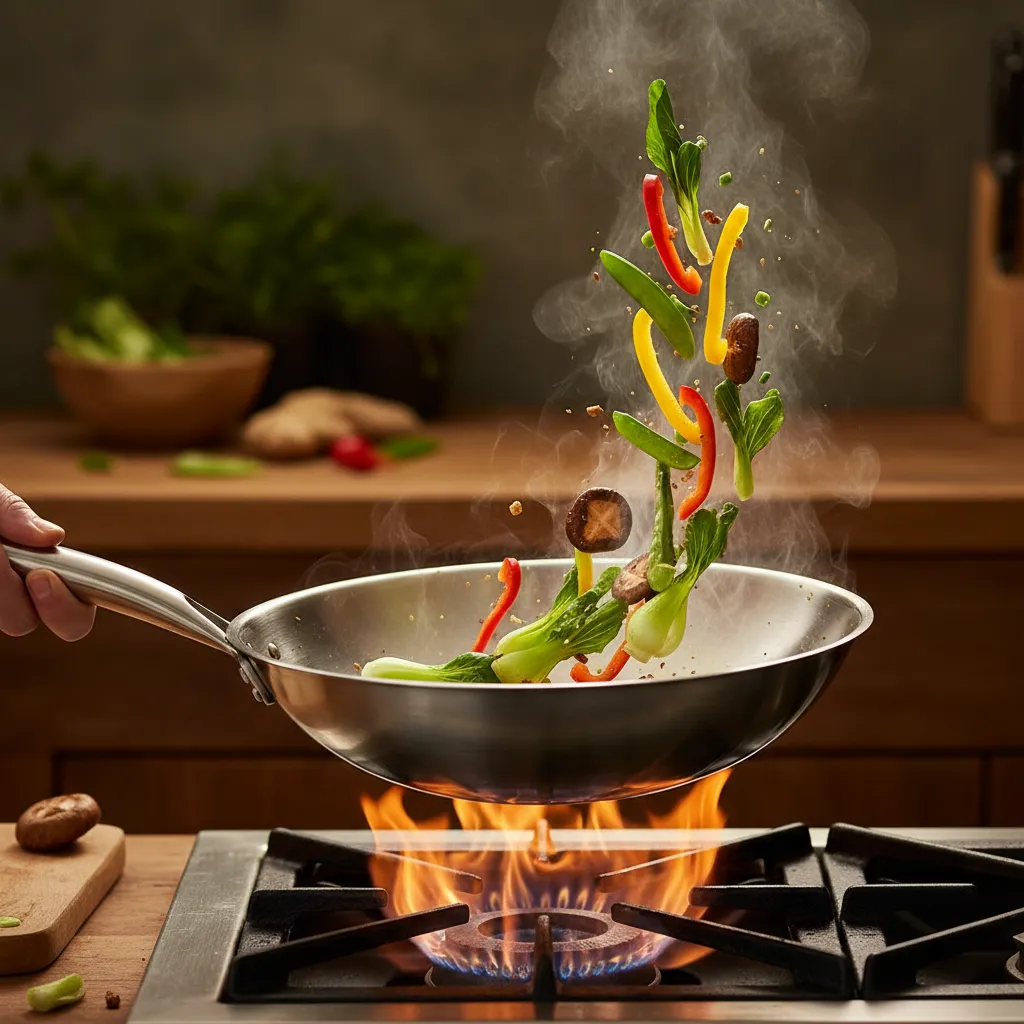
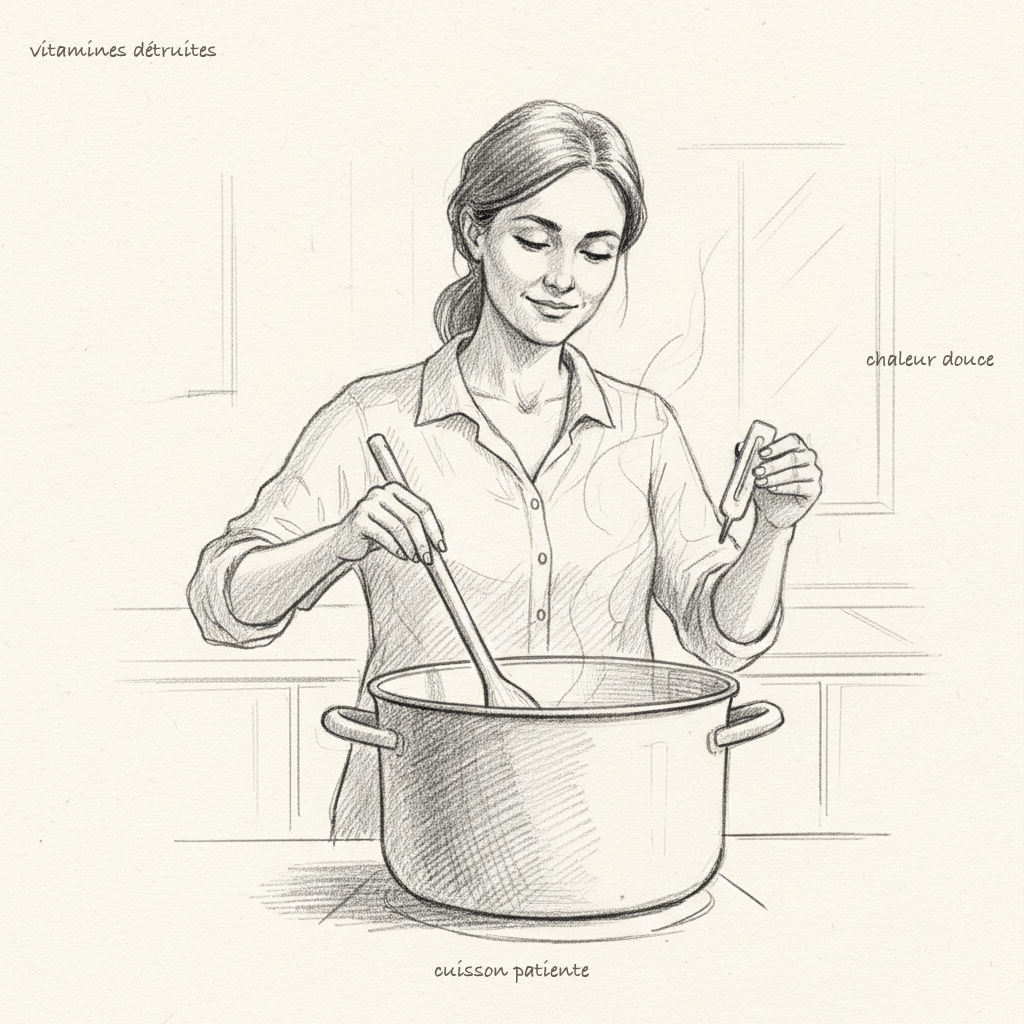
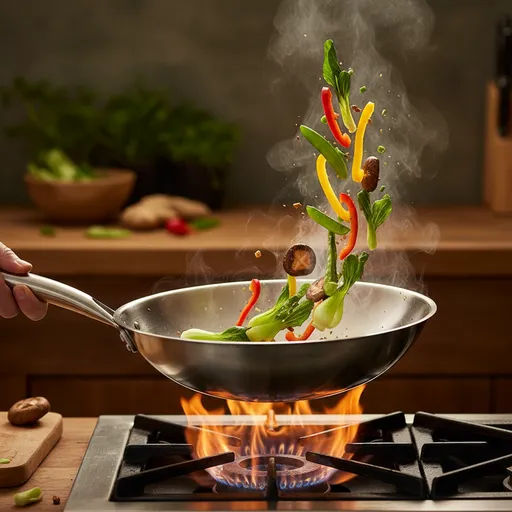
The wok (28-30 cm, flared sides) is the utensil for paradoxically gentle cooking: high heat, short time, maximum preservation. Studies by Zhang and Nugrahedi showed that wok stir-frying preserves vitamins and glucosinolates better than most other cooking methods. A triply stainless steel wok provides homogeneous heating across the entire flared surface, avoiding the hot spots typical of carbon steel.
The steamer basket in stainless steel is the utensil for gentle cooking par excellence. Placed on a pot of simmering water, it allows you to cook vegetables at less than 100 degrees without contact with water, preserving 80 to 95% of nutrients. It’s an essential addition to any healthy kitchen set.
The minimum kit for a healthy kitchen
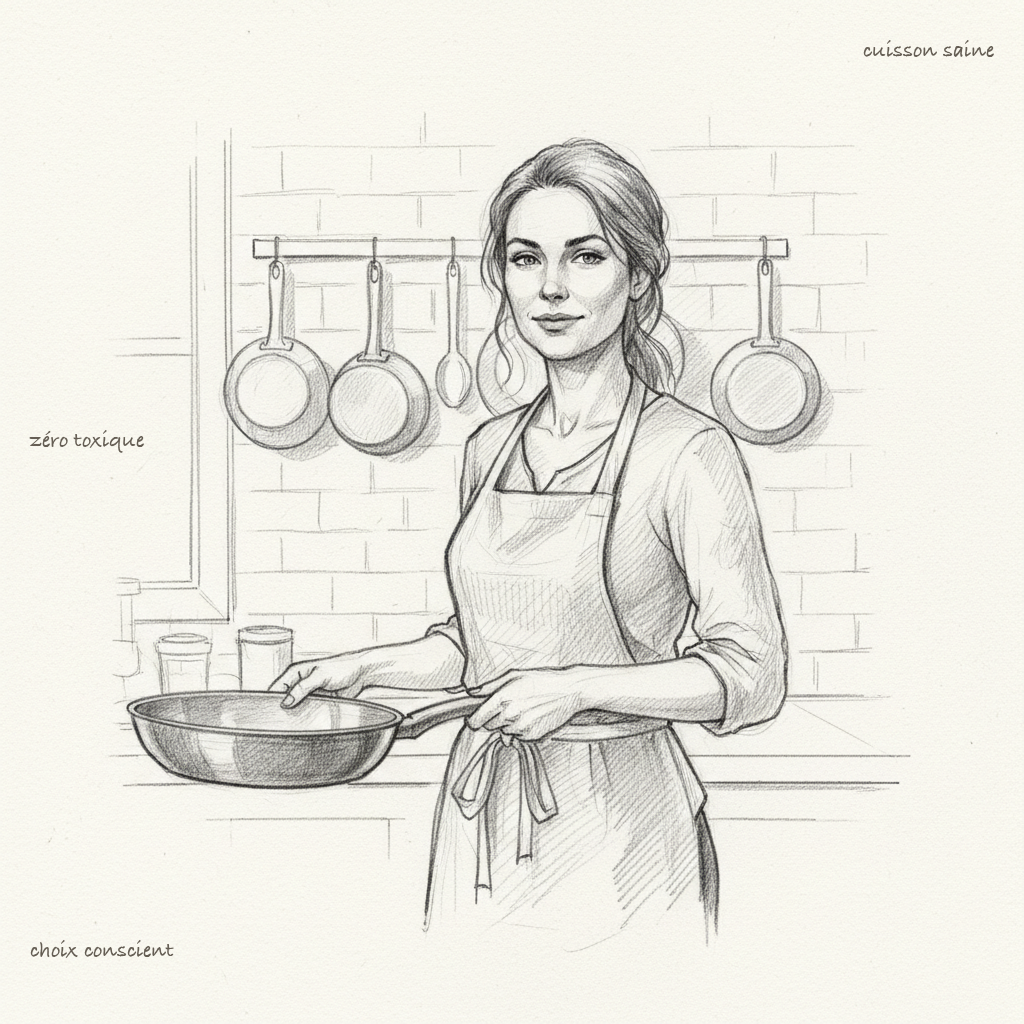
You don’t need 15 utensils. Five pieces of 18/10 triply stainless steel cover 95% of a daily kitchen’s needs: a pan, a pot with lid, a Dutch oven with lid, a wok, and a steamer basket. With these five pieces, you can sear, simmer, braise, stir-fry, steam, make sauces, soups, crepes, omelets.
The initial investment is higher than a set of discounted non-stick pans. But it’s an investment for 20 years. Not 20 months. Twenty years. And during those 20 years, zero Teflon microparticles, zero PFAS, zero aluminum, zero plastic in your food. The calculation is straightforward.
For complementary utensils, same logic: wooden or stainless steel spatulas (never plastic), wooden cutting boards (never plastic; plastic micro-scratches harbor bacteria and release microplastics), stainless steel knives, and glass or stainless steel containers for storage. Before cooking, a food purifier removes surface residue from fruits and vegetables. The rule is clear: anything that touches food must be chemically inert.
Keep it simple, choose well, keep it long
The philosophy of naturopathy applies to cooking as well: surround yourself with few objects, but let those objects be reliable, durable, and healthy. As PranaCook states: “Cooking is not a technical act; it’s an everyday art. And art begins with the choice of tools.”
Marc replied to me three weeks after his initial message. He had replaced his entire kitchen set with five pieces of triply stainless steel. “I hesitated over the price,” he wrote, “and then I calculated what I’d spent on non-stick pans over the past ten years. It was double.” He also sent me a photo of his first salmon cooked in stainless steel, perfectly seared, golden, cleanly released from the pan. “The water droplet test really works.”
To equip yourself, PranaCook offers a complete range of 18/10 stainless steel triple-bottom utensils, designed for healthy cooking.
“Keep it simple.” It’s perhaps the best advice naturopathy has to offer your kitchen. Keep it simple, keep it healthy, keep it sustainable. And in 20 years, your pans will still be there.
Laisser un commentaire
Sois le premier à commenter cet article.