IgG Food Sensitivities and Hashimoto: Treating the Cause, Not the Symptom
Émilie handed me a three-page list. Three pages of results from an IgG food test she’d done at a laboratory. Thirty-seven reactive foods. Wheat, eggs, almonds, tomatoes, garlic, chicken, salmon, apples, rice, green beans. Practically everything she ate was highlighted in red or orange. Émilie, diagnosed with Hashimoto five years ago, had already eliminated gluten and dairy products on a friend’s advice. Then she’d done this test, and the result had plunged her into paralyzing food anxiety. “What can I still eat?” she asked me, her eyes glistening. “Everywhere I read that I need to eliminate. But if I eliminate everything that’s red on this list, I’m left with broccoli, sweet potato, and lamb.”
I looked at the list, then I looked at Émilie, and I told her something that surprised her: “The problem isn’t in the foods. The problem is in your gut. These thirty-seven reactivities aren’t thirty-seven allergies. They’re one single symptom expressed in thirty-seven variations. Your intestine is permeable. And when your intestine is permeable, it lets everything you eat pass through into your blood, regardless of how good the food is.”
“Disease does not begin in the organ we accuse. It begins in the intestine that preceded it.” Catherine Kousmine
This phrase from Kousmine, written more than forty years ago, perfectly summarizes what modern research confirms today. Food sensitivities are not the cause of thyroid autoimmunity. They are the symptom. The symptom of an intestine that has lost its seal, that lets through molecules that should never reach the blood, and that triggers an immune cascade for which the thyroid pays the price.
The Symptom We Mistake for the Cause
There’s a trap that many Hashimoto patients fall into, and even some practitioners. This trap consists of confusing the symptom with the cause. You take an IgG test. You discover that you react to twenty, thirty, forty foods. You eliminate everything. At first, you feel better. Normal: by removing the foods that cause inflammation, you relieve your immune system. But a few months later, new reactivities appear. Foods that were “green” on your first test become “red.” Because you haven’t treated the cause. You’ve just changed what passes through the leaky filter, but the filter is still leaky.
Dr. Jean Seignalet understood this dynamic long before IgG tests existed. In his “third medicine,” he didn’t speak of food sensitivities in the modern sense. He spoke of “mutated proteins” (modern wheat, cow’s milk) that the human intestine hadn’t had time to learn to manage over the course of evolution. But his clinical intuition went further: he knew that it wasn’t the food itself that was the problem, but the interaction between the food and a weakened intestine. The same food, eaten by someone with an intact intestine, poses no problem. Eaten by someone whose intestinal barrier is compromised, it becomes an immune trigger.
This is a fundamental distinction. If food sensitivities were the primary cause, then permanent elimination should be sufficient to heal. But that’s not what we observe. What we observe is that people who eliminate without repairing their intestine end up reacting to more and more foods, until they find themselves with such a restrictive exclusion diet that it creates nutritional deficiencies that worsen the disease. It’s a vicious circle of impoverishment.
IgG and IgE: Two Different Worlds
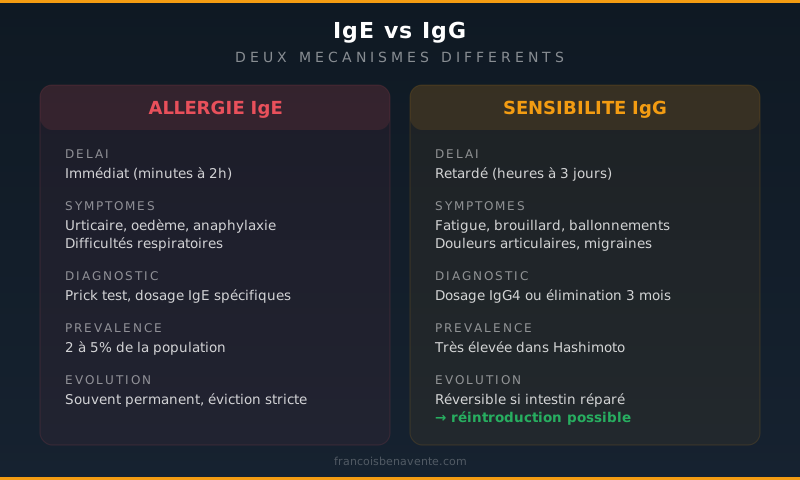
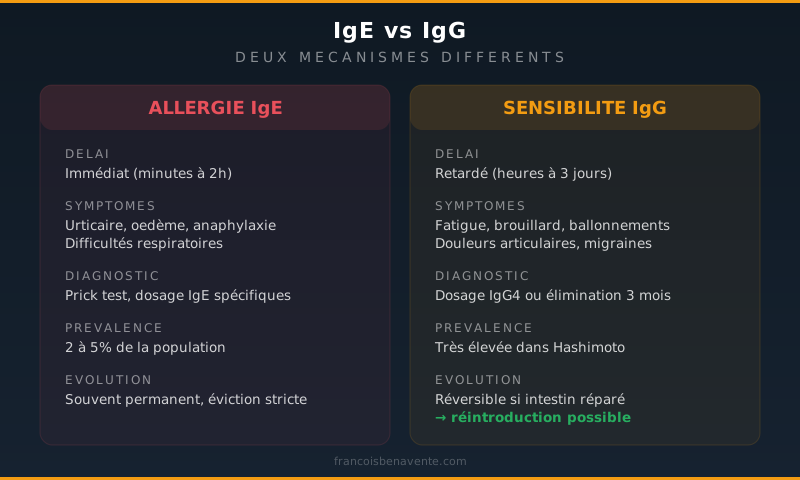
To understand food sensitivities, you must first distinguish between two types of immune reactions that have virtually nothing in common. IgE allergy is the one everyone knows about. It’s the reaction to peanuts that causes anaphylactic shock, the shellfish allergy that triggers giant hives, the egg allergy that makes your throat swell. It’s immediate (a few minutes to two hours), often dramatic, and potentially dangerous. IgE allergies affect 2 to 5 percent of the adult population and are diagnosed by prick test or specific IgE testing. They are generally permanent.
IgG sensitivity is a completely different animal. The reaction is delayed, from a few hours to three days after ingestion. Symptoms are diffuse and nonspecific: fatigue, brain fog, bloating, joint pain, migraines, acne, worsening of autoimmune symptoms. This delay makes identifying the culprit extremely difficult. How do you know that Wednesday’s fatigue is caused by Monday’s cheese? This is why food IgG tests or structured elimination diets are the only reliable tools for detecting these reactions.
Studies suggest that 50 to 80 percent of people suffering from chronic digestive disorders can link their symptoms to specific food triggers. In Hashimoto, the prevalence is probably even higher, because intestinal permeability is nearly systematic. The crucial difference between IgE and IgG, and this is the hopeful point, is that IgG sensitivities are reversible. When the intestine is repaired, when tight junctions close back up, when the intestinal barrier regains its integrity, food proteins stop passing into the blood and IgG reactivities disappear. You’ll be able to eat most of the eliminated foods again.
When You React to Everything
The clearest sign of a leaky gut is when you react to a growing number of foods. If you started by eliminating gluten and dairy, then soy, then eggs, then nuts, then nightshades, then seeds, and you keep discovering new reactivities, it’s not that you’re “intolerant to everything.” It’s that your intestine is letting everything you eat pass through.
The mechanism is crystal clear. The intestinal mucosa is composed of a single layer of cells, the enterocytes, connected to each other by tight junctions. These junctions act like microscopic zippers that control what passes and what doesn’t. When these junctions open, under the effect of gluten (which stimulates zonulin, a protein that opens junctions), nonsteroidal anti-inflammatory drugs, alcohol, chronic stress, infections, or dysbiosis, undigested protein fragments cross the barrier and reach the blood. The immune system, unaccustomed to meeting these food proteins in circulation, mounts an IgG response against them.
The more permeable the intestine, the higher the number of proteins that pass through, and the higher the number of reactivities increases. It’s a matter of permeability, not food toxicity. Almonds aren’t toxic. Salmon isn’t toxic. But when their proteins reach the blood without being properly broken down into amino acids through digestion, they become immune targets.
The True Roots
If food sensitivities are a symptom, what are the causes of the intestinal permeability that generates them? The literature today is fairly clear on this point, and the causes overlap very strongly with the causes of Hashimoto itself.
SIBO, or small intestinal bacterial overgrowth, is one of the most common and most underdiagnosed causes. Hypothyroidism slows peristalsis (intestinal movements), creating a stagnant environment in which bacteria proliferate where they shouldn’t be. These bacteria produce toxic metabolites that damage the mucosa and open tight junctions. SIBO alone can explain why you react to fermentable foods (FODMAPs) without those foods being intrinsically problematic.
Fungal infections, particularly intestinal candidiasis, are another major cause. Candida albicans, when it shifts from its yeast form to its filamentous form, literally drives its hyphae into the intestinal mucosa and creates micro-perforations. Chronic stress, via cortisol which inhibits enterocyte regeneration, worsens the picture. Hypochlorhydria (lack of stomach acid), common in hypothyroidism, compromises protein digestion upstream, allowing protein fragments that are too large to reach the intestine, more likely to trigger an immune reaction.
Marchesseau described this phenomenon with different terminology but identical intuition. He spoke of “intestinal toxemia,” this toxic overload that originates in a dysfunctional intestine and progressively poisons the entire terrain. For him, the intestine was the “root of the health tree.” If the root is sick, all the branches become sick, regardless of the quality of light and water you provide elsewhere.
The Path to Reintroduction
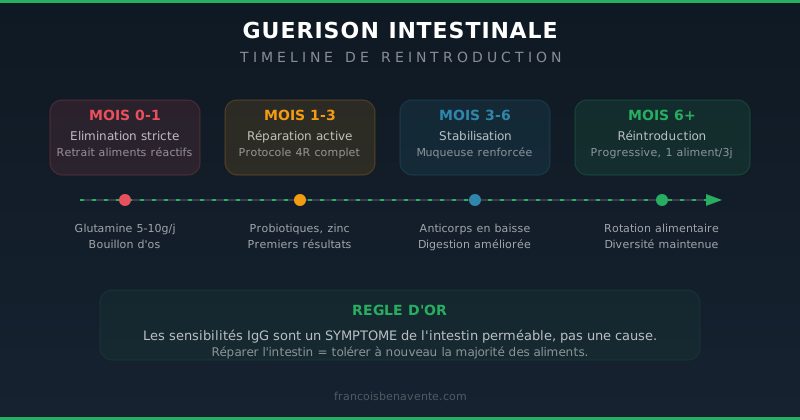
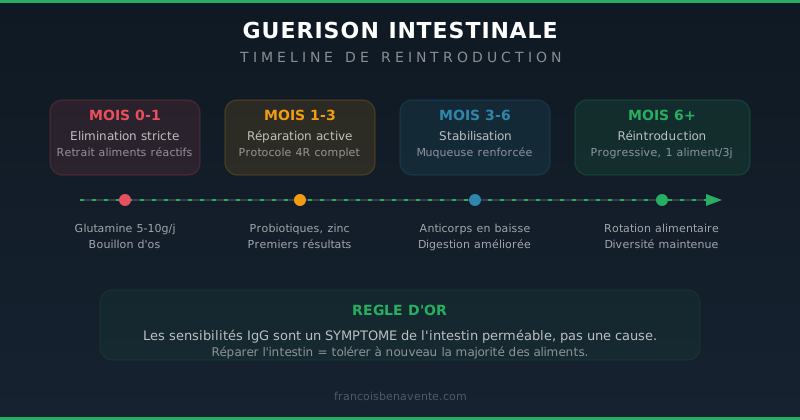
The good news is that the intestine is one of the fastest regenerating organs. Enterocytes have a renewal cycle of 3 to 5 days. This means that if you remove the aggressors and provide the repair materials, the mucosa can begin to restore itself within weeks. Complete restoration, including restoration of the flora, normalization of permeability, and resolution of IgG reactivities, typically takes between 3 and 6 months.
The 4R protocol is the tool I use systematically. Remove (reactive foods, infections, toxins). Replace (digestive enzymes, hydrochloric acid if necessary). Reinoculate (targeted probiotics, prebiotics). Repair (glutamine, zinc, vitamin A, omega-3s). It’s not a linear protocol. The four “R”s overlap and interact. But the logic is simple: stop aggravating, provide the means to digest, restore ecology, and rebuild the barrier.
The reintroduction phase is the most delicate and most rewarding. After 3 to 6 months of work on the intestine, when digestive symptoms have improved and inflammation has decreased, you begin reintroducing eliminated foods. One food at a time. A small amount. Then you wait three days while observing reactions. If nothing happens, you increase the amount. If a reaction appears (fatigue, bloating, pain, brain fog), you note the food and wait before trying again.
In my experience, the majority of patients recover tolerance to 70 to 80 percent of the foods they had eliminated. The reactivities that persist are generally those related to molecular mimicry (gluten and casein) and not those related to permeability alone. That’s a remarkable result. You go from a survival diet of thirty foods to diverse and nourishing eating, simply by repairing the filter rather than restricting what passes through it.
Émilie came back to see me nine months after our first consultation. She had followed the 4R protocol for six months, then started reintroductions. Of the thirty-seven reactive foods on her initial list, she could now tolerate thirty-one. Cooked eggs, rice, chicken, tomatoes, almonds: everything had come back. She kept gluten and dairy at a distance, as a precaution, but she had regained the pleasure of eating without fear. “I didn’t think it was possible,” she told me. It is possible. When you treat the cause rather than the symptoms, the body knows how to repair itself. It always has known.
Want to assess the state of your intestine? Take the dysbiosis questionnaire for a quick initial assessment.
Going Further
To go deeper into intestinal healing, I recommend The 4R Protocol, SIBO and Hashimoto, Intestinal Dysbiosis, and The Seignalet Method for an ancestral vision of nutrition that makes sense in Hashimoto.


Laisser un commentaire
Sois le premier à commenter cet article.