Marie-Claire is sixty-seven years old and has a liver that’s crying for help. Not a diseased liver in the medical sense (her transaminases are normal, her ultrasound is clean), but an overloaded liver. The one giving her a yellowish complexion in the morning, nausea when she eats fat, headaches that start behind her right eye around 4pm, constipation resistant to magnesium, and an alcohol intolerance that developed progressively (half a glass of wine and she gets a migraine). Her Hashimoto is stable on Levothyrox, but her free T3 remains low despite adequate T4. Her liver isn’t converting.
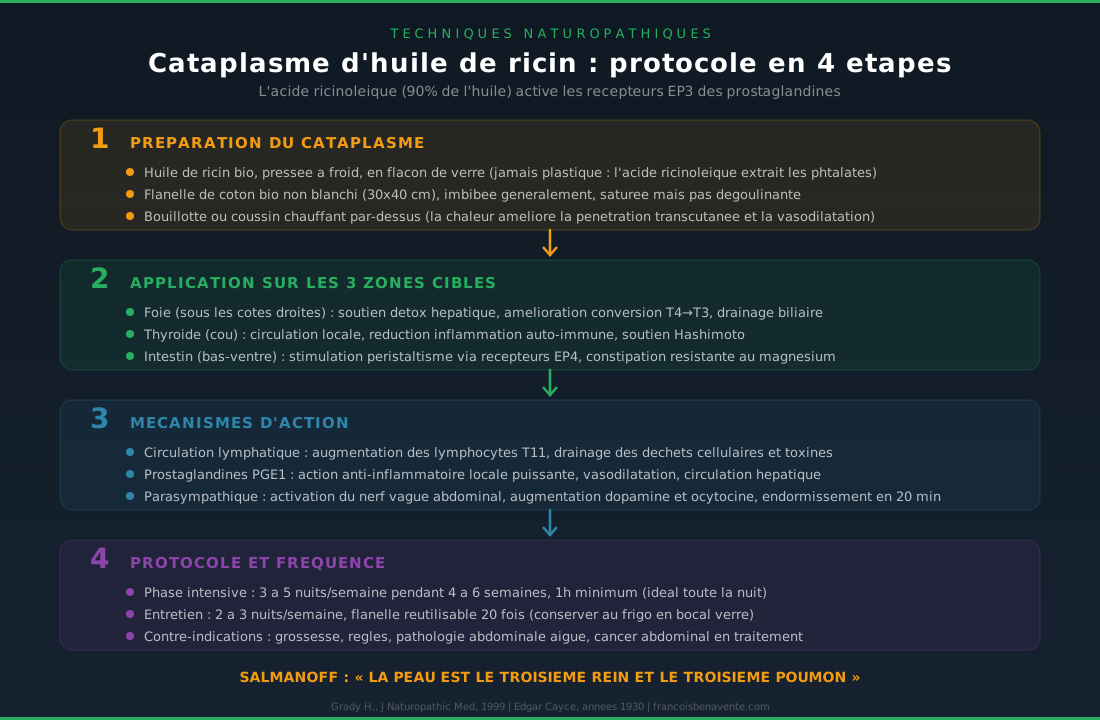
I proposed a tool I could have prescribed three thousand years ago if I’d been practicing in pharaonic Egypt: a castor oil poultice on the liver. Marie-Claire looked at me with skepticism. A poultice. In 2026. With oil. On her belly. She was probably imagining an old wives’ remedy incompatible with her master’s degree in biochemistry.
Four weeks later, her complexion had changed. The postprandial nausea had disappeared. The 4pm headaches had become less frequent. And most importantly, her free T3 had risen from 3.0 to 3.6 pmol/L without any modification to her Levothyrox. Her liver had started converting again. Marie-Claire told me, with her dry humor: “If the Egyptians had filed a patent, they’d be billionaires.”
Ricinoleic acid: the active ingredient
Castor oil (Ricinus communis) is composed of 90% ricinoleic acid, a hydroxylated fatty acid with eighteen carbons found in no other vegetable oil in significant quantities. This chemical uniqueness is what gives it its therapeutic properties.
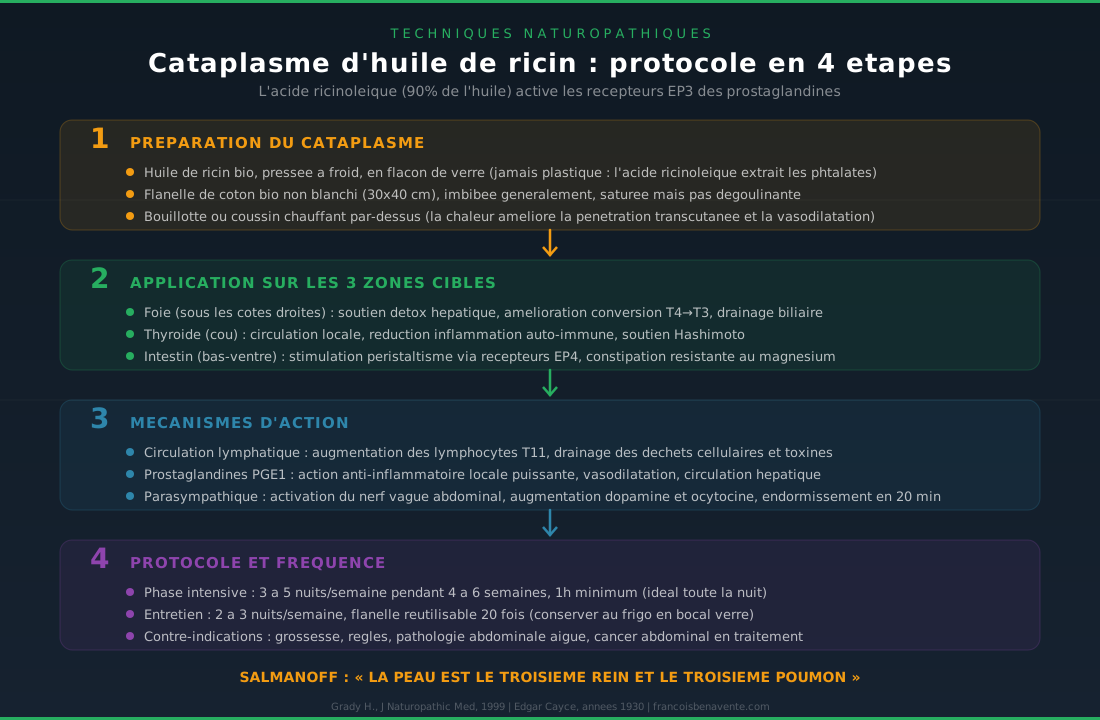
Ricinoleic acid binds to EP3 prostaglandin receptors, which explains its powerful local anti-inflammatory action. It also stimulates EP4 receptors, which activates intestinal motility (hence the historical use of castor oil as an oral laxative, which I do NOT recommend as it’s too irritating). Applied via transdermal route (as a poultice), ricinoleic acid penetrates the dermis in thirty to sixty minutes and reaches the underlying tissues: liver, intestine, lymph nodes.
Salmanoff, the father of capillary therapy, taught that “the skin is the third kidney and the third lung.” He advocated baths, wraps, and topical applications as major therapeutic tools, complementary to internal medicine. The castor oil poultice fits perfectly within this hydrological tradition that modern naturopathy has too often abandoned in favor of dietary supplements.
Five benefits of the hepatic poultice
The first benefit is support for hepatic detoxification. The liver is the central organ of detoxification, with its two enzymatic phases (phase 1 oxidation and phase 2 conjugation). When hepatic circulation is improved by the poultice (increased local blood flow via vasodilation induced by prostaglandins), liver enzymes work more efficiently, toxins are better eliminated via bile, and T4→T3 conversion improves. This is why Marie-Claire saw her T3 rise: her liver, better irrigated, resumed its job as a thyroid converter.
The second benefit is lymphatic drainage. The lymphatic system is the body’s sewer network. It collects cellular waste, toxins, and pathogens, and transports them to lymph nodes for filtration and elimination. Unlike the blood system which has the heart as a pump, the lymphatic system has no pump of its own and depends on muscle contraction, breathing, and massage to circulate. The castor oil poultice stimulates local lymphatic circulation (one study showed a significant increase in T11 lymphocyte count after poultice application), which helps drain hepatic and abdominal toxins.
The third benefit is improved intestinal motility. Ricinoleic acid stimulates EP4 receptors on intestinal smooth muscle, increasing peristalsis without irritant effects (unlike oral ingestion of castor oil). Constipated patients often notice improved transit within the first few days of applying the poultice to the belly. It’s a valuable complement to magnesium citrate for stubborn constipation.
The fourth benefit is deep relaxation. Applying the warm poultice to the belly activates the parasympathetic nervous system (the “rest and digest” mode) via stimulation of the abdominal vagus nerve. Studies show an increase in dopamine and oxytocin after application. In practice, most patients fall asleep within twenty minutes of application. It’s a remarkable tool for insomniacs and people in chronic sympathetic mode (permanent stress).
The fifth benefit is hormonal balance. By supporting hepatic detoxification of spent estrogens and improving pelvic circulation, the castor oil poultice helps reduce estrogen dominance. This is why it’s traditionally used for PCOS, endometriosis, fibroids, and fibrocystic breasts.
Complete instructions for use
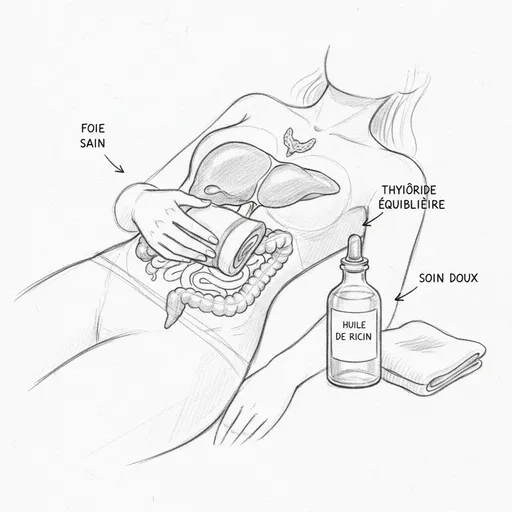
The necessary materials are simple: a piece of organic cotton flannel (unbleached) approximately 30 by 40 centimeters, organic cold-pressed castor oil in a glass bottle, plastic wrap or a stain-resistant towel, and optionally a heating pad or heat pack.
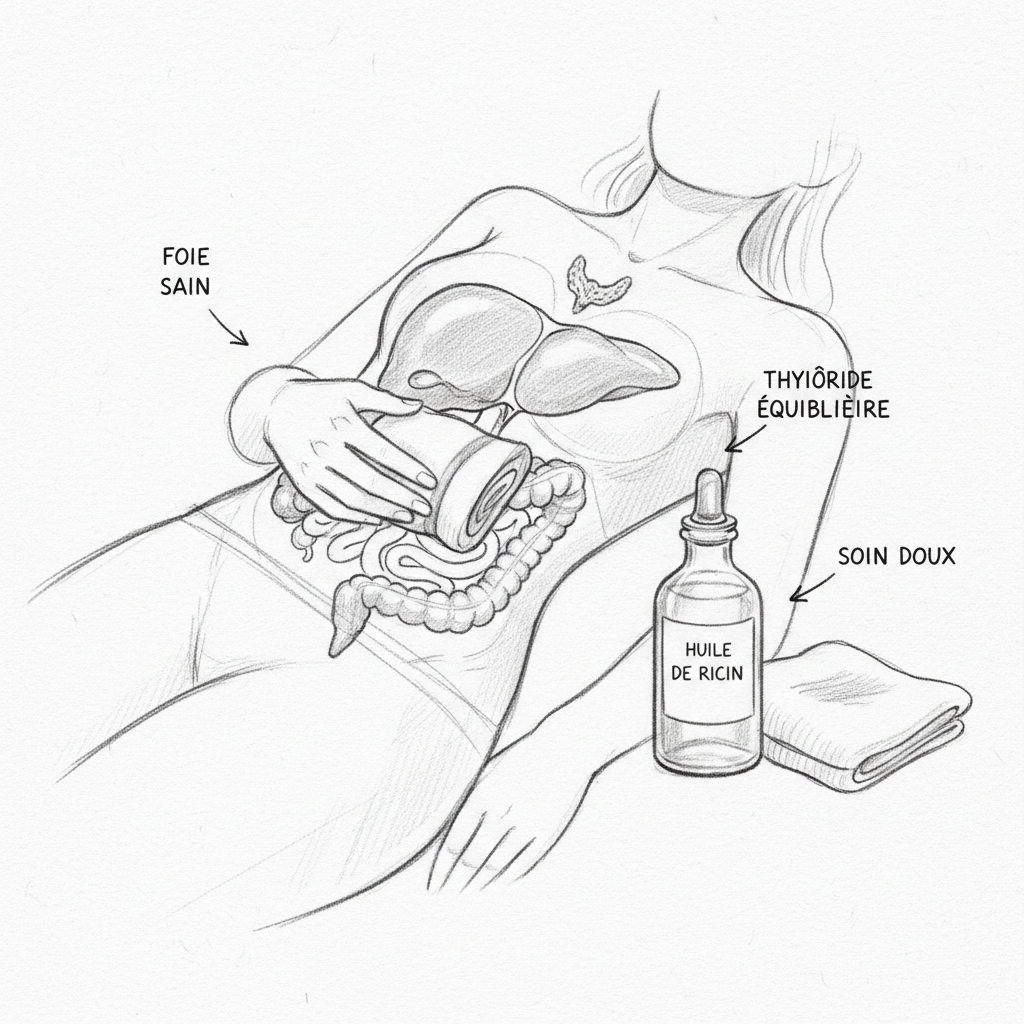
Preparation: generously soak the flannel with castor oil (it should be saturated but not dripping). Fold into two or three layers. Apply over the liver area (under the right rib cage, from the midline to the right flank). Cover with plastic wrap to prevent stains. Place the heating pad over it (heat improves penetration and vasodilation). Lie down comfortably for at least one hour, ideally overnight.
Frequency: three to five nights per week for the first four to six weeks (intensive phase). Then two to three nights per week for maintenance. Some patients adopt the poultice as a daily long-term ritual and do very well with it.
Maintenance: the flannel can be reused about twenty times. Store it in a glass bag (like a Le Parfait jar) in the refrigerator. Add a bit of oil each time you use it. Replace when the flannel changes color or smell.
Poultice and naturopathic protocol
I integrate the castor oil poultice into almost all my detox protocols. It prepares the liver before antimicrobial treatment (preparation phase for SIBO or candida protocol), it supports the liver during detoxification (reducing Herxheimer effects), and it maintains hepatic function long-term.
For thyroid patients, the poultice is particularly indicated when free T3 remains low despite adequate T4 (sign that the liver isn’t converting) and when hepatic symptoms are present (alcohol intolerance, nausea after fatty meals, late afternoon headaches, coated tongue in the morning). It’s a simple tool that complements the nutritional approaches detailed in my article on naturopathy basics.
Kousmine already used hepatic poultices in her practice: “The liver is the great forgotten organ of modern medicine. We test its enzymes to check it’s not dying, but we do nothing to help it live.” The castor oil poultice may be the oldest and simplest tool to help the liver live better.
Precautions
The poultice is contraindicated during pregnancy (ricinoleic acid can stimulate uterine contractions), during menstruation (risk of increased flow), in case of acute abdominal pathology (appendicitis, obstruction, peritonitis), and in case of abdominal cancer undergoing treatment (stimulation of circulation could theoretically promote dissemination, although no study has demonstrated this).
Don’t confuse poultice (external application) and ingestion (oral intake). Castor oil taken orally is a powerful and irritating laxative that causes cramps and diarrhea. I NEVER recommend it orally. The poultice is the only route of administration I prescribe.
Robert Masson, in his approach to experiential dietetics, reminded us that “the simplest gestures are often the most powerful in natural medicine.” A piece of cloth soaked in oil placed on the belly. No capsule, no prescription, no technology. Just an ancestral gesture that’s worked for three thousand years. Sometimes, simplicity is the ultimate sophistication.
Want to evaluate your status? Take the free colloidal toxemia questionnaire in 2 minutes.
To cook healthily, discover PranaCook stainless steel utensils, with no endocrine disruptors.
To go further
- Hepatic detoxification: the 3 phases and methylation
- Infrared sauna: deep detox, thyroid and stress management
- Colloidal toxemia: when mucus, phlegm and lipids clog your body
- Vitality and toxemia: the terrain questionnaire that tells you everything about your health
Want to evaluate your status? Take the free acid toxemia questionnaire in 2 minutes.
Healthy recipe: Regenerative bone broth: Combine the poultice with bone broth for your intestines.
Laisser un commentaire
Sois le premier à commenter cet article.