Marine is twenty-nine years old, has been vegetarian for five years, and was diagnosed with Hashimoto two years ago. When she came to my consultation, I immediately noticed her striated nails, thin and brittle hair, and dark under-eye circles. She told me she ate “quite well.” Cereals in the morning with soy milk, a composed salad at lunch with tofu, pasta in the evening with vegetables. She thought she was doing things correctly. And in terms of vitamins and minerals, it wasn’t catastrophic. But when I calculated her protein intake, the number was damning: 35 grams per day. For a woman of 62 kilos with an autoimmune disease, that was half of what she needed.
Marine didn’t lack willpower. She lacked protein. And not just any kind. She lacked specific amino acids that her thyroid, intestine, and immune system desperately needed. Tyrosine, without which T4 isn’t produced. Glutamine, without which a leaky gut isn’t repaired. Carnitine, without which brain fog persists. Marine took her Levothyrox every morning, but she wasn’t providing her body with the building blocks necessary for that medication to do anything.
“Man is what he eats, or more precisely what he digests and assimilates.” Catherine Kousmine
This phrase from Kousmine takes on particular significance when discussing proteins and thyroid autoimmunity. Because in Hashimoto, the choice of proteins is not trivial. Some proteins nourish and repair. Others trigger immune reactions that worsen the disease. Knowing which ones to choose and which to avoid is one of the most powerful levers you can pull.
Why 80% of Hashimoto patients react to dairy
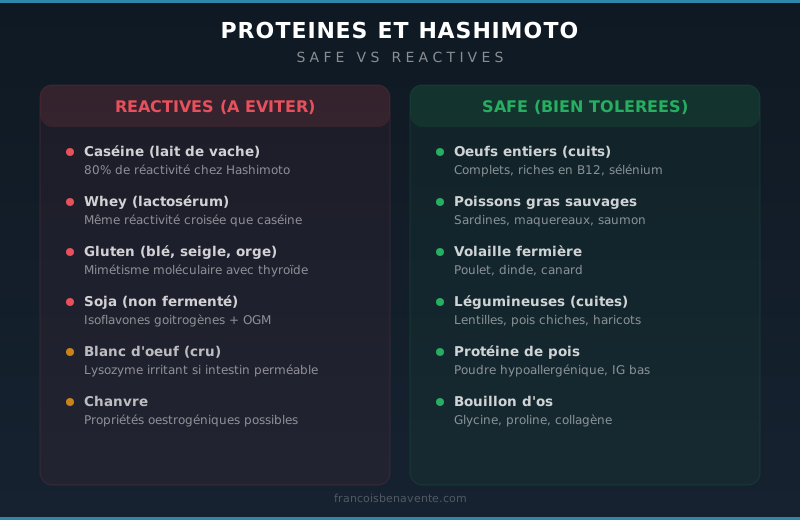
This is a figure that always surprises in consultation. Approximately four out of five people with Hashimoto present reactivity to dairy proteins, mainly casein and whey. This reactivity is not an allergy in the classical sense. It’s not an immediate IgE reaction with hives and angioedema. It’s a delayed IgG reaction, insidious, manifesting as fatigue, bloating, joint inflammation, acne, brain fog, sometimes days after consumption.
The mechanism is twofold. First, there is molecular mimicry. The protein structure of cow’s milk casein presents amino acid sequences similar to those of thyroglobulin, the protein that stores thyroid hormones in the gland. When the immune system, already in a state of hypervigilance in Hashimoto, encounters these casein fragments that have crossed a leaky gut, it confuses them with pieces of thyroid and launches an attack. It’s an autoimmune friendly fire. Dr. Jean Seignalet had perfectly described this mechanism in his “Third Medicine.” He classified dairy proteins among “mutated proteins,” those that the human organism didn’t have time to learn to recognize over the course of evolution.
Next, there is intestinal permeability. In Hashimoto, the intestinal mucosa is often compromised. I detailed this mechanism in my article on the 4R protocol. When the intestinal tight junctions open, incompletely digested dairy peptides pass into the blood. These large protein fragments should never end up in circulation. The immune system identifies them as intruders and mounts an inflammatory response that, by ricochet, stimulates the production of anti-thyroid antibodies.
Eliminating dairy products for three months is often the first advice I give to my Hashimoto patients. Results are sometimes spectacular. Marine, after three weeks without dairy or soy, sent me a message saying that her chronic bloating had disappeared, her brain fog had lifted, and her morning joint pain had vanished. “I didn’t think soy milk could do all that,” she wrote to me. Soy milk actually combines two problems: soy isoflavones are slightly goitrogenic (they interfere with iodine uptake by the thyroid), and the vast majority of global soy is genetically modified, which adds a layer of potential reactivity.
The amino acids your thyroid needs
Proteins are not a monolithic block. They are chains of amino acids, and each of these amino acids has a specific role in thyroid function, intestinal health, and immune system function. When I speak of “proteins” in consultation, I’m really talking about elementary building blocks that the body needs to build itself, repair itself, and function.
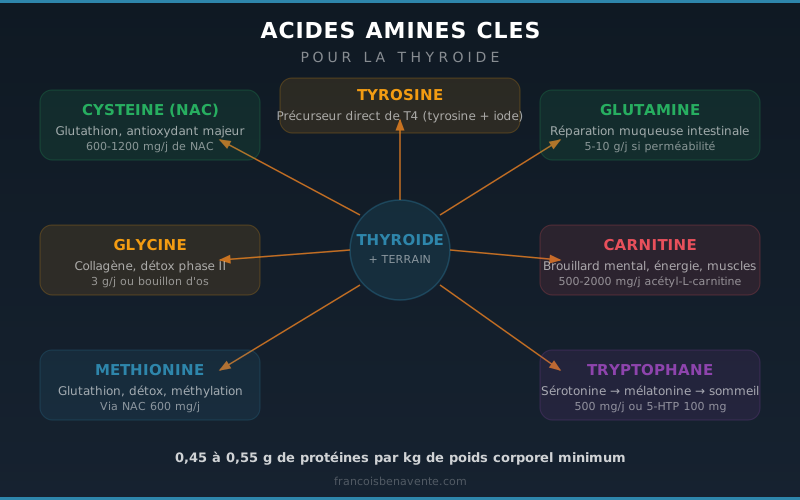
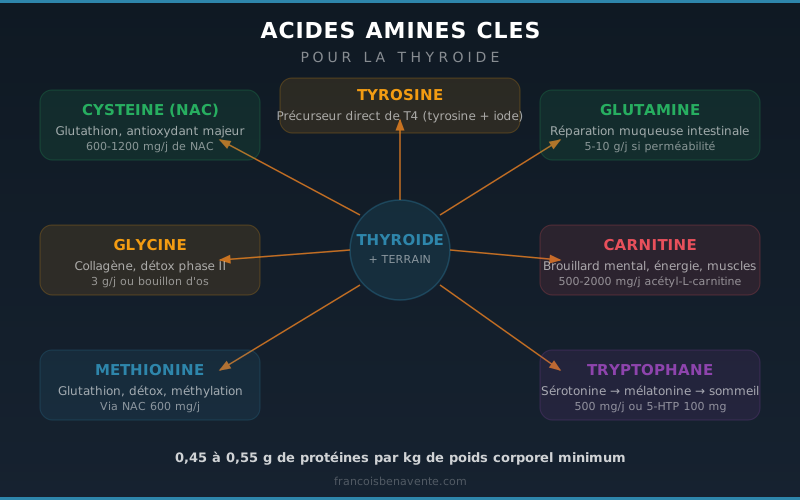
Tyrosine is the most obvious. It’s the direct precursor amino acid of T4, thyroxine. The name T4 itself comes from there: four iodine atoms attached to a tyrosine molecule. Without sufficient tyrosine, the thyroid cannot produce its hormones, even if iodine is available. It’s like having gasoline but no engine. Tyrosine is also the precursor of dopamine and adrenaline, which explains why patients deficient in proteins are often tired, unmotivated, and mentally slow. The best sources of tyrosine are eggs, fish, poultry, almonds, and pumpkin seeds.
Glutamine is the most abundant amino acid in the body and the main fuel for enterocytes, the cells of the intestinal wall. In Hashimoto, where intestinal permeability is almost systematic, glutamine is the first repair tool. At a dose of 5 to 10 grams per day in powder form, taken on an empty stomach, glutamine helps close tight junctions and restore the integrity of the intestinal barrier. It’s the cornerstone of the “R” for “Repair” in the 4R protocol that I use in consultation.
Carnitine deserves special attention. This amino acid, synthesized from lysine and methionine, transports long-chain fatty acids into the mitochondria to be burned there. When carnitine is low, mitochondria run at a crawl, ATP production drops, and brain fog sets in. Acetyl-L-carnitine, which crosses the blood-brain barrier, is particularly interesting for patients complaining of cognitive fatigue. The usual dose is 500 to 2000 milligrams per day. Red meat is the richest food source of carnitine, which poses a specific problem for vegetarians and vegans with Hashimoto.
Methionine is an essential sulfur-containing amino acid, precursor of cysteine and glutathione. Glutathione is the body’s main intracellular antioxidant. It protects thyroid cells from oxidative stress generated by H2O2 production necessary for hormone synthesis. Supplementation with NAC (N-acetylcysteine), a derivative of cysteine, is one of the most effective ways to support glutathione production. Dr. Hertoghe regularly prescribes NAC to his thyroid patients for this reason.
Finally, tryptophan is the precursor of serotonin, itself a precursor of melatonin. In Hashimoto, sleep disorders are extremely common, and tryptophan deficiency is often a contributing cause. Eggs, turkey, cashews, and pumpkin seeds are good sources of tryptophan. In supplementation form, 5-HTP (100 to 200 milligrams in the evening) is the form directly converted to serotonin.
How much protein per day
The question of dosage is crucial and often poorly addressed. Official French recommendations (0.83 g per kg of body weight) are calculated to prevent malnutrition in a healthy person. These are not recommendations for someone with an autoimmune disease who must repair their gut, support their thyroid, feed their immune system, and maintain their muscle mass.
For Hashimoto, I recommend between 0.8 and 1.2 grams of protein per kilogram of body weight per day. For Marine, who weighs 62 kilos, this represents between 50 and 75 grams of protein per day, double what she was consuming. In practice, this means protein at each meal, not just dinner. Two eggs at breakfast provide approximately 14 grams. A portion of sardines at lunch: 25 grams. A portion of chicken in the evening: 25 grams. Plus residual protein from legumes, nuts, and seeds consumed throughout the day.
Marchesseau had a nuanced vision of proteins. He was not against animal proteins, contrary to what is sometimes read. He recommended a mostly plant-based diet, but including quality animal proteins in moderate quantities. His criticism focused on excess red meat, processed meats, and proteins damaged by excessive cooking. He probably would have approved of the idea of combining organic eggs, wild fish, farm-raised poultry, and well-cooked legumes, exactly what I propose in consultation.
Distribution throughout the day matters as much as total quantity. Proteins at breakfast have a particularly strong impact on blood sugar throughout the day. A protein-rich breakfast stabilizes blood glucose, reduces sugar cravings, supports the adrenals, and provides the amino acids necessary for morning hormone synthesis. It’s the most important meal for a thyroid patient, and it’s paradoxically the one most often rushed through.
The best sources
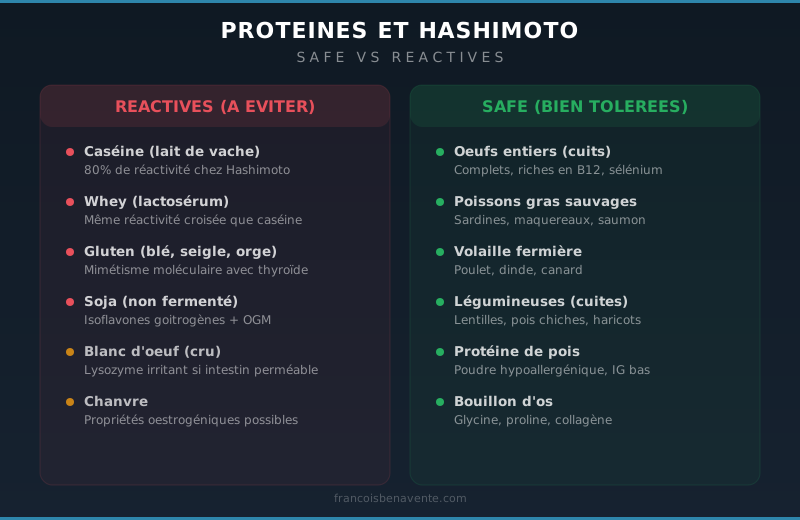
Eggs are probably the best source of protein for Hashimoto. Whole (white and yolk together, always cooked), they provide all essential amino acids, selenium, vitamin B12, choline, vitamin D, and omega-3s (if the hens are raised outdoors). Egg yolk contains phospholipids that support cell membranes. It’s the most complete food nature has invented. Kousmine included it in her famous Budwig cream as a daily protein source.
Wild fatty fish occupy the second place. Sardines, mackerel, anchovies are rich in proteins, anti-inflammatory omega-3s (EPA and DHA), selenium, and vitamin D. Small fatty fish have the added advantage of accumulating fewer heavy metals than large predators (tuna, swordfish). In practice, three to four portions of fatty fish per week cover omega-3 needs and contribute significantly to protein intake.
Pea protein powder is a hypoallergenic plant option that suits the vast majority of Hashimoto patients. It contains neither gluten, nor lactose, nor soy. Its amino acid profile is comparable to that of whey but without the associated immune reactivity. In a smoothie with avocado, spinach, and blueberries, it’s a quick, protein-rich breakfast that stabilizes blood sugar until lunch.
Bone broth is a food I particularly recommend in phases of intestinal restoration. Rich in glycine, proline, and collagen, it nourishes enterocytes and supports the phase II of liver detoxification. It’s not a trendy food. It’s an ancestral food that all culinary traditions in the world used daily before the advent of industrial cooking.
What to avoid
Beyond dairy proteins we’ve discussed, gluten deserves an in-depth discussion. Molecular mimicry between gliadin (wheat protein) and thyroid transglutaminase is documented in scientific literature. This doesn’t mean all Hashimoto patients must be gluten-free for life. But a three-month elimination, parallel to dairy elimination, allows you to check if your immune system is sensitized. In my clinical experience, about half of Hashimoto patients react to gluten in a measurable way (improved antibodies, energy, and digestion after elimination).
Non-fermented soy should be avoided for several reasons. Isoflavones inhibit thyroid peroxidase (TPO), the very enzyme that anti-TPO antibodies attack in Hashimoto. It’s like pouring oil on the fire. Fermented soy (tempeh, miso, tamari) is better tolerated because fermentation breaks down some of the isoflavones and anti-nutrients, but it should still be consumed in moderation.
Ultra-processed proteins, industrial meat substitutes, protein bars loaded with emulsifiers and sweeteners should be avoided. Not because of their protein content, but because of everything that comes with them: carrageenan, polysorbates, maltitol, soy lecithin. These additives disrupt the intestinal barrier and feed dysbiosis, which returns to the vicious cycle of intestinal permeability and autoimmunity.
How Marine rebuilt her proteins
Marine restructured her diet in three stages. First stage: eliminate reactive sources (soy milk, daily tofu, yogurts). Second stage: reintroduce quality animal proteins (she accepted eggs and fish, maintaining a significant plant base). Third stage: add a protein smoothie in the morning with pea protein, and glutamine powder on an empty stomach for intestinal repair.
In six weeks, her protein intake went from 35 to 65 grams per day. Her nails stopped splitting in three weeks. Her brain fog lifted in a month. Her ferritin, which had stagnated at 18 despite iron supplementation, began to rise because her intestine was finally absorbing correctly. At three months, her anti-TPO antibodies had dropped by fifteen percent. Her endocrinologist was surprised. Marine knew exactly where this improvement came from. Not from a new medication. From a new breakfast.
Seignalet was right when he wrote that food is the first medicine. But it’s not enough to “eat well.” You must eat the right proteins, in sufficient quantity, at the right time, and while avoiding those that trigger an immune response in those whose immune system is already at war with their own thyroid. It’s precision work, not blind restriction. And it’s work that pays off when done properly.
Do you want to know if your protein intake is sufficient? Take the micronutrition assessment to evaluate your intake and deficiencies.
To go further
To deepen the subject of proteins and thyroid, I recommend The Seignalet Method to understand the classification of ancestral proteins, The Wentz Protocol for a global vision of the nutritional approach in Hashimoto, The Wentz Elimination Diet for the practical 4-step protocol, and Restore Your Gut with the 4R Protocol for mucosal repair.
Laisser un commentaire
Sois le premier à commenter cet article.