One spring evening, in the fifth century before our era, a man leaves the shores of Samos, a small Greek island resting on the Aegean Sea, carrying with him only a thirst for learning that nothing could quench. He is twenty years old. He will not return for thirty years. This man is Pythagoras. And the journey he undertakes will lay, without his knowing it, the first stones of a discipline that will only bear his name twenty-five centuries later: naturopathy.
“As long as man continues to destroy living beings inferior to him, he will know neither health nor peace. As long as men massacre animals, they will kill each other.” Pythagoras
When I tell this story to my patients in consultation, I often see an eyebrow raise. Pythagoras, the mathematician of the theorem? The one of right triangles? Yes, exactly that one. But Pythagoras was infinitely more than a geometer. He was philosopher, physician, mystic, pedagogue, and above all, he was the first Western thinker to pose a radical question that still resonates in every naturopathy practice: what if health were not the absence of disease, but the harmony of the entire being with the laws of nature?
The insatiable traveler: from Samos to Crotone
To understand Pythagoras, you must first understand where he came from and where he went. Born around 580 before our era in Samos, son of a precious stone engraver, he grew up on a prosperous island at the crossroads of trade routes between East and West. Very young, he was initiated into the mysteries by the priests of his island. But that was not enough for him. He wanted to see, touch, and understand the medical and spiritual traditions of the great civilizations of his time.
He departed for Egypt. He would remain there twenty-five years. Twenty-five years studying with the priests of Memphis and Thebes, learning sacred geometry, purification rites, ritual fasting, the dietetics of temples. In Egypt, the priests already knew that food was medicine and that the body had to be purified regularly. Pythagoras absorbed everything. He observed the dietary discipline of Egyptian priests, their strict vegetarianism, their knowledge of plants, their understanding of the Nile cycles and seasons. He learned that health is never reduced to the physical body, that it involves a sacred dimension, a relationship with the cosmos.
Then he was taken to Babylon, probably as a prisoner during the Persian invasion of Egypt by Cambyses II in 525 before our era. But even in captivity, Pythagoras learned. In Babylon, he discovered Chaldean astronomy, the science of numbers, the correspondences between planets and organs of the body. The Babylonians had a sophisticated astrological medicine that established links between celestial movements and human diseases. This vision of an ordered universe, where each element is in resonance with the others, would deeply mark his thinking.
He also traveled to India, according to certain traditions, where he met the gymnosophists, those naked ascetics who practiced yoga and meditation. He immersed himself in Vedic thought, discovered the concept of ahimsa, non-violence toward all living beings, which would become a pillar of his dietary ethics.
When he finally returned to Magna Graecia, around 530 before our era, he was nearly fifty years old. He settled in Crotone, a Greek colony in southern Italy, and founded a school that had no equivalent in the ancient world. It was neither a university, nor a temple, nor a hospital. It was all three at once. A living community where one studied mathematics in the morning, music in the afternoon, and where one practiced meditation and purification exercises in the evening. A school where dietetics, philosophy, science, and spirituality formed one single path.
The theory of Numbers and the sacred nature of 7
Before speaking of the 4 bodies, one must understand a fundamental concept in Pythagoras: Numbers are not simply calculation tools. For Pythagoreans, Numbers are the constitutive principles of all reality. The entire world is governed by numerical relationships. Music, seasons, planetary orbits, plant growth, crystal structure, everything obeys mathematical proportions. And if the world is number, then health is harmony, in the musical sense of the term. A harmony that can be measured, understood, and restored.
The number 7 occupies a particular place in Pythagorean thought. Seven visible planets, seven notes of the scale, seven days of the week, seven orifices of the face, seven ages of life. This is not fanciful numerology, it is an observation of biological rhythms that anticipates what modern chronobiology confirms. The human body functions in cycles of seven: intestinal cells renew every seven days, red blood cells live about four times seven weeks, the skeleton reconstructs itself in seven years.
In naturopathy, this sensitivity to natural rhythms is fundamental. When I see a patient who eats at any hour, who sleeps at erratic times, who respects no regularity in their days, I already know that part of the problem is there. The body needs rhythm. It was Pythagoras who understood this first, and the foundations of naturopathy still rest on this principle twenty-five centuries later.
The 4 bodies: a vision of the human being that changes everything
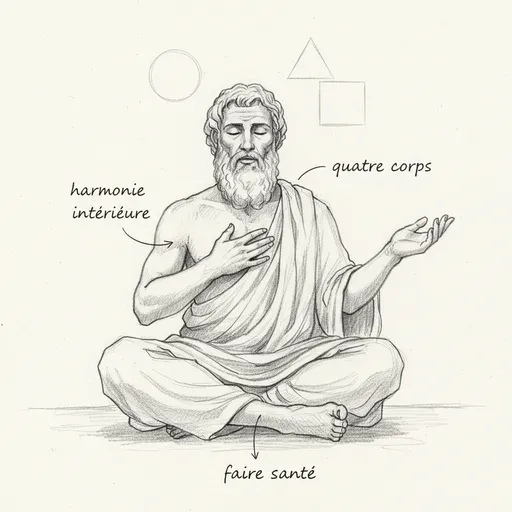
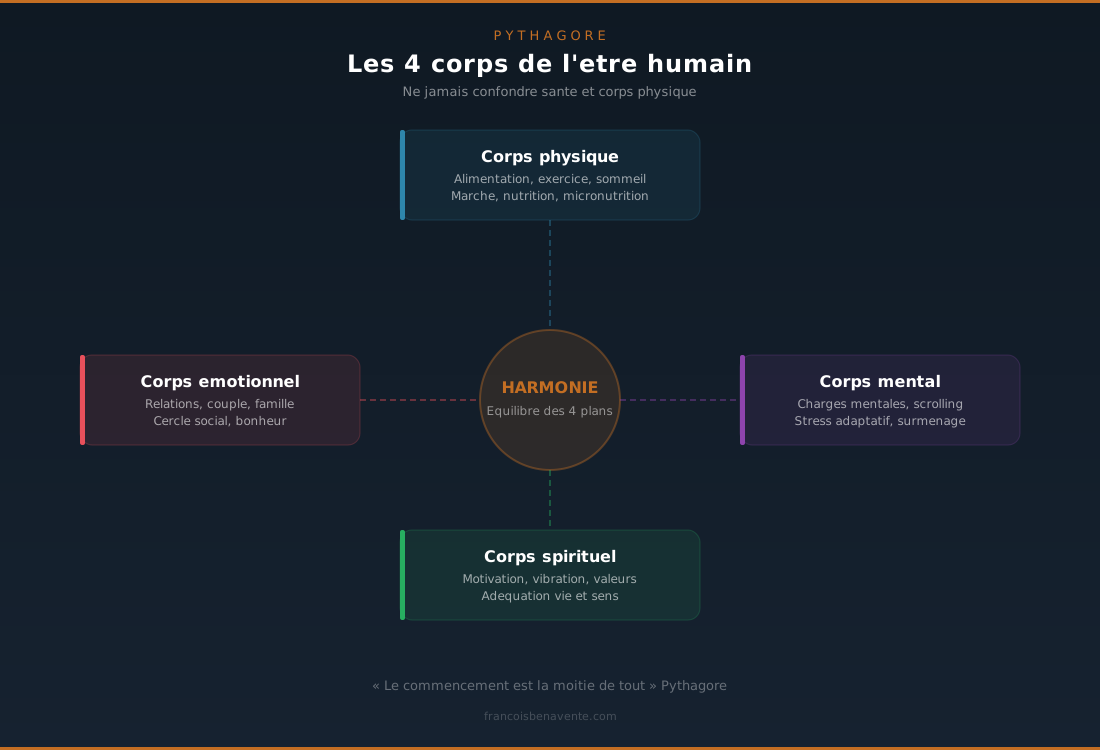
Here is the heart of Pythagorean teaching that interests the naturopath. Pythagoras does not see the human being as a simple physical body. He distinguishes four planes of existence, four bodies, four dimensions intertwined with one another, and whose harmony determines health.
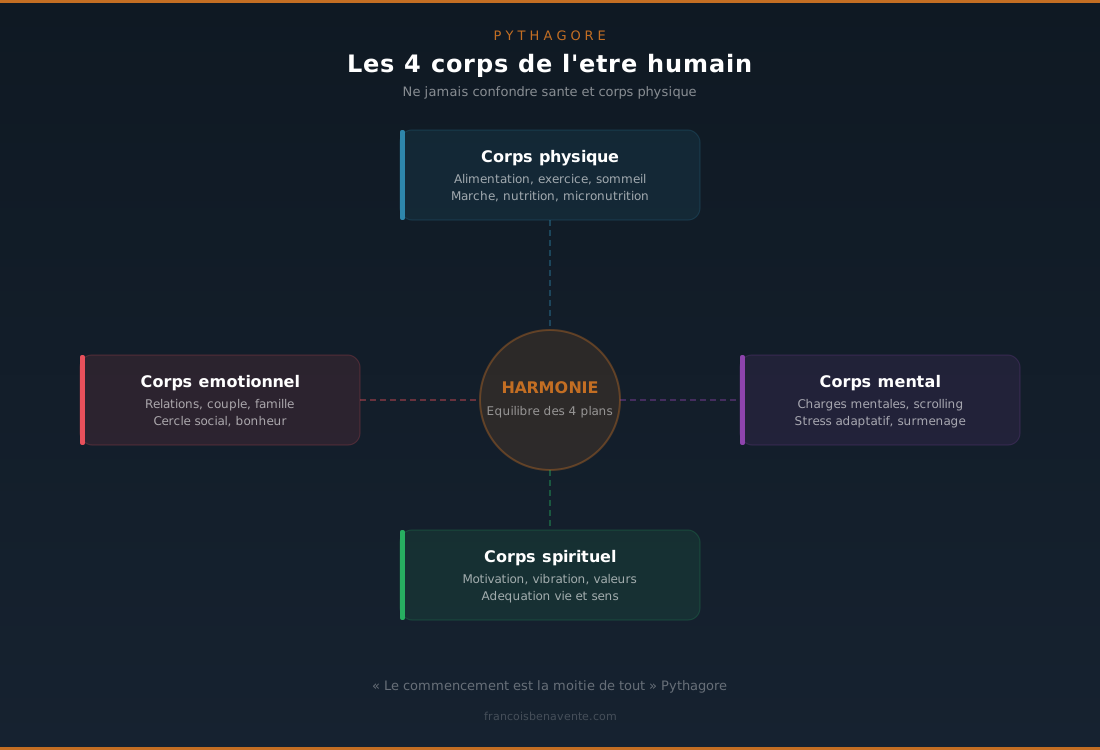
The physical body first. This is the densest plane, the most tangible. It is what conventional medicine knows and measures best. Nutrition, sleep, exercise, breathing, hydration, sun exposure, contact with the earth. Pythagoras was extremely precise on this point. He recommended a vegetarian diet, not out of sentimentalism, but because he believed that animal flesh burdens the body and obscures the mind. He also excluded beans, probably because he empirically knew favism, this genetic disease common in the Mediterranean where bean consumption provokes a hemolytic crisis. He advocated daily walking, breathing exercises, cold baths, periodic fasting. In consultation, this is often where I start. How do you walk, how much do you sleep, what do you eat, do you breathe correctly. The fundamentals.
The emotional body next. And this is where Pythagorean naturopathy distinguishes itself radically from conventional medicine. For Pythagoras, emotions are not epiphenomena, byproducts of the brain that can be ignored or medicated. Emotions are a body in their own right, with their own physiology, their own needs, their own diseases. The emotional body is the quality of your relationships: your couple, your family, your friends, your social circle. It is the capacity to express what you feel, to welcome both joy and sadness, to set boundaries, to give and receive love.
I constantly see patients in my practice whose physical body is in perfect condition, with flawless blood tests, ideal weight, regular physical activity, and yet they are exhausted, anxious, unhappy. When I dig deeper, I almost always find a suffering emotional body. A couple in silent crisis, a toxic parent one doesn’t dare confront, a grief not processed, social isolation that sets in without one noticing. Pythagoras understood this twenty-five centuries ago. Unexpressed emotions become diseases of the body. Modern naturopathy, enriched by psychoneuroimmunology, confirms what the master of Crotone taught his disciples.
The mental body is the third plane. It is the world of thoughts, beliefs, cognitive patterns, mental burdens. The mental body is your capacity to organize your thinking, to concentrate, to manage the flow of information, to make decisions without exhausting yourself. If Pythagoras returned today, I am convinced he would be horrified by what we are subjecting our mental body to. The permanent scrolling on social media, the incessant notifications, screens before sleep, information overload, the loss of contemplation and silence. Pythagoras imposed complete silence periods on his disciples, sometimes for years. Novices had to listen without speaking for five years before being authorized to ask questions. This was not a punishment, it was hygiene of the mental body. A cognitive detox, as we would say today.
In consultation, I always ask questions about the mental body. How much time do you spend on your phone each day? Can you concentrate on one task for more than twenty minutes without interruption? Do you ruminate in the evening before sleep? Do you feel that your mind never stops? The answers are often revealing. And this exhausted, overloaded mental body, constantly solicited, eventually overflows into the physical body: sleep disorders, cervical tension, migraines, chronic fatigue. Everything is connected.
The spiritual body finally. And here, pay attention: spiritual does not mean religious. Pythagoras was not a priest in the way we understand it. The spiritual body, in Pythagorean thought, is the plane of meaning. Why do you get up in the morning? What drives you forward? What are your deepest values? Is your daily life aligned with what you truly believe is important? Do you feel that you are contributing to something greater than yourself?
This is perhaps the most neglected plane in modern medicine, and yet it is often what determines everything else. I regularly see patients who have optimized everything at the physical level, people who eat organic, who exercise, who sleep eight hours, who take the right supplements, and yet they are not well. When I dig deeper, I discover they have lost meaning. They do work that no longer suits them, they live a life that doesn’t resemble what they had dreamed of, they have forgotten why they do what they do. The spiritual body is lying fallow. And without that body, the other three eventually collapse. Pythagoras knew this. The quest for wisdom, philosophy in the etymological sense of the term, the love of wisdom, is not an intellectual luxury. It is a biological necessity.
”Making health”: the Pythagorean revolution
There is a phrase I repeat often in consultation, and it comes directly from Pythagorean thought: we do not fight disease, we make health. The nuance is fundamental. It changes everything. It changes your posture, your strategy, your mindset, and even your results.
Conventional medicine is built on the model of combat. We fight cancer, we battle infection, we attack the bacterium, we destroy the sick cell. The vocabulary is military, and the logic is that of war. Pythagoras proposed exactly the opposite. It is not about fighting against something, but about building something. Building health, actively, consciously, daily, while respecting natural laws and cultivating harmony of the four bodies.
“Health is the perfect consonance of all parts of the being.” Pythagoras
This is not naive optimism. It is a radically different strategy. When you spend your energy fighting disease, you focus on what is wrong. You live in fear, in urgency, in reaction. When you make health, you build, you strengthen, you prevent. You do not ask yourself “what is wrong with me?” but “what can I do to feel better?” And this question opens doors that the other one closes.
In practice, this means that each naturopathic consultation should not begin with “what is your problem?” but with “how are you, on all four planes?” The physical body: how you eat, how you sleep, how you move. The emotional body: how is your couple, your family, your friends. The mental body: can you find stillness, reflect, be in silence. The spiritual body: does your life have meaning, do you feel aligned with your values.
And that is where the consultation becomes exciting. Because you never know in advance which body will be the priority. Some patients come for a digestive problem, and we discover that it is the emotional body that is crying out. Others come for anxiety, and we realize that the physical body is in ruins, that they are not eating, not sleeping, not moving. Still others have optimized everything except meaning, and it is this lack of direction that slowly undermines their vitality. In my experience, nine consultations out of ten involve advice that goes beyond the physical body. And I owe this approach to Pythagoras.
Temperance: the golden mean in all things
Pythagoras advocated temperance, that ancient word which means the golden mean, balance, measure in all things. No excess, no deprivation. Temperance in nutrition: eating enough, but not too much, choosing simple, unprocessed foods, universally accessible. Temperance in work: working with commitment, but knowing when to stop, respecting cycles of rest. Temperance in relationships: loving deeply, but without possessiveness or dependence.
This principle of temperance is one of the most difficult to apply in our modern world. We live in a society of excess. Excess of food, excess of information, excess of stimulation, excess of work. And when we try to correct excess, we often fall into the opposite excess: drastic diets, prolonged fasting, extreme detoxes, rigid stoicism. Pythagoras would have disapproved of both. Health is in measure. It is a subtle dance between too much and not enough, and this dance requires attention, consciousness, presence to oneself.
In consultation, I constantly see patients who oscillate between the two extremes. They eat anything for three months, then launch into a hyper-restrictive diet for three weeks. They exercise not at all for six months, then sign up for a high-intensity program five times a week. They accumulate stress without ever resting, then collapse in burnout. This manic-depressive alternation has nothing to do with health. Pythagorean health is constancy, regularity, measure, day after day, season after season. It is a way of life, not a one-time program.
Prevention before treatment
Pythagoras is perhaps the first Western thinker to have established prevention as a superior medical strategy to treatment. For him, true medicine does not intervene when disease is declared. True medicine prevents disease from appearing. This is exactly what naturopathy calls the medicine of terrain. We do not simply treat symptoms, we strengthen the terrain so that symptoms no longer have reason to appear.
This preventive approach rested in Pythagoras on several pillars: a vegetarian and frugal diet, daily physical exercise adapted to the age and temperament of each person, breathing and meditation exercises, periods of fasting and purification, respect for circadian rhythms (early rising, early sleeping), and harmonious social life within a benevolent community.
You recognize there, no doubt, the foundations of what we call today naturopathic techniques. Nutrition, exercise, breathing, stress management, detoxification treatments, chronobiology. None of this is new. It was all already there, in Crotone, five centuries before our era, in the school of a mathematician-philosopher-physician who had understood that health is an art of living, not a medical act.
Three lessons for today’s naturopath
The first lesson Pythagoras leaves us is that we must never confuse health with the physical body. Health is global, multidimensional, irreducible to blood tests and biological constants. A patient can have perfect tests and be profoundly ill. Another can have degraded markers and radiate vitality. The numbers don’t tell everything. The four bodies tell the rest.
The second lesson is that we do not attack disease. We seek harmony. This posture radically changes the therapeutic relationship. The naturopath is not a warrior who fights on behalf of the patient. He is a tuner who helps the patient find their just pitch. It is an image I use often: your body is a musical instrument. When it sounds false, it is not because it is broken. It is because it is out of tune. And to retune it, you must first understand which strings are too tight, which are too loose, and find the right tension for each of them.
The third lesson is to look beyond oneself. Pythagoras was a man of openness. He traveled for thirty years. He studied with Egyptians, Babylonians, Indians, Greeks. He never believed that a single tradition held the truth. He synthesized, integrated, unified. In naturopathy, this humility is essential. We do not hold all the answers. We must remain curious, open, ready to learn from all medical traditions, ancient and modern. Naturopathy is not a dogma. It is a path, and this path begins with Pythagoras.
From Pythagoras to your next consultation
When you come in for a consultation, or when you think about the next one, remember that Greek mathematician who bathed in the Nile, who meditated in Babylon, who taught in Crotone. Remember that health is not a matter of pills and protocols, but of harmony. And this harmony is cultivated on four planes, not just one.
Ask yourself honestly: which body is suffering the most in you right now? Is it the physical body, the one you nourish poorly or don’t move enough? Is it the emotional body, the one you neglect by staying in relationships that drain you? Is it the mental body, the one you exhaust by scrolling for hours on your phone? Or is it the spiritual body, the one that lacks direction, meaning, reason to be?
The answer to this question is the starting point of your healing. And this healing, Pythagoras did not call healing. He called it return to harmony. Because you are not broken. You are out of tune. And sometimes it takes adjusting just one string for the whole instrument to start singing again.
Hippocrates, who will come two generations after Pythagoras, will take up this holistic vision and systematize it into five pillars. But it was Pythagoras who opened the way. He planted the seed. And every naturopath who, in consultation, takes the time to explore the four planes of being, every practitioner who refuses to reduce their patient to a diagnosis, every therapist who seeks harmony rather than combat, perpetuates, whether they know it or not, the teaching of the master of Crotone.
“Do not say few things in many words, but many things in few words.” Pythagoras
Twenty-five centuries after his death, Pythagoras still tells us the essential in one sentence. Health is harmony. And harmony begins with you.
To go further
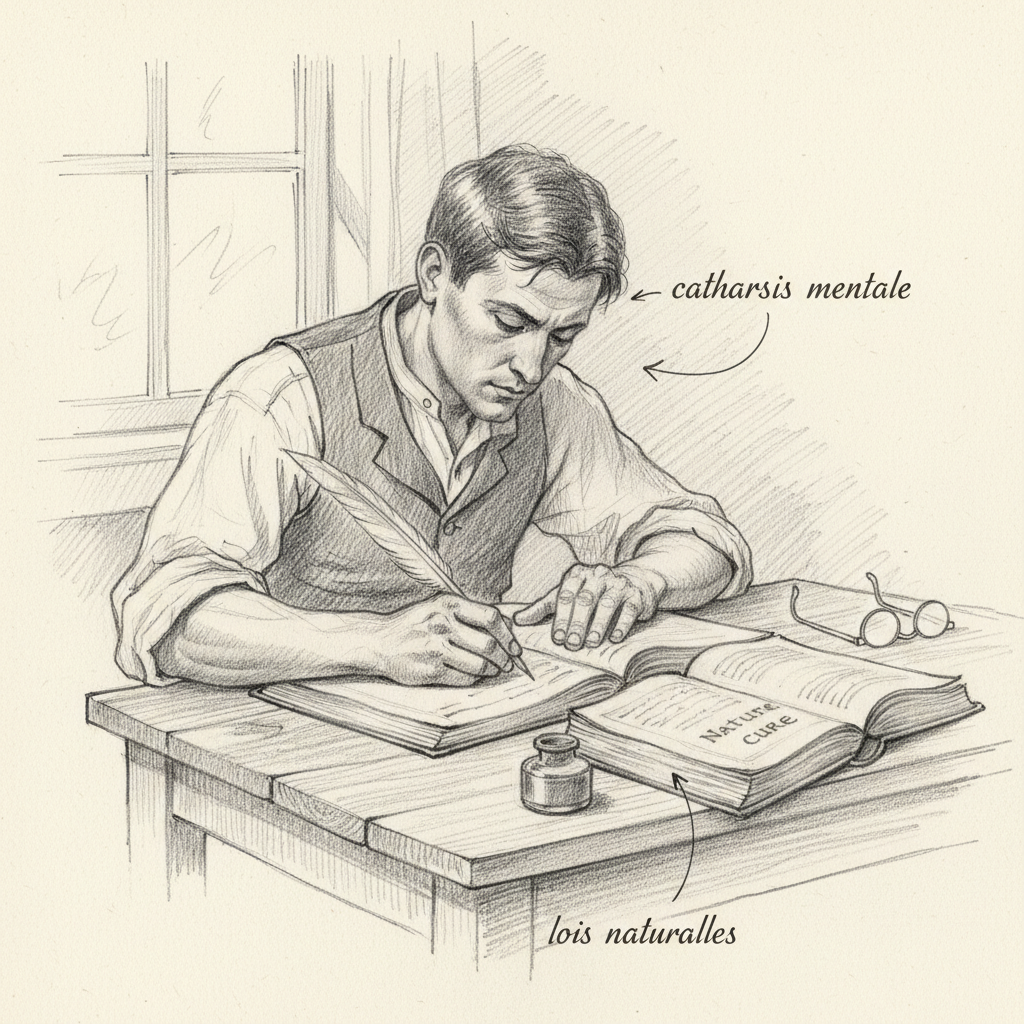
- Lindlahr: catharsis and Nature Cure, pillars of American naturopathy
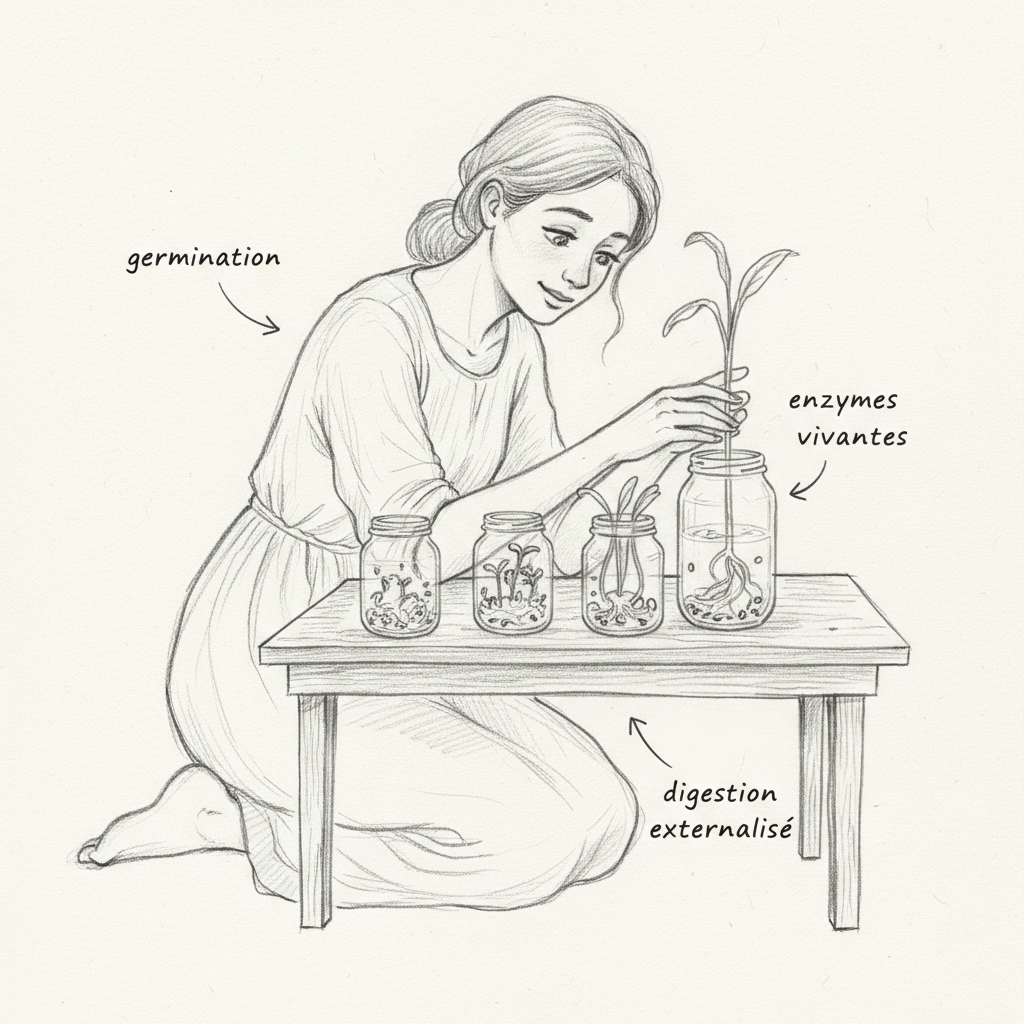
- Ann Wigmore: sprouting and living food in naturopathy
- Bernard Jensen: iridology and dry brushing, the skin as an emunctory
- Hippocrates: the 5 pillars and 4 temperaments of naturopathy
Healthy recipe: Quinoa with herbs and lemon: Plant-based nutrition was at the heart of Pythagorean philosophy.


Laisser un commentaire
Sois le premier à commenter cet article.