Moscow, 1921. In an office in the Kremlin, a forty-six-year-old doctor sits across from Vladimir Ilyich Lenin. The Soviet leader, already ravaged by the illness that would claim him three years later, listens attentively. The doctor’s name is Alexander Salmanoff. Since 1918, he has been Lenin’s personal physician and director of all thermal stations in Russia, a vast network stretching from the Black Sea to the Caucasus. Salmanoff has an unusual request. He wants a passport. He wants to leave the USSR. He tells Lenin, with a frankness that could have cost him his life under another regime: “The medicine as we practice it here is insufficient. In the West there is work on capillary circulation that could change our understanding of disease and aging. I want to go study it.” Lenin looks at him for a long moment, then signs the passport. Salmanoff leaves the Soviet Union. He will never return.
This departure marks the beginning of Alexander Salmanoff’s second life, the one that will make him one of the most original fathers of European naturopathy. For Salmanoff will not content himself with studying Krogh’s work. He will transform it into a comprehensive theory of health and disease, centered on a network that medicine had almost completely ignored until then: the capillaries.
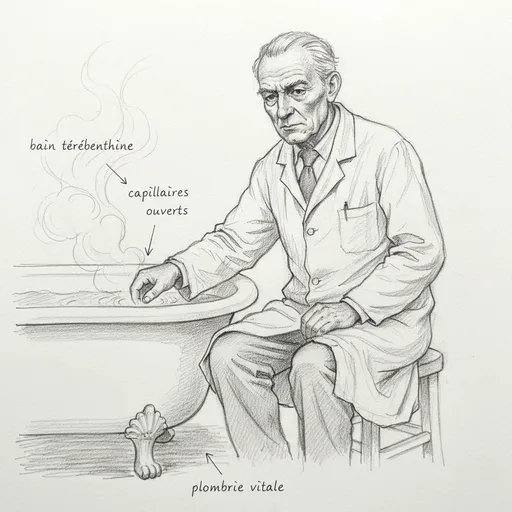
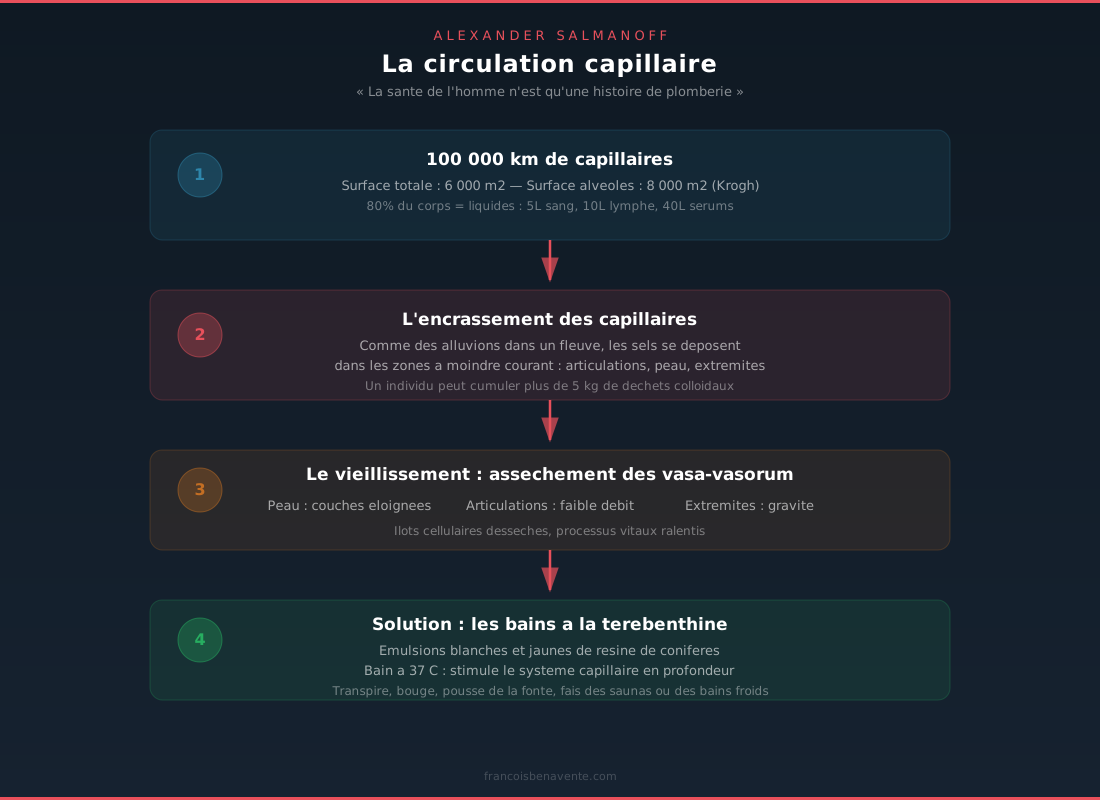
“Man’s health is merely a matter of plumbing.”
This phrase, which sums up Salmanoff’s entire philosophy, may seem reductive. It is not. Behind this seemingly simple metaphor lies one of the most profound and pertinent visions of human physiology. A vision that, a century later, has lost none of its explanatory power.
Krogh and the capillary revolution
To understand Salmanoff, one must first understand August Krogh. This Danish physiologist received the Nobel Prize in Medicine in 1920 for his work on the regulation of capillary circulation. Before Krogh, medicine was essentially concerned with the heart and large vessels: arteries, veins, aorta. Capillaries, these microscopic vessels that connect arterioles to venules, were considered mere passive tubes, inert channels through which blood circulated by cardiac pressure alone.
Krogh demonstrated that capillaries are not passive. They are equipped with their own musculature that allows them to contract and dilate independently of the heart. They themselves regulate local blood flow according to the needs of each tissue. A working muscle sees its capillaries dilate to receive more oxygenated blood. A resting organ sees its capillaries contract to conserve resources. This capillary self-regulation is a remarkably sophisticated system that operates continuously, twenty-four hours a day, without any conscious intervention.
Salmanoff was deeply moved by this discovery. He immediately understood that capillaries were not merely a distribution network but the true theater of cellular life. For it is at the capillary level, and only at the capillary level, that exchanges occur between blood and cells. Oxygen leaves the blood to enter cells through the capillary wall. Carbon dioxide and cellular waste travel the reverse path. Nutrients cross the capillary wall to nourish cells. Hormones pass through capillaries to reach their target organs. All cellular life, without exception, depends on the proper functioning of this microscopic network.
One hundred thousand kilometers of network
The figures that Salmanoff loved to cite are dizzying. The human body contains approximately one hundred thousand kilometers of capillaries. One hundred thousand kilometers. That is two and a half times around the Earth. It is the distance from Earth to the Moon and back with a detour. If laid flat, these capillaries would represent an exchange surface of six thousand square meters, the size of a football field. The pulmonary alveoli, these tiny sacs where gas exchanges occur, offer an area of eight thousand square meters in themselves.
These figures are not anecdotal. They reveal a fundamental reality: the exchange surface between blood and cells is infinitely greater than all visible organs combined. The heart, the liver, the kidneys, the lungs, the brain, all these organs that medicine studies and operates on with such care, represent only an infinitesimal fraction of the vital surface of the body. The essence of life takes place in these one hundred thousand kilometers of microscopic tubes that medicine had forgotten.
Salmanoff also liked to point out that the human body is eighty percent composed of liquids. Five liters of blood, ten liters of lymph, forty liters of cellular and interstitial serums. We are not solid beings. We are liquid beings, complex hydraulic systems in which fluids circulate continuously to nourish, cleanse, and renew each cell. And the quality of this circulation determines the quality of our health.
It was this awareness that led Salmanoff to formulate his plumbing metaphor. If you conceive of your body as a hydraulic network of one hundred thousand kilometers, then health is a matter of circulation. When the pipes are clean and open, fluids circulate freely, cells are nourished and cleansed, and the organism functions optimally. When the pipes become blocked, fluids stagnate, cells are suffocated and intoxicated, and disease sets in. It is that simple. And that profound.
The alluvium in the river: how capillaries become clogged
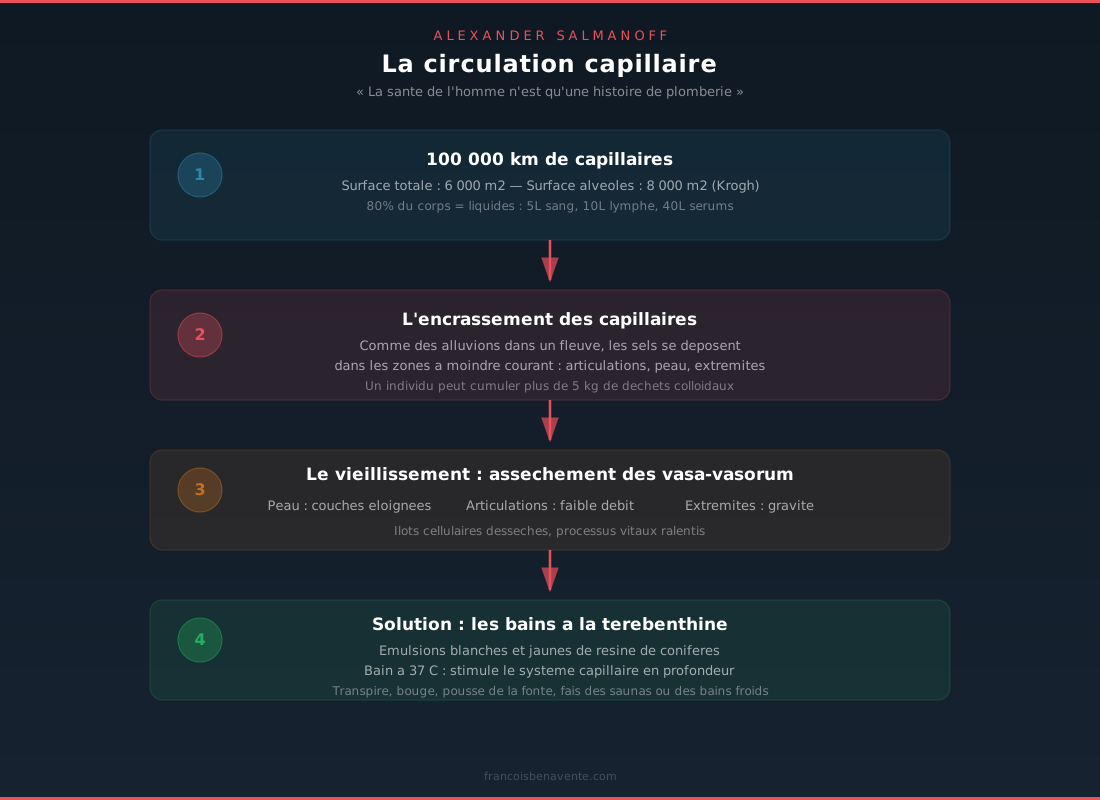
Salmanoff used a fluvial analogy of striking clarity to explain the mechanism of capillary clogging. Imagine a great river flowing through a plain. Its current is powerful at the center, where the flow is strongest. But on the banks, in the meanders, in the dead arms, the current slows. And it is in these areas of weaker current that alluvium deposits. Sand, gravel, plant debris accumulate slowly, insidiously, until they form banks that reduce the river’s channel and disrupt the entire circulation.
The same phenomenon occurs in the human body. Metabolic waste products, these acidic and colloidal residues produced by cellular metabolism, circulate in the blood and lymph. At the level of large vessels, the current is powerful enough to carry them to the organs of elimination. But at the capillary level, especially in areas far from the heart where the current is weak, these waste products deposit like alluvium. They accumulate in the capillary walls, reduce the diameter of the vessels, and eventually obstruct them completely.
The zones of preferential deposit are characteristic. The joints first, these mechanical intersections where capillaries are subject to pressure and movement constraints that slow circulation. The knees, elbows, fingers, toes, neck: all these joints are zones of preferential waste accumulation. This is why joint pain is so frequent and often appears first in the aging process. It is not the joint that is diseased. It is the capillaries irrigating it that are clogged.
The skin next. Skin capillaries are the farthest from the heart and most subject to temperature variations. Circulation there is naturally slower, which favors deposits. This is why the skin is often the first organ to show signs of aging: wrinkles, age spots, dryness, loss of elasticity. All these signs reflect an impoverishment of skin capillary circulation.
The extremities finally. The feet and hands, by the effect of gravity and by their distance from the heart, are particularly vulnerable zones for capillary deposits. Cold feet, icy hands, tingling, numbness: all these symptoms that millions of people consider normal are actually signs of capillary insufficiency.
Salmanoff estimated that a middle-aged individual could accumulate more than five kilograms of colloidal waste in their tissues. Five kilograms of mineral and acidic waste encrusted in capillary walls, joints, connective tissue, muscles. Five kilograms that are not detected by standard blood tests (the blood itself is continuously regulated by buffer systems), but which are indeed present and which slow all vital processes.
Aging as drying of the vasa-vasorum
One of Salmanoff’s most original contributions to medicine is his theory of aging. For him, aging is not a genetically programmed fatality. Aging is a process of progressive drying of the smallest capillaries, those that anatomists call the vasa-vasorum, literally “the vessels of the vessels.”
The vasa-vasorum are capillaries so tiny that they nourish the walls of the capillaries themselves. It is a system of vessels within vessels, a circulatory mise en abyme that illustrates the extraordinary fineness of vascular architecture. When these vasa-vasorum become clogged or dry up, the capillaries they nourish degenerate. And when these capillaries degenerate, the cells they irrigated no longer receive oxygen or nutrients. Dried cellular islands form, like oases drying up in an advancing desert. All vital processes slow down: cellular regeneration, waste elimination, enzyme production, immune response.
Salmanoff drew an audacious conclusion from this: the theoretical life expectancy of humans would be one hundred twenty to one hundred fifty years if their lifestyle did not reduce their vital resources by prematurely obstructing their capillary network. Centenarians are not genetic miracles. They are individuals whose capillary network has remained sufficiently open to maintain adequate circulation. And if one could clean and reopen obstructed capillaries, one could not stop aging but could slow it considerably.
This theory aligns with the most recent work on microcirculation and vascular aging. Contemporary researchers have confirmed that the decline of microcirculation is one of the central mechanisms of aging and most chronic diseases. Silent micro-infarcts, micro-strokes, macular degeneration, diabetic neuropathy, nephropathy: all these pathologies are fundamentally diseases of microcirculation. Salmanoff was right half a century before science confirmed it.
Terpenic baths: Salmanoff’s solution
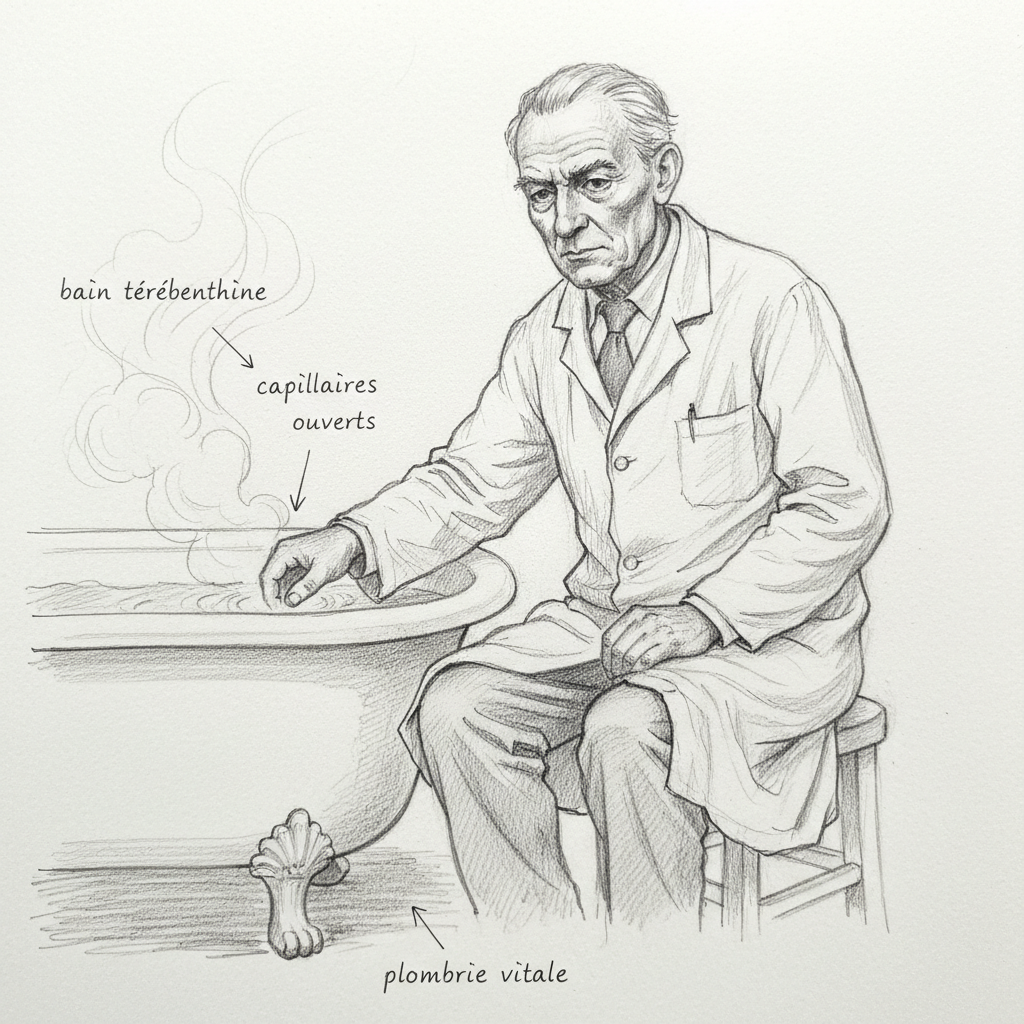
If the problem is capillary, the solution must be capillary. This logical reasoning led Salmanoff to develop his famous terpenic baths, one of the most original therapeutic contributions in the history of natural medicine.
Terpenic baths use emulsions based on turpentine, a natural resin extracted from conifers (pines, firs, larches). Turpentine has been used in medicine since antiquity, notably by Hippocrates who used it in friction to relieve joint pain. Salmanoff made systematic and codified use of it, developing two types of emulsions with complementary properties.
The white emulsion is designed to stimulate capillary vasodilation. Diluted in a bath at thirty-seven degrees Celsius, it penetrates the skin and causes the opening of cutaneous and subcutaneous capillaries. This vasodilation improves local circulation, promotes cellular exchanges, and accelerates the elimination of waste deposited in tissues. The patient feels intense heat, sometimes tingling, which testifies to the reopening of capillaries. The white emulsion is particularly indicated in people with low blood pressure, those who are sensitive to cold, and neuro-arthritic constitutions that tend toward peripheral vasoconstriction.
The yellow emulsion has a slightly different mechanism of action. It combines turpentine with oleic acid and castor oil, which gives it deeper penetration properties. It is particularly suited for people with elevated blood pressure and cases of osteoarthritis, sciatica, polyarthritis. The yellow emulsion promotes the dissolution of intra-articular calcareous deposits and the reopening of deep capillaries.
Salmanoff was very precise in his protocols. He recommended baths of fifteen to twenty minutes, at a temperature of thirty-seven degrees, with progressively increasing emulsion concentration over a series of thirty baths. Progressivity was essential: too much turpentine too quickly could cause unpleasant skin reactions. Too little produced no effect. Salmanoff adjusted the concentration based on the patient’s individual response, carefully observing skin coloration, the duration of post-bath redness, and reported sensations.
The Paris clinic: two hundred patients over seventy-five years old
The most spectacular clinical proof of the effectiveness of terpenic baths comes from the clinic that Salmanoff opened in Paris in the nineteen thirties. After leaving the USSR, he had settled in France where he practiced for several decades. In his Parisian clinic, he treated thousands of patients, but his results in elderly people are the most remarkable.
Salmanoff formed a group of two hundred patients over seventy-five years of age, suffering from various chronic pathologies: osteoarthritis, circulatory insufficiency, rheumatism, chronic fatigue, cognitive disorders. He administered them a series of thirty terpenic baths over a period of two to three months. The results were sufficiently convincing that Salmanoff published and presented them to the medical community.
After thirty baths, the majority of patients reported a significant improvement in joint mobility, a reduction in pain, a burst of energy, improvement in sleep, skin more supple and better irrigated, and above all a global feeling of rejuvenation that Salmanoff attributed to the reopening of obstructed capillaries. Some patients who could no longer climb stairs recovered fluid walking. Others who had suffered from icy hands and feet for years felt warmth return to their extremities.
These results, although not published according to current standards of randomized clinical trials, constitute an impressive empirical corpus. Salmanoff himself acknowledged the limitations of his observations and called for more rigorous studies. But he knew, with the certainty of the clinician who observes his patients for decades, that terpenic baths worked. And that their mechanism of action, the reopening of capillaries, was consistent with everything Krogh’s physiology had demonstrated.
The hypercaloric bath: artificial fever in the service of detox
Salmanoff also developed the concept of the hypercaloric bath, a therapeutic sweating technique that deserves particular attention. The principle is simple in its conception and profound in its effects: by gradually raising the bath temperature above thirty-seven degrees (up to thirty-nine or forty degrees), one provokes artificial hyperthermia that mimics the effects of natural fever.
Fever, let us recall, is not a malfunction of the organism. It is a defense mechanism: by raising its internal temperature, the body accelerates enzymatic reactions, stimulates the immune system, activates sweating, and promotes the elimination of toxins. The hypercaloric bath artificially reproduces this mechanism in people whose organism, weakened by age or illness, is no longer capable of spontaneously producing sufficient fever.
Sweating induced by the hypercaloric bath is a powerful detoxification mechanism. Sweat eliminates not only water and mineral salts, but also heavy metals, organic acids, and lipophilic substances that the kidneys cannot filter. Salmanoff considered the skin, with its millions of sweat glands, to be an organ of elimination as important as the kidneys, and that regular sweating was one of the most effective means of maintaining the cleanliness of the internal environment.
This vision aligns with that of Paul Carton who placed skin among his four main organs of elimination as a “safety valve” for the organism. Salmanoff and Carton, although starting from different premises (Salmanoff from capillary circulation, Carton from humoral terrain), reach the same conclusion: the skin is a major organ of elimination whose functions are dramatically underutilized in our modern lifestyle, where sedentariness, synthetic clothing, and air conditioning prevent natural sweating.
The liquid body: rethinking physiology
Salmanoff’s vision invites us to fundamentally rethink our conception of the human body. We are accustomed to thinking in terms of solid organs: the heart, liver, lungs, brain. We visualize our body as a machine composed of distinct parts, each fulfilling a specific function. Salmanoff reverses this perspective. For him, the body is first and foremost a liquid environment in which cells bathe.
Eighty percent of the body is made of liquids. Five liters of blood that circulate continuously through the vascular network. Ten liters of lymph that drain tissues and transport immune cells. And especially forty liters of cellular and interstitial serums, these liquids that surround and bathe each cell in the body. The cell is not an isolated element. It is immersed in an internal ocean whose quality directly determines its health and functioning.
If this internal ocean is clean, rich in oxygen and nutrients, cleansed of its waste, the cell thrives. It divides normally, produces the necessary proteins and enzymes, communicates effectively with its neighbors, and accomplishes its specific function with precision. If this internal ocean is polluted, poor in oxygen, laden with waste and toxins, the cell suffers. It malfunctions, it degenerates, it dies prematurely. And when enough cells malfunction in the same organ, disease appears.
This cellular vision of disease is perfectly consistent with what naturopathy has taught since its origins. The terrain of Béchamp, the energy transformer of Carton, the clogging of Marchesseau: all these notions describe the same phenomenon from different angles. The pollution of the internal environment is the first cause of disease. And the purification of this internal environment is the royal path to healing.
Salmanoff adds to this vision a practical dimension that the other fathers of naturopathy had not developed with such precision: the capillary network is the system for distributing and cleansing this internal ocean. If the network is open, the internal environment is clean. If the network is clogged, the internal environment becomes polluted. Health is therefore, literally, a matter of plumbing.
Salmanoff and modern naturopathy
Salmanoff’s influence on contemporary naturopathy is more discreet than that of Kneipp or Carton, but it is no less profound. Marchesseau was familiar with Salmanoff’s work and integrated it into his naturopathic synthesis. The notion of humoral clogging, hydrotherapy techniques, the importance accorded to sweating and skin as an organ of elimination, the vision of aging as drying: all these Marchessian concepts bear Salmanoff’s imprint.
In consultation, when I examine a client’s hands and feet to assess the quality of their peripheral circulation, when I palpate the temperature of their skin, when I ask them about their sensations of cold in the extremities, when I recommend them warm baths with essential oils of pine or rosemary, I am doing Salmanoff without always naming it. The capillary network is the invisible backdrop of every naturopathic consultation, even when not explicitly mentioned.
Modern naturopathy has enriched Salmanoff’s approach with current scientific knowledge. We now know that nitric oxide (NO), produced by the vascular endothelium, is the primary endogenous vasodilator and that its production decreases with age. We know that regular physical exercise stimulates NO production and maintains vascular flexibility. We know that certain foods (beets, garlic, cocoa, citrus) promote vasodilation through precise biochemical mechanisms. We know that the thyroid plays a key role in vascular tone and that hypothyroidism is associated with peripheral vasoconstriction that explains the cold extremities and characteristic sensitivity to cold.
All this modern knowledge confirms and enriches Salmanoff’s vision. Microcirculation is indeed the main theater of health and disease. Capillaries are indeed the essential actors of cellular life. And aging is indeed, in large part, a story of pipes that become clogged.
Salmanoff’s lesson: clean the plumbing
If you retain only one thing from this article, retain this image: your body is a network of one hundred thousand kilometers of capillaries in which fifty-five liters of liquids circulate. The quality of your health depends on the cleanliness and openness of this network. Every processed food, every hour of sedentariness, every too-short night, every unmanaged stress deposits alluvium in your capillaries. And this alluvium, accumulating day after day, year after year, gradually reduces your ability to nourish and cleanse your cells.
The good news is that the process is reversible. Movement reopens capillaries. Sweating (warm bath, sauna, physical exercise) eliminates waste accumulated in tissues. Living, alkalizing food reduces the production of acidic waste. Sufficient hydration maintains the fluidity of organic liquids. Deep breathing oxygenates the blood and stimulates venous return. Every vital hygiene gesture you make is a sweep through your internal plumbing.
Salmanoff stands in the direct line of Paul Carton (terrain as the cause of disease) and upstream of Marchesseau (the naturopathic synthesis). Where Carton looked at digestion and organs of elimination, Salmanoff looked at circulation and capillaries. But both reach the same finding: disease is the consequence of internal environment clogging, and healing passes through the cleansing of this environment.
The man who left the USSR to study capillaries left us a message of disarming simplicity: take care of your plumbing. Clean your pipes, make your fluids circulate, open your capillaries, sweat regularly, move every day, and your organism will have the conditions necessary to function as nature intended. It may be the most fundamental and universal health advice that naturopathy can offer.
To go further
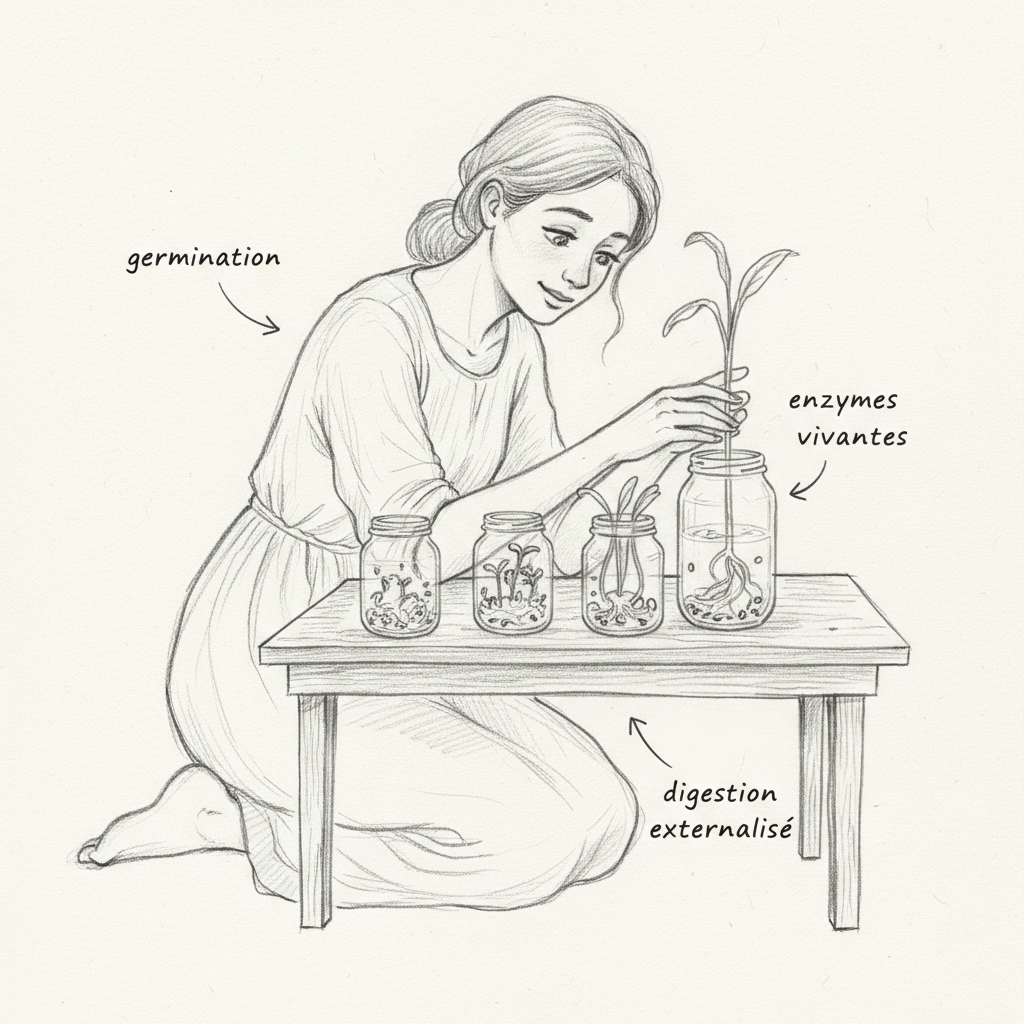
- Ann Wigmore: germination and living food in naturopathy
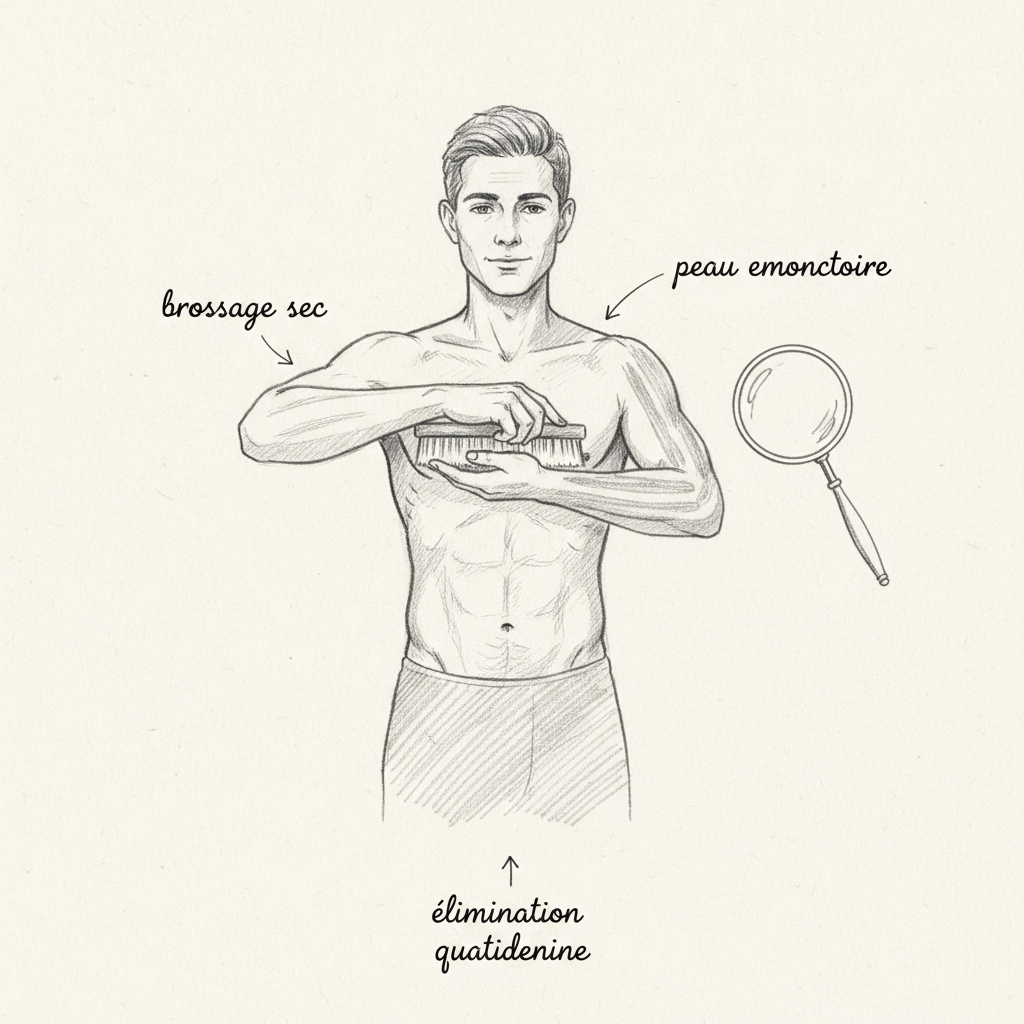
- Bernard Jensen: iridology and dry brushing, the skin as organ of elimination
- Kneipp: the abbot of cold and the roots of naturopathic hydrotherapy
- Kousmine: the 6 pillars and the intestine as motor of disease
Healthy recipe: Pure beet juice: Beets support micro-circulation.



Laisser un commentaire
Sois le premier à commenter cet article.