Claire jumps at the slightest sound. A slamming door, a ringing phone, a car horn in the street: each stimulus makes her flinch. Her heart races without warning, sometimes in the middle of the night, without nightmares, without reason. She feels her jaw permanently clenched. Her shoulders are raised up to her ears. She grinds her teeth at night. She cannot sit in a café without watching the door. She has seen two cardiologists for her heart palpitations: normal heart. A gastroenterologist for her heartburn: normal stomach. A psychiatrist who prescribed her an anxiolytic: immediate effect but dependence in three weeks. No one asked her the real question: is your brain producing enough GABA?
GABA (gamma-aminobutyric acid) is the primary inhibitory neurotransmitter of the central nervous system. If dopamine is the accelerator and acetylcholine the turbo, GABA is the brake. Without brakes, a car becomes a weapon. Without GABA, a brain becomes an anxiety machine. And that’s exactly what happens to millions of people living in a state of permanent hypervigilance that they mistake for “psychological” anxiety when it’s actually a biochemical deficit.
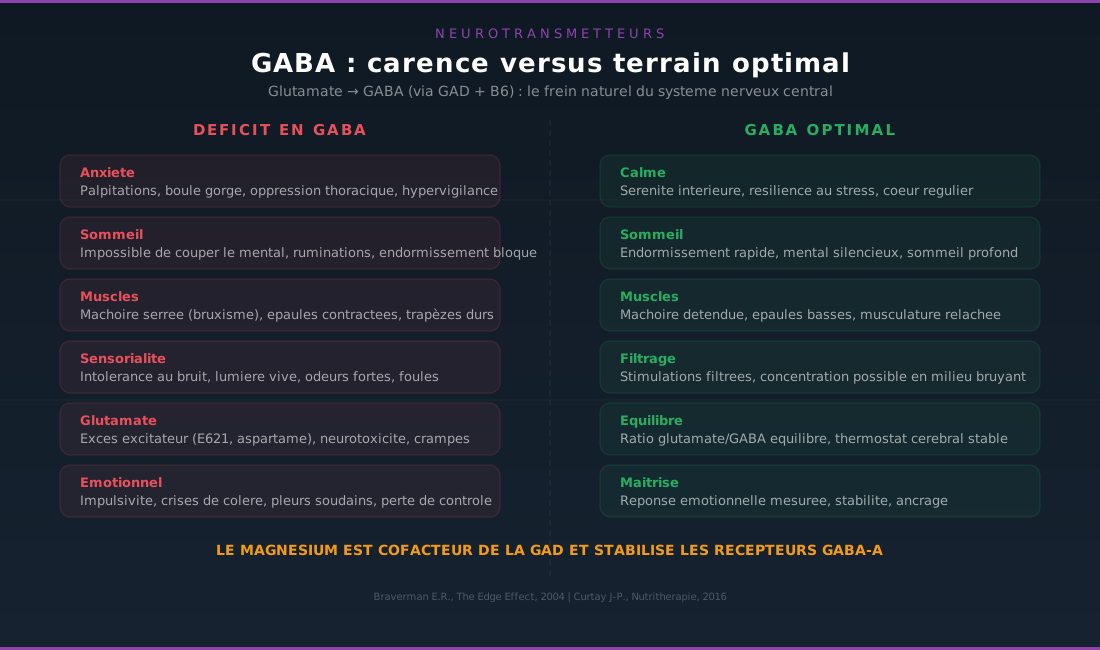
How GABA is produced
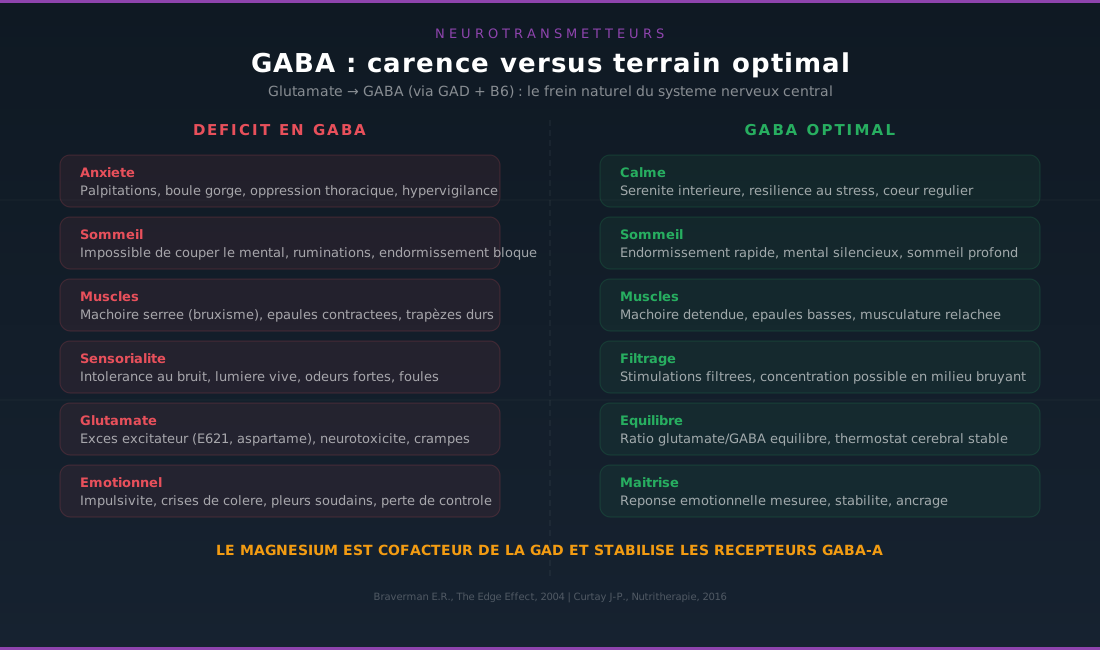
The synthesis chain is elegantly simple: glutamate (the most abundant excitatory neurotransmitter in the brain) is converted to GABA by the enzyme glutamate decarboxylase (GAD). This enzyme requires only one cofactor: vitamin B6 in its active form P5P. Magnesium is a cofactor of GAD and stabilizes GABA-A receptors. Zinc modulates the activity of GABA receptors.
This is why B6 and magnesium deficiency is so often associated with anxiety. Without B6, glutamate cannot become GABA. Glutamate accumulates: and excess glutamate is an excitatory neurotoxin that causes anxiety, insomnia, noise sensitivity, palpitations and muscle cramps. Exactly Claire’s symptoms.
GABA is then degraded by GABA transaminase into succinic acid, which enters the Krebs cycle. The glutamate/GABA balance is the brain’s central thermostat. When GABA dominates, you are calm, composed, confident. When glutamate dominates, you are anxious, agitated, hypervigilant. Benzodiazepines (Lexomil, Xanax, Valium) work by potentiating GABA’s action on GABA-A receptors. They work: but they create dependence within a few weeks and tolerance that forces you to increase doses. Naturopathy seeks to restore endogenous production rather than artificially mimic the effect.
Signs of GABA deficiency
Anxiety is the cardinal symptom, but not just any anxiety. It’s a physical, somatic, visceral anxiety. Heart palpitations without cardiac cause. A lump in the throat. A knot in the stomach. A sensation of chest tightness. Fine tremors in the hands. The body is in “alert” mode permanently, as if an imminent danger were threatening: when there is none.
Insomnia is characteristic: difficulty falling asleep due to inability to “shut off the mind.” The brain loops, ruminating, anticipating, worrying. Intrusive thoughts flood in with no possibility of stopping them. This is different from serotonergic insomnia (nighttime awakenings between 3am and 5am): here, it’s falling asleep that is blocked.
Chronic muscle tension is the most reliable somatic sign. Clenched jaw (bruxism), contracted shoulders, trapezius tight as stone, neck pain, tension lower back pain. GABA relaxes muscle tone: without it, muscles remain contracted permanently. Nocturnal bruxism is quasi-pathognomonic of GABA deficiency combined with magnesium deficiency.
Sensory hypersensitivity: intolerance to noise, bright light, strong odors, crowds. A brain deprived of GABA no longer filters stimulations: everything arrives at once, at full power, without buffering. Impulsivity and difficulty controlling emotional reactions (angry outbursts, sudden tears) reflect the absence of inhibitory regulation.
Take the Braverman GABA deficiency questionnaire to assess your profile.
What destroys GABA
Chronic stress is the primary culprit. Elevated cortisol reduces the sensitivity of GABA-A receptors and increases glutamate release. It’s a double blow: fewer functional receptors and more excitatory neurotransmitter in the synaptic cleft. The vicious cycle is relentless: stress depletes GABA, GABA deficiency increases vulnerability to stress.
Magnesium deficiency is endemic and directly linked to GABA deficiency. Seventy percent of French people do not meet recommended magnesium intake. Stress accelerates magnesium loss through urine. Magnesium stabilizes GABA-A receptors: without it, they don’t function properly, even if GABA levels are adequate.
Excess dietary glutamate (monosodium glutamate, additive E621, very present in industrial cooking, chips, prepared dishes, Asian cuisine) overloads the excitatory system and unbalances the glutamate/GABA ratio. Aspartame (sweetener) releases aspartic acid, another neuronal excitant.
Alcohol is a cruel trap. It potentiates GABA artificially: that’s why it relaxes and disinhibits. But alcohol withdrawal causes a rebound of glutamatergic hyperexcitability. The chronic alcoholic has a collapsed GABA system, masked by daily consumption. Excess coffee (more than three cups) increases glutamate and antagonizes GABA.
Restoring GABA naturally
Magnesium bisglycinate is the first prescription. The bisglycinate form is doubly interesting: magnesium itself is a GABA cofactor, and glycine is an inhibitory amino acid that potentiates magnesium’s action. Dose: 300 to 400 milligrams of elemental magnesium per day, preferably at dinner.
Taurine (1 to 2 grams per day) is an amino acid that activates GABA-A receptors and stabilizes neuronal membranes. It’s the most underestimated natural anxiolytic. L-theanine (100 to 200 milligrams, present in green tea) increases GABA and cerebral alpha waves (awake relaxation waves) without causing drowsiness.
Valerian (300 to 600 milligrams of standardized extract at dinner) contains valeric acid that inhibits GABA transaminase, slowing GABA degradation. Passionflower (Passiflora incarnata) increases GABA through a similar mechanism. Lemon balm (Melissa officinalis) inhibits GABA transaminase and has documented anxiolytic action.
Slow diaphragmatic breathing (four seconds inhalation, six seconds exhalation) activates the vagus nerve, which stimulates GABA release in the brainstem. Five minutes of this breathing measurably reduces cortisol and increases heart rate variability, a marker of parasympathetic (GABAergic) activity. Moderate physical exercise (yoga, walking, swimming) increases cerebral GABA by twenty-seven percent according to a study published in The Journal of Alternative and Complementary Medicine.
Claire started with magnesium bisglycinate at dinner and square breathing three times a day. Within two weeks, the palpitations had disappeared. In four weeks, she was no longer grinding her teeth at night. In two months, she was sitting in a café without watching the door. She no longer needs Lexomil.
To go further
- Acetylcholine: the forgotten neurotransmitter of your memory
- Dopamine: when motivation fades for no reason
- GABA Nature: the stable and organized profile according to Braverman
- The Braverman method: your brain in 4 neurotransmitters
Want to assess your status? Take the free magnesium deficiency questionnaire in 2 minutes.
Sources
- Braverman, Eric R. The Edge Effect. Sterling Publishing, 2004.
- Streeter, Chris C., et al. “Effects of yoga versus walking on mood, anxiety, and brain GABA levels.” The Journal of Alternative and Complementary Medicine 16.11 (2010): 1145-1152.
- Curtay, Jean-Paul. Nutrithérapie : bases scientifiques et pratique médicale. Testez Éditions, 2016.
- Hertoghe, Thierry. Atlas de médecine hormonale et nutritionnelle. International Medical Books, 2006.
If you want personalized support, you can book a consultation.
Healthy recipe: Digestive infusion: Calming plants support GABA.


Laisser un commentaire
Sois le premier à commenter cet article.