Hippocrates: The Founder of Natural Medicine
Athens, 430 BC. The plague ravages the city. Corpses pile up in the streets. The temples are full of the dying. Doctors flee or die themselves. Only one man dares to confront the epidemic. He has enormous aromatic fires lit at crossroads, pyres of fragrant wood, thyme, cypress, juniper, whose smoke purifies the air and, in a way that no one yet understands, slows the contagion. This man’s name is Hippocrates. He is thirty years old, and he has just made the first act of what will become natural medicine.
“Let your food be your first medicine.” Hippocrates
Everyone knows this phrase. You see it on mugs, on t-shirts, on Instagram posts. But few understand what it truly means, and even fewer know that it is only the visible tip of a twelve-hundred-page intellectual iceberg. Because Hippocrates did not write an aphorism. He wrote the Corpus Hippocraticum, a monumental work that founds not only Western medicine, but also the five pillars upon which all modern naturopathy rests.
The man behind the myth
Hippocrates was born around 460 BC on the island of Cos, in the Aegean Sea, into a family of physician-priests. According to tradition, he is the seventeenth descendant of Asclepius, the Greek god of medicine. Whether this genealogy is historical or mythical, it says something essential: Hippocrates inherits a millennia-old medical tradition that he will radically transform.
For until Hippocrates, Greek medicine is a matter of temples. People come to sleep in the Asclepieion, the temple of Asclepius, they wait for a prophetic dream, the priest interprets the dream, and they go home with a divine diagnosis. This is sacerdotal, theurgic, magical medicine. Hippocrates will accomplish a Copernican revolution: he will take medicine out of the temple and place it on the earth. Illness is not a punishment from the gods. It has natural causes. And these natural causes, we can understand them, prevent them, treat them.
This gesture is foundational. It inaugurates rational thought in medicine. And yet, contrary to modern medicine which has pushed rationalism to the point of evacuating all vital and spiritual dimension, Hippocrates maintains a subtle balance. Yes, illness has natural causes. But nature itself possesses an intelligence, a healing force, a vital breath. Hippocrates called this pneuma, Pythagoras called it harmony, and modern naturopaths call it vital force. The word changes, the reality remains.
From 14 quotes to 5 pillars
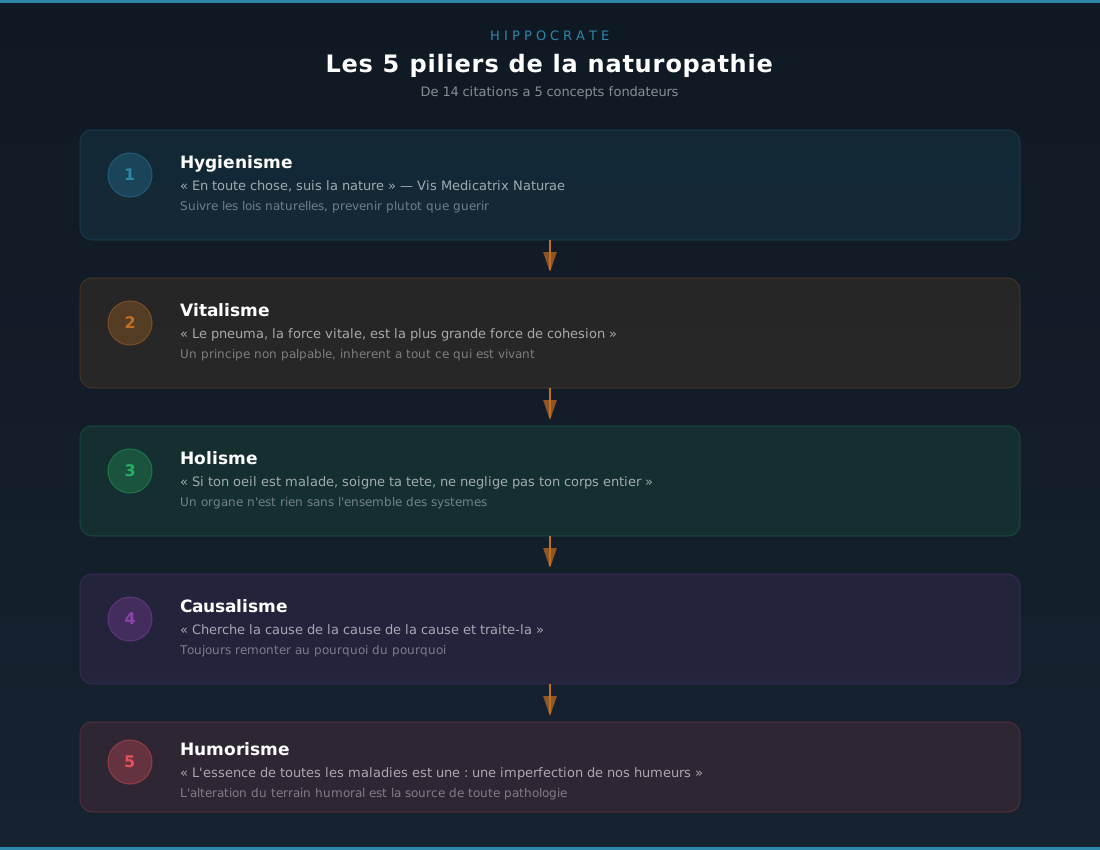
When you read the Corpus Hippocraticum with the eyes of a naturopath, you find at least fourteen major quotes that, brought together, draw five great principles. These five principles are the pillars of naturopathy. They were not invented by modern naturopaths. They were extracted, distilled, formalized from Hippocrates’ work. Marchesseau, the father of French naturopathy, systematized them in the twentieth century, but the raw material comes from Cos.
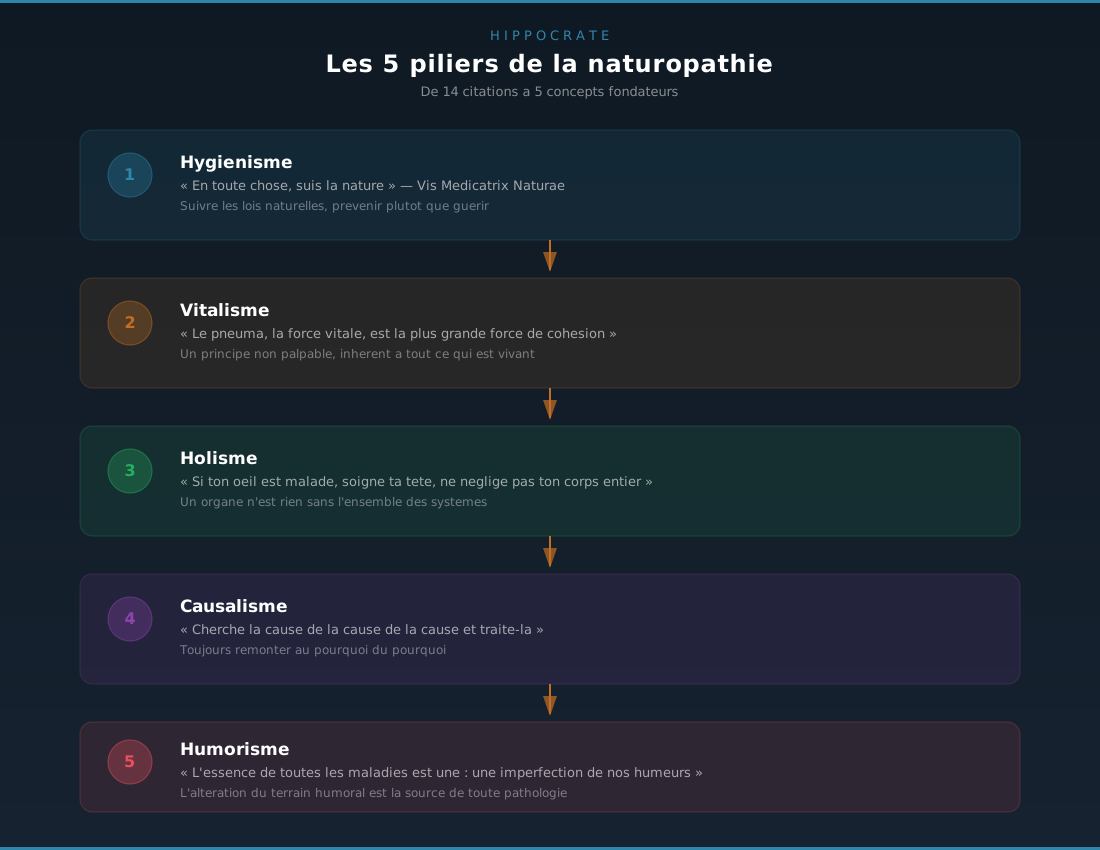
First pillar: hygienism
“The force that is in each of us is our greatest physician.” Hippocrates
Hygienism is the principle that health is maintained by following natural laws. Eating natural foods, sleeping when it is dark, moving when it is light, breathing pure air, drinking clean water, living in rhythm with the seasons. This seems simple, almost banal. But look around you. How many people follow these elementary rules? How many eat ultra-processed foods, sleep at erratic hours, spend their days enclosed under fluorescent lights, breathe conditioned air, and live in a permanent artificial spring thanks to central heating?
Hippocratic hygienism rests on a central concept: the Vis Medicatrix Naturae, the healing force of nature. This concept means that the body possesses within itself the mechanisms necessary for its own healing. Fever, inflammation, diarrhea, skin eruptions, mucus: all of this is not illness. These are defense reactions, self-cleansing processes, manifestations of vital force in action. The role of the therapist is not to suppress these reactions, but to accompany them, to give them favorable conditions to fulfill themselves. This is exactly the opposite of the pharmaceutical approach which suppresses the symptom without caring about the cause.
Second pillar: vitalism
“The soul is the same in all parts of the body.” Hippocrates
Vitalism is the recognition that there exists in every living organism an organizing force, a biological intelligence that cannot be reduced to the sum of chemical reactions. This force, Hippocrates called pneuma, vital breath, and he considered it the animating principle of all life. Pneuma is not a vague mystical concept. It is a clinical observation. Two patients with exactly the same pathology, the same tests, the same age, the same constitution, can have radically different evolutions. One heals in a few weeks, the other lingers for months. Why? Because their vital force is not the same.
In naturopathy, evaluating vital force is the first gesture of the practitioner. Even before becoming interested in symptoms, even before looking at tests, we evaluate the vital terrain. Does this person have the resources to undertake a detoxification cure, or is she too exhausted? Can we stimulate her, or must we first revitalize her? This evaluation, which the foundations of naturopathy teaches in the first year of training, traces directly back to Hippocrates.
Third pillar: holism
“It is not the part of the body that must be treated, but the totality of the human.” Hippocrates
Holism, from the Greek holos, the whole, is the principle that the human being forms an indivisible totality and that illness cannot be understood if you isolate an organ, a symptom, a system. When a patient comes to me with eczema, I do not look at the skin. I look at the intestines, the liver, the nervous system, stress, diet, emotions. Because the skin is an emunctory, an elimination organ, and if it reacts, it is because something else is overflowing upstream.
This holistic vision is a direct heritage from Hippocrates. In the Corpus, he insists that the physician must know the patient in his totality: his history, his place of residence, his diet, his habits, his temperament, his environment, his social relationships, his activities. It is a medicine of the person, not a medicine of the organ. And this is exactly what the modern naturopath does in consultation, when he takes two hours for the first session and systematically explores all systems and all planes of being.
Fourth pillar: causalism
“Seek the cause of the cause of the cause.” Hippocrates
Causalism is perhaps the most revolutionary pillar. It is not enough to find one cause. You must trace back the causal chain to the first cause. A patient comes with chronic migraines. Immediate cause: cerebral vasodilation. Underlying cause: hepatic overload. Cause of the cause: diet too high in histamine. Cause of the cause of the cause: intestinal dysbiosis that no longer properly breaks down histamine. Cause of the cause of the cause of the cause: massive antibiotic treatment suffered three years ago that destroyed the microbiota.
If you treat the migraine with a pain reliever, you eliminate the symptom but the cause remains. If you treat the liver with a drainage, you improve things but the dysbiosis continues to produce too much histamine. It is only by tracing back to the root, by repairing the intestines, by resowing the microbiota, that the problem is durably resolved. Hippocrates understood this twenty-five centuries ago. Modern medicine has largely forgotten it, obsessed with the immediate symptom and the molecule that suppresses it.
Fifth pillar: humoralism
“All illness begins with an imperfection of the humors.” Hippocrates
Humoralism is the most misunderstood pillar. For Hippocrates, the body contains four humors: blood, yellow bile (or chole), black bile (or atrabile, melancholy) and phlegm (or lymph). Health is a state of balance between these four humors, which the Greeks called eucrasia. Illness results from an imbalance, dyscrasia. Too much yellow bile makes one angry and causes hepato-biliary disorders. Too much phlegm slows the entire organism and engenders cold and humid diseases. Too much black bile engenders melancholy and chronic diseases.
Of course, we no longer speak today of black bile or phlegm. But the principle remains valid: illness is born from an imbalance of organic fluids, what we call today the humoral terrain. Tissue acidification, overload of toxins, lymphatic stagnation, blood thickening: all of this is only a modern translation of Hippocratic humoralism. And when a naturopath prescribes a drainage cure, a water fast, a monodiet, depurative plants, he is doing exactly what Hippocrates did in Cos: he is restoring eucrasia, the balance of humors.
The 4 temperaments: the second great heritage
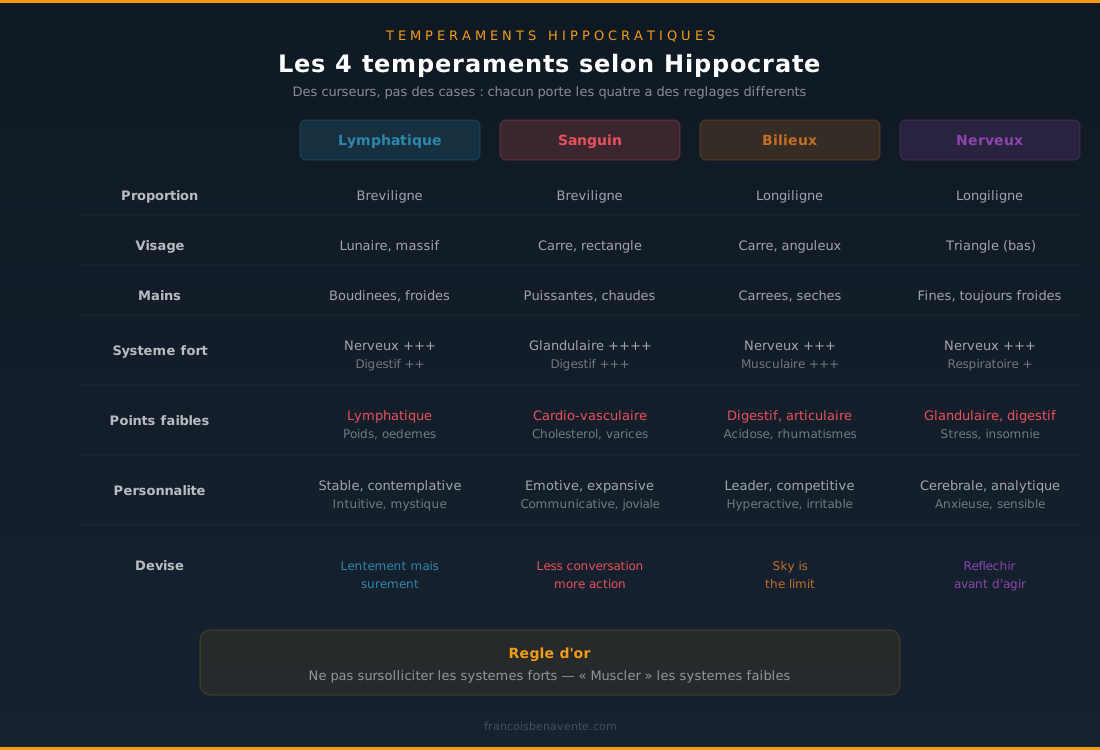
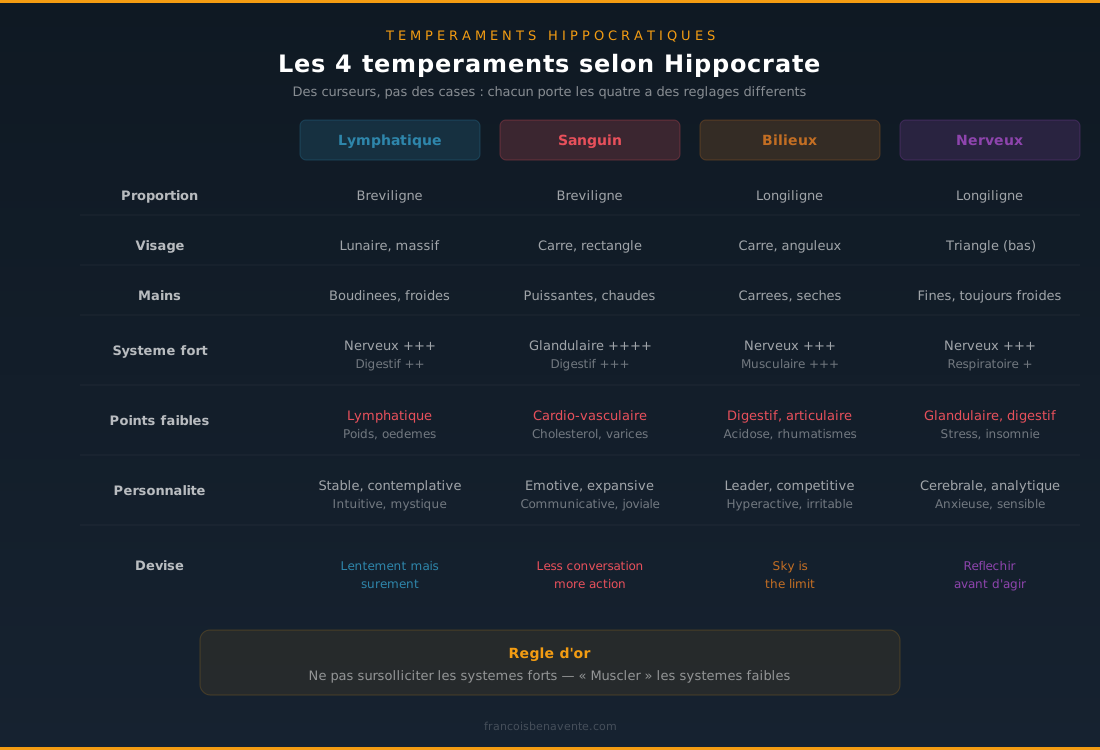
Hippocrates’ other major contribution to naturopathy is the four temperaments. This classification, enriched and systematized by Galen and then taken up again by Marchesseau, remains a fundamental tool of naturopathic consultation. Understand this well: temperaments are not boxes in which to confine you. They are cursors, dominant tendencies, grids of reading that help the practitioner personalize his advice.
The lymphatic temperament
The lymphatic person is a brevilign, meaning they tend toward round forms, drooping shoulders, a lunar face, soft and cold flesh. Their dominant humor is phlegm. Their element is water. This is the contemplative, the dreamer, the gentle, the patient one. He digests slowly, moves slowly, reacts slowly. His strong system is the digestive system: he can eat anything and digest everything, at least during the first decades of his life. His weak system is the lymphatic system: slow circulation, water retention, tendency to congestion.
In consultation, the lymphatic person is often the one who comes to see me for fatigue, edema, insidious weight gain, recurrent infections. The golden rule is not to over-solicit his digestive system (which seems strong but will eventually fail if constantly overtaxed) and to strengthen his lymphatic system: gentle but regular physical activity, dry brushing, lymphatic drainage, stimulating plants like butcher’s broom or horse chestnut.
The sanguine temperament
The sanguine is also a brevilign, but this time square, dense, jovial, expressive. Their dominant humor is blood. Their element is air. This is the good liver, the action-taker, the man of action, the sociable one. He has warm skin, a rosy complexion, a firm handshake. His strong system is the glandular system: his hormones work well, his vitality is high, his libido is strong. His weak system is the cardiovascular system: high blood pressure, vascular risk, tendency to blood plethora.
The sanguine is often the one who does not come to consultation because he feels invincible. When he comes, it is often too late: a cardiovascular accident, type 2 diabetes, gout. The naturopathic strategy for the sanguine is to channel his energy without bridling it: intense physical exercise (he needs it), decongesting diet, hypotensive plants like hawthorn or olive, and above all, learning to slow down, to meditate, to cultivate the inner calm he does not have spontaneously.
The bilious temperament
The bilious person is a longilign, angular, dry, muscular, nervous. Their dominant humor is yellow bile. Their element is fire. This is the leader, the decision-maker, the competitor, the perfectionist. He has a bony face, square jaws, a piercing gaze. His strong system is the musculoskeletal system: he is hardy, resistant, capable of sustained effort. His weak system is the osteo-articular system: early arthritis, tendinitis, rheumatism.
The bilious person comes to see me for joint pain, hepatic disorders, irritability, insomnia. He eats quickly, he works too much, he does not listen to himself. The strategy is to calm the fire: anti-acid diet, hepato-protective plants like milk thistle or desmodium, stretching exercises, and above all, learning to delegate, to let go, to accept that not everything depends on him. The bilious person should also spare his joints: avoid impact sports, favor swimming, yoga, tai chi.
The nervous temperament
The nervous person is a slender longilign, triangular (narrow shoulders, wide pelvis in women, or vice versa), cold, dry, cerebral. Their dominant humor is black bile (atrabile). Their element is earth. This is the intellectual, the artist, the thinker, the introvert. His strong system is the nervous system: he thinks quickly, analyzes finely, perceives the subtleties that others miss. His weak system is his hormonal and immune system: thyroid fragility, tendency to infections, nervous fatigue.
The nervous person is my most frequent patient. He comes for anxiety, insomnia, functional digestive disorders, chronic fatigue, hypersensitivity. He often has a disorganized microbiota and an unbalanced autonomic nervous system (sympathetic predominance). The strategy is to nourish the nervous system without over-stimulating it: magnesium, B vitamins, omega-3s, adaptogenic plants like ashwagandha or rhodiola, coherent breathing, sophrology. And above all, learning to embody, to inhabit one’s body, to not live only in one’s head. The nervous person must develop his hormetic capacities, his stress resistance, his ability to bounce back.
The golden rule of temperaments
Hippocrates posed a simple and profound rule: do not over-solicit your strong systems, they will eventually fail. Strengthen your weak systems, they will become your allies. This rule is counter-intuitive. We naturally tend to do what we do well, to solicit what works, to ignore what is fragile. The sanguine runs marathons while his heart is already overloaded. The nervous person reads books fourteen hours a day while his nervous system is on the verge of collapse. The bilious person works relentlessly while his joints cry for mercy.
The art of the naturopath is to invert this tendency. It is to tell the sanguine: stop running and come meditate. To tell the nervous person: put down your book and go walk barefoot in the grass. To tell the bilious person: delegate this file and go get a massage. To tell the lymphatic person: get off this couch and move, even gently.
This individualized approach, adapted to the temperament of each patient, is a direct heritage from Hippocrates. And it is fundamental in naturopathy. There is no universal diet, no standard program, no single protocol that suits everyone. What heals the lymphatic can worsen the bilious. What calms the nervous can put the sanguine to sleep. Personalization is the key. And this key, it is Hippocrates who gave it to us.
From Hippocrates to Marchesseau: the lineage
Hippocrates dies around 377 BC, after having taught his whole life, healed his whole life, written his whole life. His work crosses the centuries. Galen takes it up in Rome and systematizes it. Arab physicians translate it and enrich it. The School of Salerno preserves it in the Middle Ages. And in the twentieth century, Pierre-Valentin Marchesseau, the founder of French naturopathy, accomplishes a decisive gesture: he takes the five Hippocratic pillars, articulates them with the German hygienic traditions of Kneipp and Lindlahr, and builds naturopathy as we practice it today.
The five pillars of Hippocrates become the five basic concepts taught in all naturopathy schools. The four temperaments become a systematic consultation tool. The Vis Medicatrix Naturae becomes the founding principle. Causalism becomes the method. Humoralism becomes the theory of terrain. Everything is there, from twenty-five centuries ago.
What Hippocrates still tells us
What strikes me most about Hippocrates is the modernity of his thinking. When he says “let your food be your first medicine,” he anticipates nutritional therapy by twenty-five centuries. When he says “seek the cause of the cause of the cause,” he anticipates functional medicine. When he says “primum non nocere” (first do no harm), he anticipates current debates on medical iatrogenesis. When he says “man must harmonize body and mind,” he anticipates psychoneuroimmunology.
And above all, when he distinguishes four temperaments and four humors, when he personalizes each treatment based on the patient and not the disease, he anticipates what precision medicine promises today with billions of dollars in genomic research. Hippocrates practiced personalized medicine with his eyes, his hands, and his clinical intelligence. He did not need DNA sequencing to know that a lymphatic person is not treated like a bilious person.
“Life is short, art is long, opportunity fleeting, experience deceptive, judgment difficult.” Hippocrates
This phrase, the first aphorism of the Corpus, sums up everything. Medical art is long to master. Experience alone is not enough, it can deceive. Judgment is difficult, it requires humility and reflection. And the opportunity to heal is fleeting, it only presents itself to those who know how to seize it. Twenty-five centuries later, these words still resound in every consultation, in every training, in every reflection of the naturopath who seeks, with sincerity, to help his fellow man regain health.
To go further
- Hippocrates: 15 lessons from the father of natural medicine
- Lindlahr: catharsis and Nature Cure, pillars of American naturopathy
- Pythagoras: the 4 bodies and harmony, foundation of naturopathy
- Ann Wigmore: sprouting and living food in naturopathy
Healthy recipe: Tomato-basil gazpacho: Hippocrates said: let your food be your medicine.


Laisser un commentaire
Sois le premier à commenter cet article.