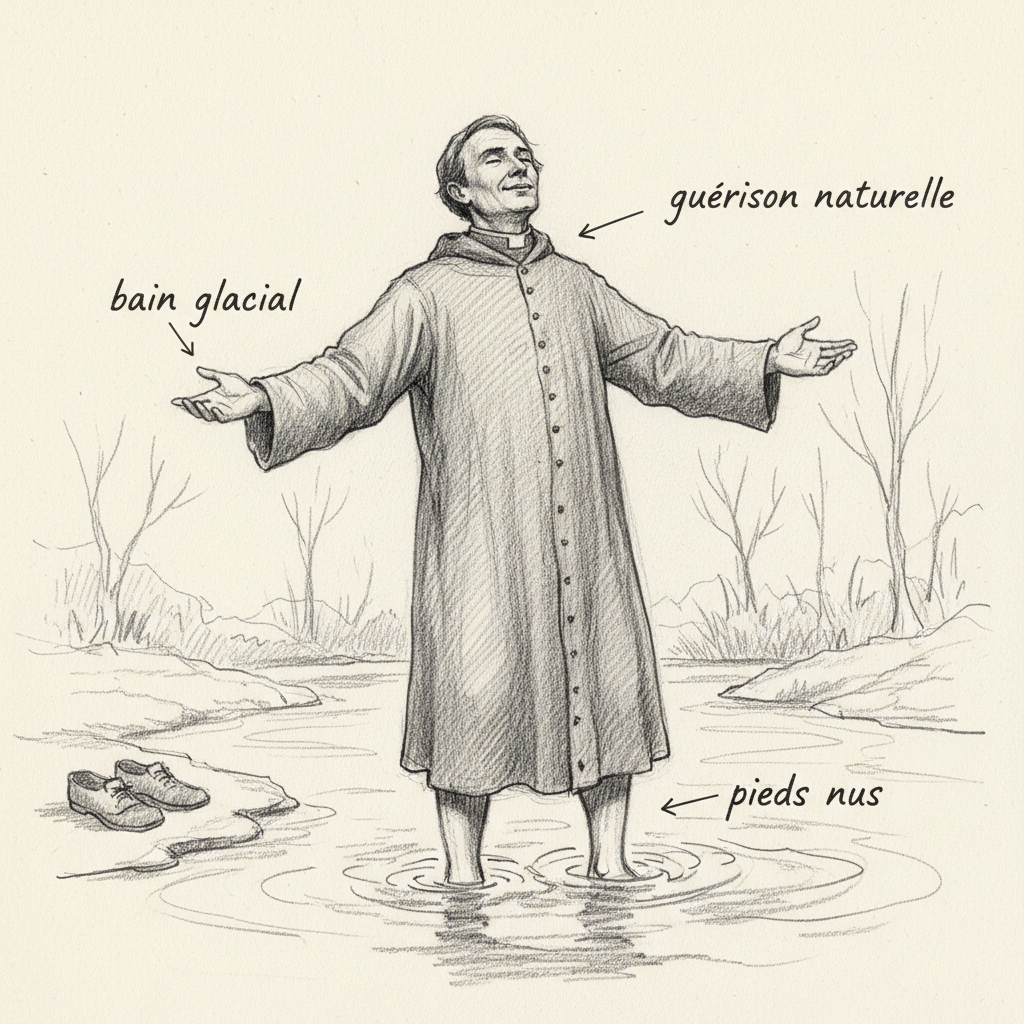
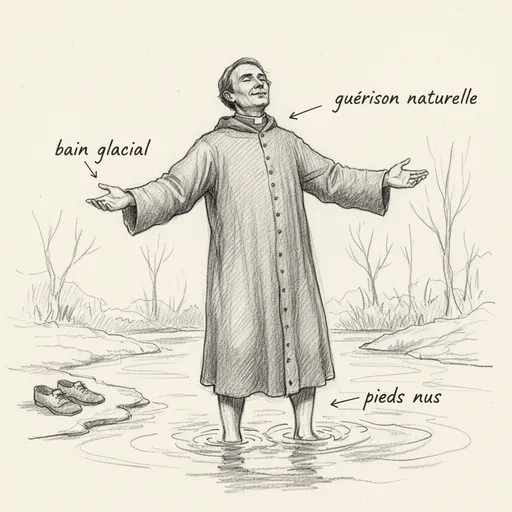
Winter 1849. Night falls on Bavaria. A fasting young man of twenty-eight, emaciated, feverish, his lungs devoured by tuberculosis, undresses on the banks of the Danube. The air temperature is well below zero. The river carries chunks of ice. The doctors have condemned him. Tuberculosis at this time is a death sentence. But this young man has read a book, an old treatise by Johann Siegmund Hahn on the virtues of cold water, and he has decided to attempt the impossible. He enters the icy water. He stays there for a few minutes. He gets out, does not dry off, puts his clothes back on directly over his wet skin, and walks home through the night. He will do it again three times a week, throughout the winter. By spring, the fever has subsided. By summer, he coughs less. By the following autumn, he is cured. This man’s name is Sebastian Kneipp. And this bath in the frozen Danube will change the history of natural medicine.
“The colder the water, the warmer it is.” Sebastian Kneipp
This paradoxical phrase sums up Kneipp’s entire philosophy. It is also, without his knowing it, the most elegant formulation of the concept of hormesis: that fundamental biological principle according to which moderate and progressive stress strengthens the organism instead of weakening it. Cold does not cure because it destroys disease. It cures because it awakens vital force, because it forces the body to mobilize its adaptive resources, because it reignites the inner fire. The colder the water, the warmer it is, because the body responds to cold by producing heat, by activating circulation, by stimulating the immune system, by releasing endorphins. What could kill makes you stronger, provided it is administered progressively, intelligently, with method.
The weaver’s son
To understand Kneipp, you must understand where he comes from. Sebastian Kneipp was born on May 17, 1821 in Stephansried, a small village in Bavaria, in a family of poor weavers. Very poor. His father, Xaver Kneipp, weaves sheets to barely feed his family. Young Sebastian grows up in cold, hunger, and manual labor. But he has an ambition that devours everything else: he wants to become a priest. At that time, for the son of a weaver, the priesthood is the only way to access education, books, an intellectual life. But studies are expensive, and the family doesn’t have a penny.
Kneipp works as a laborer, as a valet, as a farm boy, saving penny after penny. He finally begins the seminary at age twenty-three, much later than his peers. But his body betrays him. Years of deprivation, overwork, and unsanitary living conditions have taken their toll. Tuberculosis sets in. First a persistent cough, then coughing up blood, then a fever that never leaves him. The doctors are clear: he will not finish his studies. He will never be a priest.
It is then that he comes across a small forgotten book in a Munich library. The work of Johann Siegmund Hahn, an eighteenth-century Saxon physician, titled “On the Virtue of Cold Water for Internal and External Use.” Hahn describes the therapeutic effects of cold water on chronic diseases. Kneipp reads, rereads, and decides to put into practice what he has just discovered. Not out of scientific conviction—he is not a doctor—but out of desperation. When you have nothing left to lose, you are ready to try anything.
The Danube: the cradle of modern hydrotherapy
The protocol Kneipp imposes on himself is brutally shaking. Three immersions per week in the Danube, in the depths of Bavarian winter, at temperatures regularly dropping below zero. He does not merely dip his feet. He enters the water up to his chest. He stays there for two to three minutes. Then he gets out, does not dry off (a crucial detail: natural drying prolongs the vasoconstrictor-vasodilator effect), and walks home in the cold.
The first weeks are atrocious. His body protests. The fever rises after each bath. But Kneipp perseveres. He observes that the post-bath fever is different from tuberculous fever. It is a reactive, dynamic, short fever, which leaves him strangely stronger afterward. He has put his finger, without knowing it, on the fundamental difference between pathological inflammation (which destroys) and reactive inflammation (which repairs). This distinction is at the heart of modern naturopathy and what we teach in the foundations of naturopathy.
After a few months, tuberculosis symptoms begin to recede. After a year, Kneipp is in remission. He completes his studies and is ordained a priest in 1852. He is assigned to the parish of Worishofen, Bavaria, where he will remain until the end of his life. But the priest has not forgotten his bath in the Danube. And he will devote the next forty-five years to transforming this personal experience into a complete therapeutic method.
From personal healing to universal method
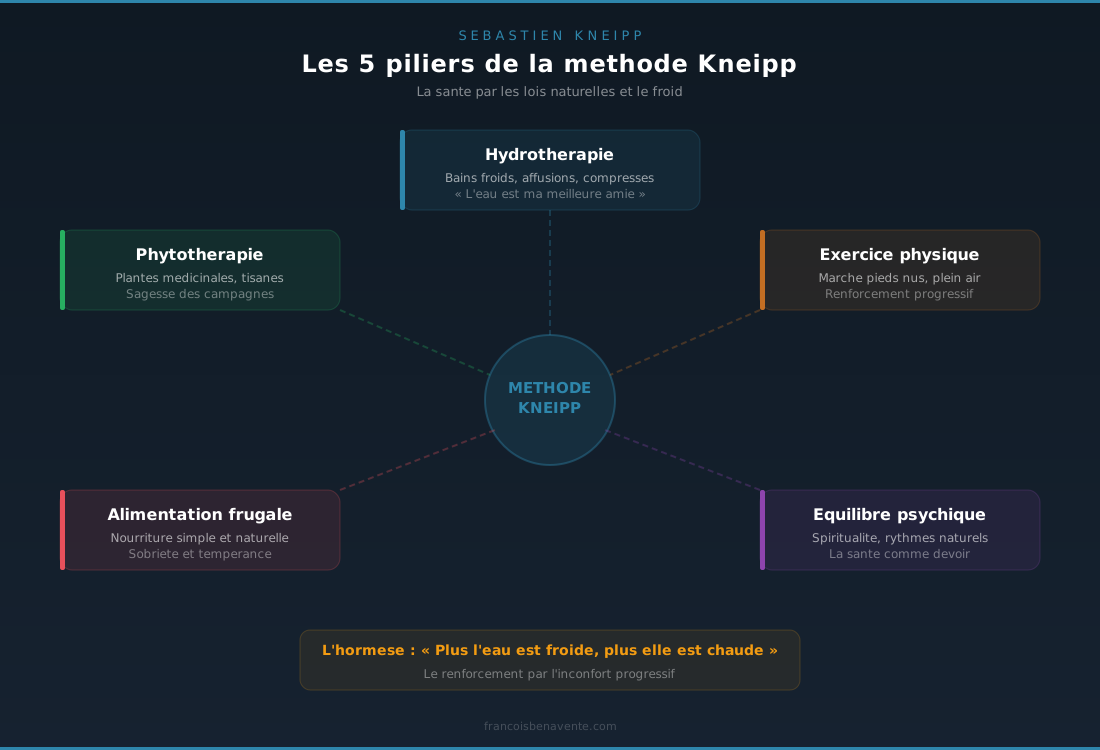
Kneipp does not merely take cold baths. He observes, he experiments, he systematizes. He understands that cold water is not the only tool. It is the most powerful, but it must be combined with other elements to become a true therapeutic method. Gradually, he develops a complete system based on five pillars.
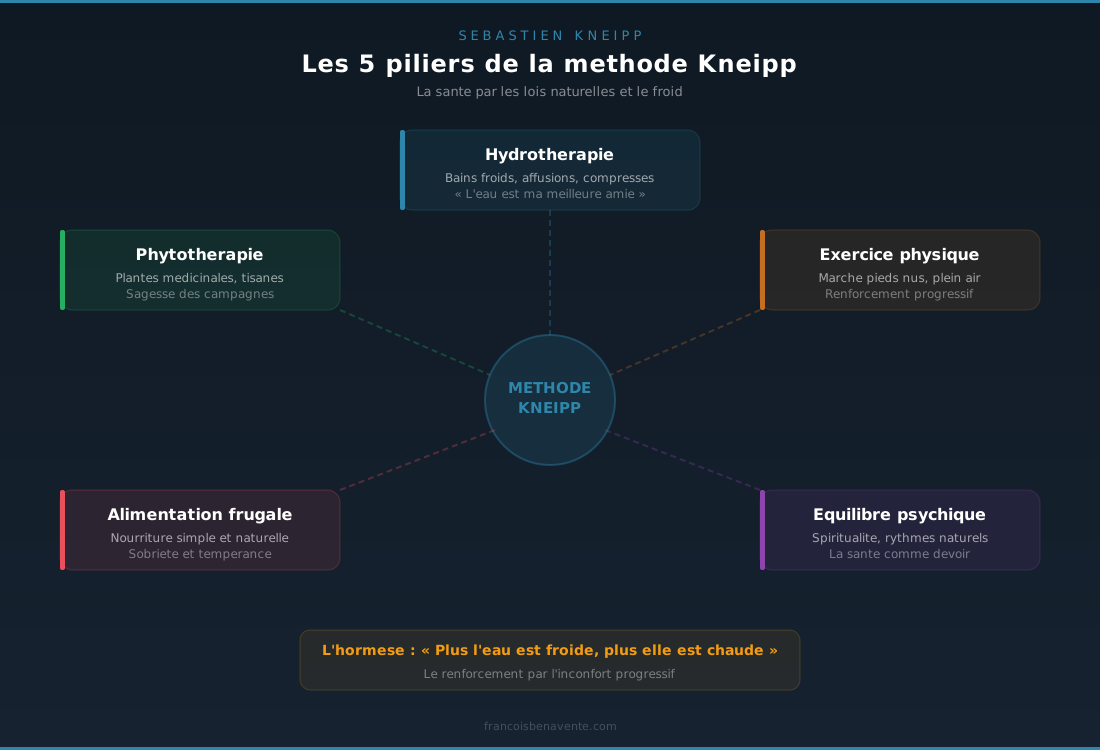
Hydrotherapy
The first pillar, the most famous, is hydrotherapy. And Kneipp does not limit himself to cold baths. He develops a therapeutic arsenal of remarkable richness. Compresses first: warm ones to drain, cold ones to invigorate, alternating ones to stimulate circulation. Baths next: foot baths, arm baths, sitz baths, full baths, hot, cold, lukewarm, alternating. Affusions: jets of water directed at specific areas of the body, along the spine, on the calves, on the nape of the neck, with almost surgical precision. Steam: local or general steam baths to open the eliminatory channels and promote elimination. Lotions: applications of cold water with cloth on the skin. Wrapping: the patient is wrapped in cold wet sheets, then in dry blankets, which causes intense reactive vasodilation. And finally, drinking: Kneipp prescribes water as a therapeutic drink, with precise quantities and temperatures.
What is fascinating is Kneipp’s precision. He does not say “take a cold bath.” He says: water temperature between 8 and 12 degrees, duration of two to four minutes, never on an empty stomach, always in the morning, followed by a twenty-minute walk. He distinguishes between tonic applications (which stimulate and strengthen) and calming applications (which soothe and drain). He adapts each prescription to the patient’s temperament, age, constitution, and illness. It is personalized medicine before the fact, in the pure Hippocratic tradition.
Phytotherapy
The second pillar is phytotherapy. Kneipp has a remarkable knowledge of medicinal plants in his region. He uses horsetail for the kidneys, thyme for the lungs, chamomile for digestion, St. John’s wort for the nerves, fenugreek for nutrition, valerian for sleep. He prepares herbal teas, decoctions, poultices, oils. He never prescribes a plant alone, but always in combination with hydrotherapy and the other pillars. The plant accompanies water treatment; it does not replace it.
Physical exercise
The third pillar is physical exercise. Kneipp is an tireless walker. He walks kilometers each day, summer and winter. And he prescribes walking to all his patients, insisting on a detail that made him famous: barefoot walking. Barefoot in the morning dew. Barefoot in wet grass. Barefoot in fresh snow. Barefoot on stream pebbles. This barefoot walking is not a whim. It stimulates the arch of the foot, activates reflex zones of the foot, improves venous return, and above all, it exposes the body to moderate and progressive hormetic stress that strengthens the immune system.
Modern science actually confirms what Kneipp observed empirically. Cold exposure activates brown fat (brown adipose tissue), stimulates noradrenaline production, improves insulin sensitivity, strengthens innate immunity, and increases white blood cell production. The work of Wim Hof, the famous Dutch “ice man,” merely confirms with modern tools what a Bavarian priest discovered in the frozen Danube one hundred fifty years ago.
Frugal eating
The fourth pillar is eating. Kneipp does not prescribe a sophisticated diet. He prescribes frugality. Eat little, eat simple, eat local and seasonal foods. Whole wheat bread, vegetables from the garden, fruits, cereals, fresh milk. Not excessive meat, no sweets, no alcohol except a bit of beer—we are in Bavaria after all. Kneippian eating is peasant eating: rustic, nourishing, unprocessed. It is exactly what modern naturopathy recommends: return to simple eating, nutrient-dense, poor in processed products.
Psychic balance
The fifth pillar, often forgotten when discussing Kneipp, is psychic and spiritual balance. Kneipp is a priest. He knows the human soul. He knows that the body does not heal if the spirit is sick. He prescribes prayer, meditation, community life, manual work, contact with nature, moments of silence. He insists on the importance of confidence, faith in healing, hope. Not as vague feelings, but as therapeutic forces in their own right. Modern psychoneuroimmunology proves him right: psychic state directly influences the immune system, healing capacity, stress resistance.
Hormesis: the concept that ties it all together
If I had to sum up Kneipp’s philosophy in a single word, it would be: hormesis. Hormesis, from the Greek hormaein (to set in motion, to stimulate), is that biological principle according to which a moderate dose of a stressful agent provokes a beneficial adaptive response, while an excessive dose of the same agent would be harmful. It is the inverted U-curve: a little stress makes you stronger; too much stress destroys.
Cold water is the quintessential hormetic agent. When you enter water at ten degrees, your body undergoes shock. Peripheral vasoconstriction is immediate: blood vessels contract, blood flows back toward vital organs, blood pressure rises, heart rate accelerates, the adrenal glands release adrenaline and noradrenaline. It is acute stress reaction, survival mode. But a few minutes later, when you exit the water, the opposite occurs: massive vasodilation, an influx of warm blood toward the periphery, an intense sensation of heat, endorphin release, activation of natural killer (NK) cells, stimulation of the thyroid, production of heat shock proteins.
It is this vasoconstriction-vasodilation alternation that is therapeutic. It “exercises” the vascular system, it trains the autonomic nervous system to shift from sympathetic to parasympathetic, it teaches the body to respond to stress without collapsing. Kneipp formulated it with this brilliant intuition: “The colder the water, the warmer it is.” Because the reactive heat produced by the body after cold is greater than what you would get from a warm bath. Cold ignites an inner fire that warmth does not ignite.
This concept of hormesis also extends far beyond hydrotherapy. Intermittent fasting is hormetic: moderate food deprivation activates cellular repair pathways (autophagy) and strengthens metabolism. Physical exercise is hormetic: muscle stress causes an adaptation that makes muscle stronger. Sun exposure is hormetic: a moderate dose of UV rays stimulates vitamin D production and activates cutaneous immune defenses. Even certain plant molecules are hormetic: grape polyphenols, turmeric curcumin, broccoli glucosinolates are slight plant “poisons” that trigger protective responses in our cells. Kneipp understood the principle with cold water. Modern science has generalized it to all living things.
Two paths: weakening or strengthening
Kneipp distinguished two possible paths for every human being. The first path, that of weakening, is the path of non-health. It is what happens when you excessively protect your body, when you avoid all stress, all cold exposure, all effort, all constraint. You think you are protecting yourself, but in reality, you are weakening yourself. Your body loses its adaptive capacities, like a muscle that atrophies from lack of use. Your vessels become rigid because they are no longer trained by warm-cold alternation. Your immune system falls asleep because it is no longer stimulated. Your adrenal glands become exhausted because they no longer know how to manage stress. It is the path of permanent comfort, and it paradoxically leads to fragility.
The second path, that of strengthening, is the path of health. It is what happens when you progressively expose your body to controlled stresses, when you train it, when you stimulate it. A cold foot bath in the morning, barefoot walking in grass, periodic fasting, regular physical exercise, sun exposure without excess. Each of these practices is a small challenge, a small stress, that forces your body to adapt, to strengthen, to build reserves. It is the path of chosen discomfort, and it leads to robustness.
In consultation, I constantly see patients on the first path without knowing it. They live in overheated apartments, never go outside without three layers of clothing, eat warm food at every meal, take burning hot baths in the evening, and are surprised to be constantly sick, cold, tired. Their internal thermostat has malfunctioned because it is no longer solicited. And the solution is not to plunge into a frozen lake tomorrow morning. The solution is progressivity. It is the key word of any hormetic approach. Start by finishing your shower with fifteen seconds of cool water, not cold, cool. Then thirty seconds. Then a minute. Then lower the temperature by one degree. Then by two. Week after week, month after month, the body adapts, strengthens, regains its capacities.
The cure: the word that sums it all up
Do you know why, in naturopathy, we speak of a “cure”? Why we say detoxification cure, revitalization cure, stabilization cure? This vocabulary comes directly from Kneipp and the German hydrotherapic tradition. In the Kuranstalt, the German spa establishments, patients came to follow a hydrotherapy program for several weeks. They were bathed, wrapped, showered, friction-rubbed, made to walk barefoot, fed simply. It was a cure. And this word has remained in naturopathic vocabulary to designate any structured therapeutic program.
Hydrotherapy is one of the three major techniques in naturopathy, along with eating and physical exercise. It is the foundation, the founding tripod. And when we say “no cure, no naturo,” we recall that hydrotherapy is not optional, a complement, a pleasant bonus. It is a pillar. Without hydrotherapy, naturopathy loses one of its deepest roots. It is like wanting to make music without rhythm, or cuisine without fire. Cold is the naturopath’s fire.
From Kneipp to Benedict Lust: the birth of naturopathy
Kneipp’s impact extends far beyond Bavaria. From the 1880s onward, thousands of people flock to Worishofen to follow the cures of the healing priest. Kings, princes, intellectuals, workers, peasants. Kneipp heals everyone, without distinction of rank or fortune. His reputation crosses borders.
Among these thousands of patients, a young man will play a decisive role in the history of natural medicine. His name is Benedict Lust. He was born in Germany in 1872, emigrated to the United States, and returned to Europe to be treated for tuberculosis by the Kneipp method. Healed, transformed, converted, Lust returns to the United States with a mission: to spread Kneipp’s teachings across the Atlantic. In 1901, he founds the first natural medicine establishment in New York, then the first naturopathy school in the world, the American School of Naturopathy. It is Benedict Lust who invents the word “naturopathy,” combining “nature” and the Greek suffix “pathos” (what one feels, suffering). Naturopathy is suffering healed by nature. And its roots are in the frozen Danube.
From Lust, naturopathy crosses the Atlantic in reverse. It returns to Europe, enriched by Germanic hydrotherapic traditions, the discoveries of Lindlahr (another disciple of the Kneippian tradition), and the work of new biology. In France, it is Marchesseau who receives it, makes it French, articulates it with Hippocratic traditions and modern discoveries, and founds the French school of naturopathy in the 1940s. But the spring still flows from the same place: a frozen river in Bavaria, a winter in 1849, and a young man who had nothing left to lose.
What Kneipp still tells us
I end my consultations, sometimes, with very simple advice: “Tomorrow morning, before anything else, finish your shower with fifteen seconds of cool water.” Some patients look at me as if I have lost my mind. Others nod with a smile, because they already know. And those who do it, those who dare this small daily discomfort, almost always come back with the same observation: “I don’t know how to explain it, but I feel more alive.”
That is exactly it. You feel more alive because you are. Cold water awakens vital force; it reignites the inner fire; it sets in motion what was stagnating. It is Kneipp’s message, simple and powerful: health is not in comfort; it is in movement. Movement of water on skin, movement of blood in vessels, movement of barefoot feet on cold ground, movement of life that refuses to sleep.
“Those who do not find a few minutes each day for their health will one day have to devote years to their illness.” Sebastian Kneipp
This sentence is perhaps the most important one in this entire article. A few minutes a day. A cold foot bath. A barefoot walk. A cool shower. A moment of contact with water, with cold, with beneficial discomfort. Kneipp was not asking to plunge into the frozen Danube. He was asking for regularity, constancy, perseverance. A few minutes a day, every day, for life. This is how health is built. Not in a one-time exploit, but in humble, daily discipline, accessible to all. The weaver’s son never forgot his origins. His method was made for simple people, poor people, people without access to expensive thermal cures or renowned doctors. Cold water, plants from the garden, walking, frugality, prayer. Nothing more. And it is sufficient.
After Hippocrates, after Pythagoras, Kneipp completes the founding triptych of naturopathy. Lindlahr will later further structure the principles of the naturopathic cure. But it is the abbot of cold, the priest of Worishofen, the son of the Bavarian weaver, who gave naturopathy its most emblematic tool, the oldest, the most universal: water. Water that washes, that purifies, that stimulates, that heals. Water that, as Kneipp said, is warmer when it is cold.
To go further
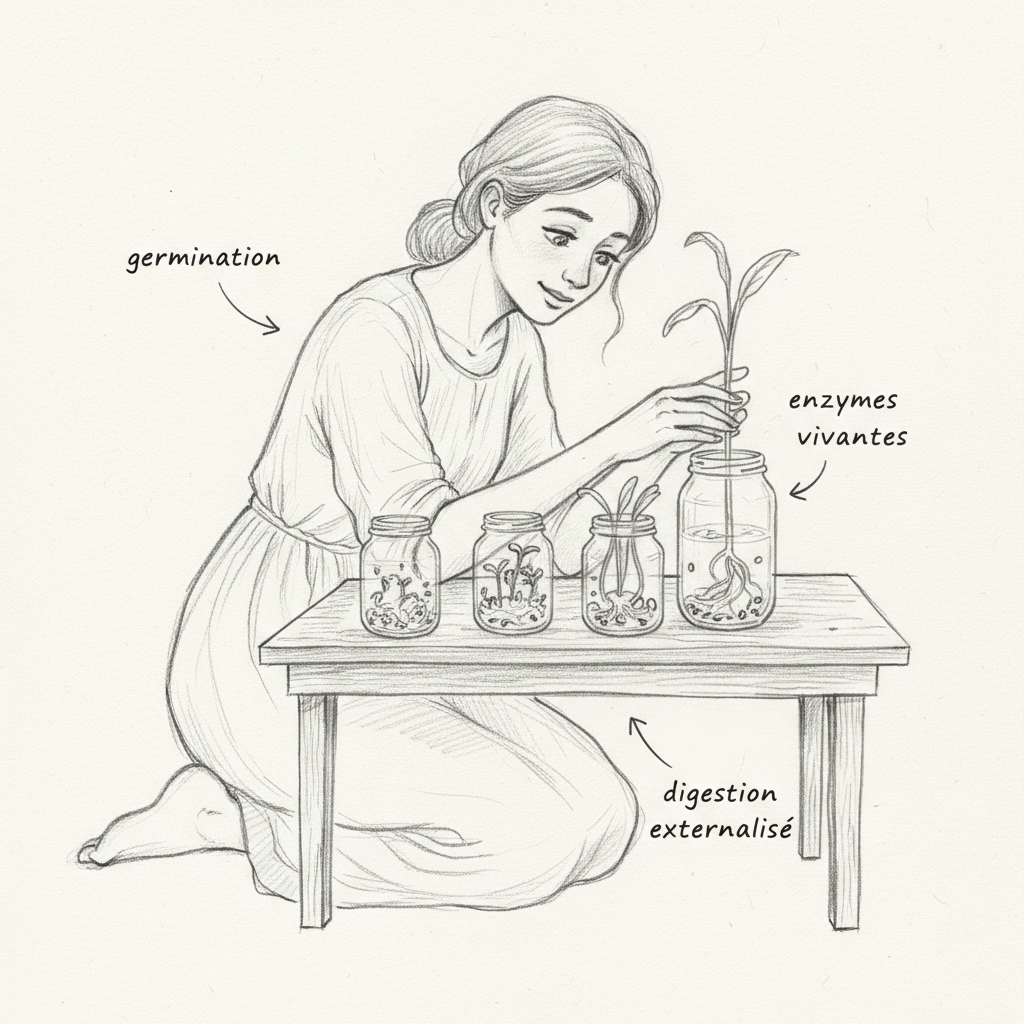
- Ann Wigmore: sprouting and living food in naturopathy
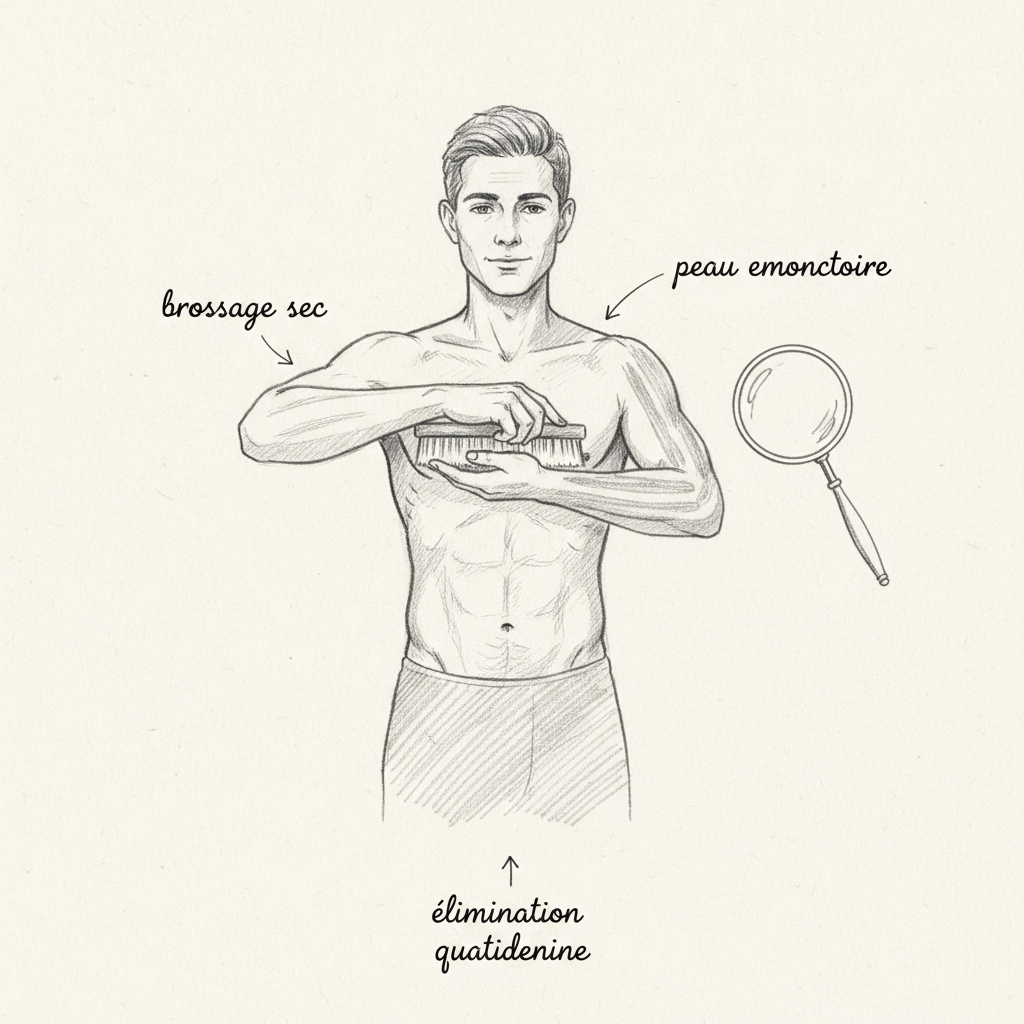
- Bernard Jensen: iridology and dry brushing, skin as an eliminatory channel
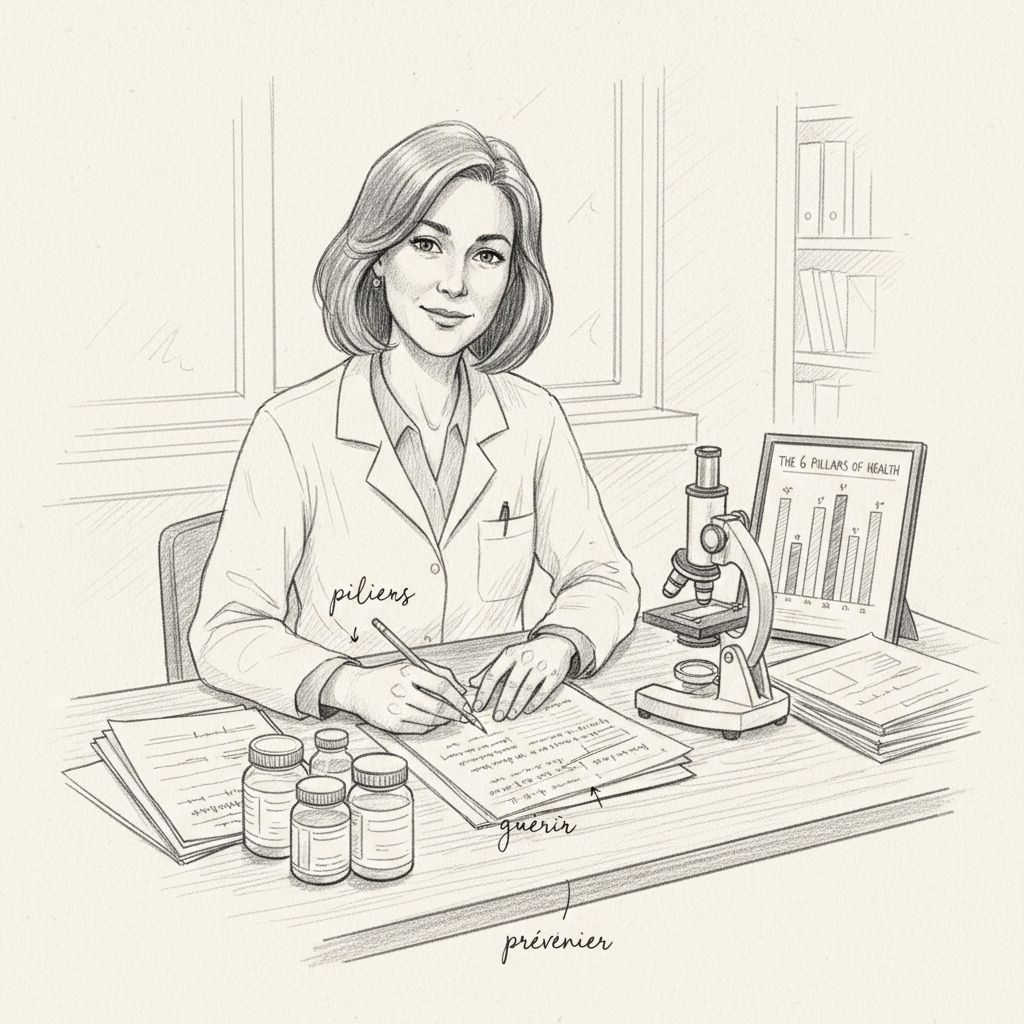
- Kousmine: the 6 pillars and the intestine as motor of disease
- Lindlahr: catharsis and Nature Cure, pillars of American naturopathy
Healthy recipe: Pure celery juice: Kneipp also recommended juice cures.
Laisser un commentaire
Sois le premier à commenter cet article.