In the 19th century, Claude Bernard was the first contemporary to demonstrate the importance of the cell’s environment as a determining factor for its proper functioning. What he called the “internal environment” became the founding concept of all naturopathy: the terrain. Each cell in your body is bathed in a fluid fed by the blood and drained by the lymph. The quality of this fluid depends on three things: the dynamics of circulation (physical activity, hydration), the nature of dietary intake, and the quality of elimination through your emunctories (liver-intestines, kidneys, lungs, skin). When this environment becomes clogged, the cell suffers. When it purifies, the cell thrives. And this is precisely where cold-pressed vegetable juice comes in.
As Paul Carton said back in 1923: “Public health depends above all on the diet followed by the community. The ills that decimate humanity have their primary source in poorly chosen food and drink.” For the past century, three researchers have laid the scientific foundations for this vitalist intuition. Their work, which I teach at Naturaneo, all converge toward the same conclusion: fresh cold-pressed vegetable juice is one of the most powerful tools for correcting the terrain.
Bioelectronic terrain: measuring the invisible
It took Louis-Claude Vincent, a French hydraulic engineer, to give a physicochemical definition of this internal environment. For twelve years, Vincent traveled through more than 400 French communes as a consulting engineer, amassing statistics on mortality and the chemical properties of water. His discovery is staggering: mortality from serious diseases is directly linked to the quality of water delivered to populations. Water that is too mineralized (dry residue exceeding 50 mg/L), too oxidized (stagnant water exposed to oxygen), or too alkalized by chemical treatments (chlorine, aluminum) correlates with a significant increase in civilization diseases. Lille, Mulhouse, Tourcoing, Roubaix: Vincent was able to name the diseased cities and explain why.
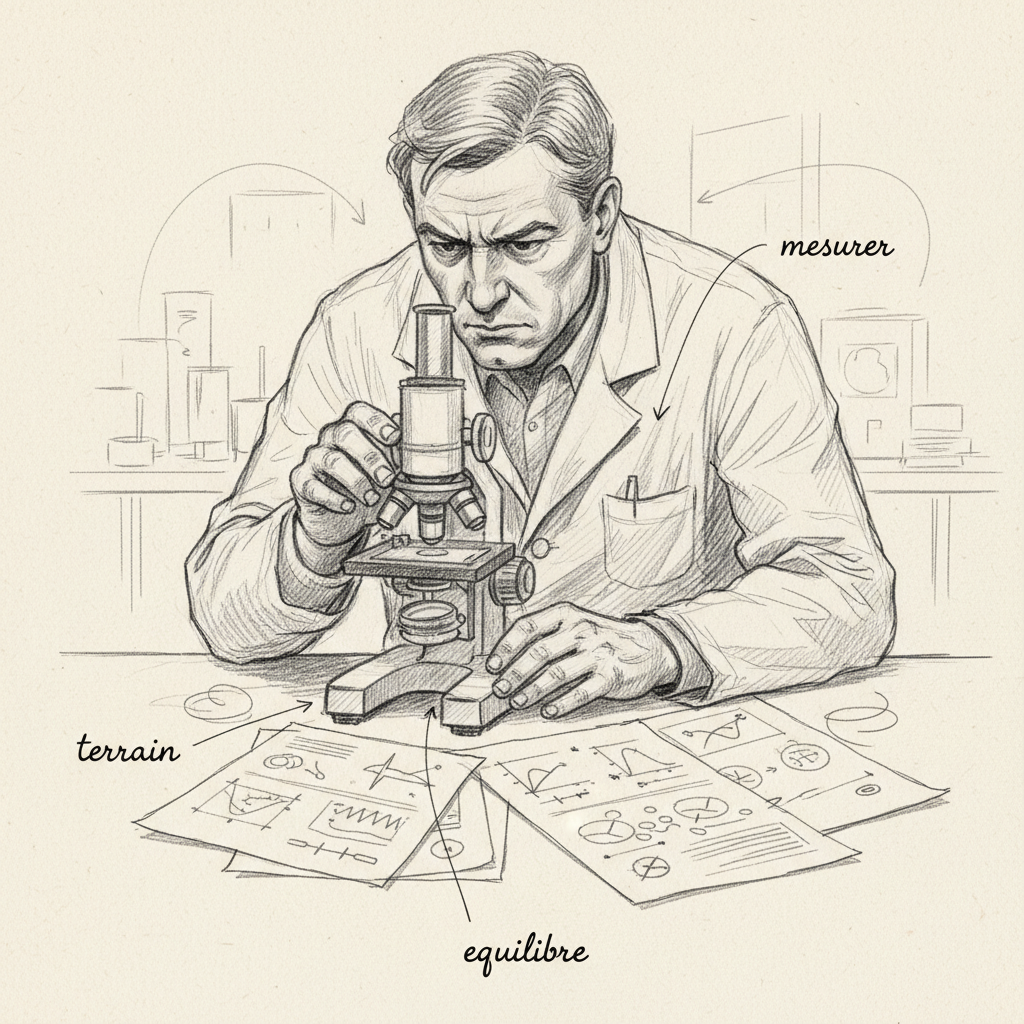
In 1948, he created a new science: electronic biology. With Dr. Jeanne Rousseau, he founded the Bioelectronic Research Center in Avrillé in 1961. Three measurable factors in three liquids (blood, urine, saliva: nine measurements total) are sufficient to define the terrain of a living being. pH measures the magnetic potential, the ionization factor. rH2 measures the electrical potential, the regulatory capacity of the environment, its degree of oxidation or reduction. Rô, the resistivity, measures the ability of electromagnetic information to circulate in the organism. As Vincent himself said: “Everywhere must be imposed what maintains life, that is to say what is acidic, reducing, and poorly mineralized. In these bioelectronic values is contained all the supreme law of hygiene and health.”
The health zone is located in the center of Vincent’s diagram. The closer you get to it, the greater your chances of aging well. And here is the crucial point: bioelectronics confirms the value of living plants as the basis of human food. The digestive tract normally constitutes an acidic and reducing environment. To respect this bioelectronic characteristic, you must limit foods, beverages, and synthetic molecules that promote alkalization and oxidation of this environment. These alterations favor putrefaction (bloating, gas), proliferation of parasites, and intestinal dysbiosis. Fresh vegetable juices are explicitly listed among the beverages that Vincent classifies as terrain correctors, alongside pure, low-mineralized water, herbal infusions, and lacto-fermented drinks (kefir, kombucha, kvass).
Vincent also demonstrated the impact of agriculture on terrain. By comparing an industrial strawberry (chemical fertilizers) and an organic strawberry (composting), he showed that the industrial strawberry presented chaotic cellular growth. Chemical analysis revealed a disproportionate increase in potassium against an almost total disappearance of magnesium, giving it bioelectronic properties that are acidic, oxidized, and devoid of minerals. Making it a “fruit” opposite to its natural properties. The Rungis strawberry and your organic farmer’s strawberry have nothing in common. Vincent summed it up this way: “Water is more important for what it carries away than for what it brings.”
Living food: when food radiates
André Simoneton, a French engineer from the early 20th century, spent more than 25 years measuring what he called the “radio-vitality of foods.” His theory starts from a principle that changes everything: everything composed of cells emits a measurable micro-radiation in angstroms. Through his research, he establishes a classification of foods based on their vibrational frequency. Raw fruits, vegetables, and sprouted seeds, picked and prepared under natural conditions, reach frequencies exceeding 9,000 angstroms: the optimal zone. Whole grains and lightly processed products oscillate between 7,000 and 9,000 angstroms. Cooked meats, refined foods, and industrial products frequently fall below 6,000 angstroms, a threshold he associated with loss of vital energy and increased toxemic load. The vitality scale of the human being would be between 6,200 and 7,200 angstroms. In other words, a food whose frequency falls below this threshold pulls your vitality downward instead of supporting it.
Concretely, the dietitian will tell you that a salad is a salad and that organic is better. The vitalist who has read Simoneton will tell you that a salad should be picked and eaten within an hour. That this same salad is a freshly picked medicinal food and a devitalizing food if it has spent five days on a shelf. A diet made of products that have spent too much time off the ground is a bit like a fire that you water with a ladle: it burns but gradually loses intensity. Simoneton also insisted on the importance of time and storage methods. The further a food moves from its natural state and place of origin, the more its vibrational frequency decreases. Prolonged transport, cold storage, refining processes deteriorate this subtle quality, to the point of rendering certain products nutritionally rich but biologically inert.
This vision, long marginalized, found an echo in modern bioelectromagnetism. In the 1970s, German biophysicist Fritz-Albert Popp made a major discovery: living cells permanently emit an ultra-weak light that he called biophotons. These light emissions, located in the visible and ultraviolet spectrum, are not mere byproducts of metabolism: they present a coherence comparable to that of a laser, indicating fine organization of biological activity. Popp demonstrated that DNA is the primary source of these emissions, functioning as a resonant optical system capable of storing and emitting photons. The fresher a food is, the more biophotons it emits. Popp’s work confirms Simoneton: the human organism is not only a biochemical entity but also a coherent system of electromagnetic communication. Drinking a vegetable juice pressed within the hour means introducing into your organism not only micronutrients but also vibrational information, witness to solar energy condensed in the plant structure.
Vegetable juice: cleaner and builder
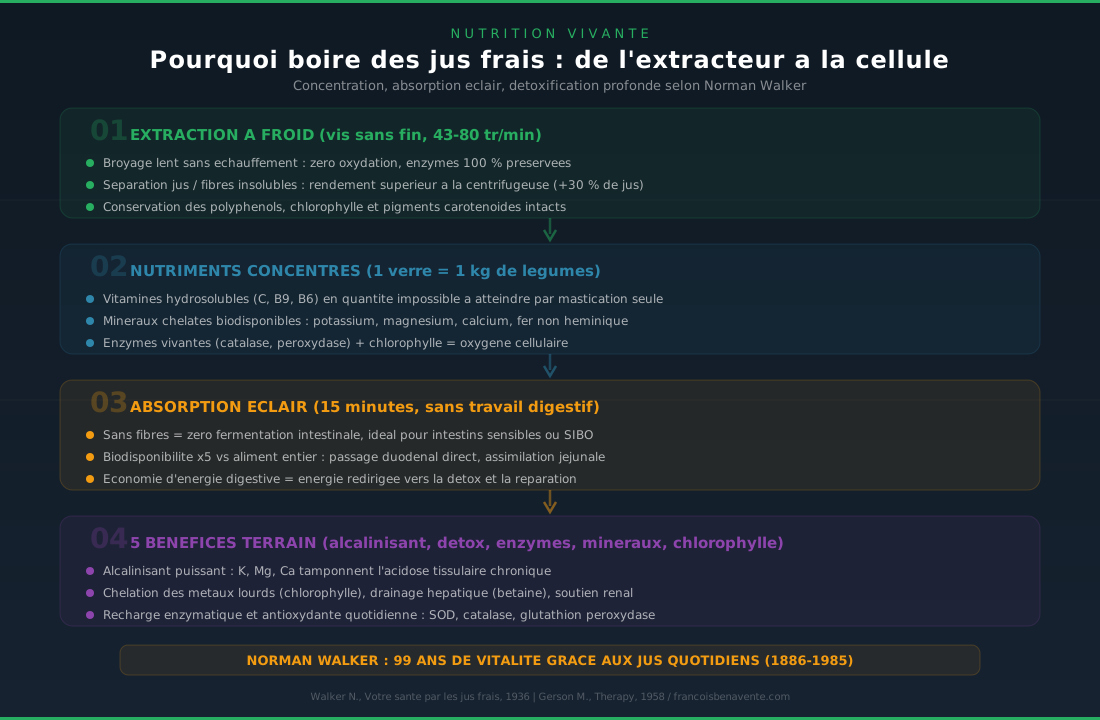
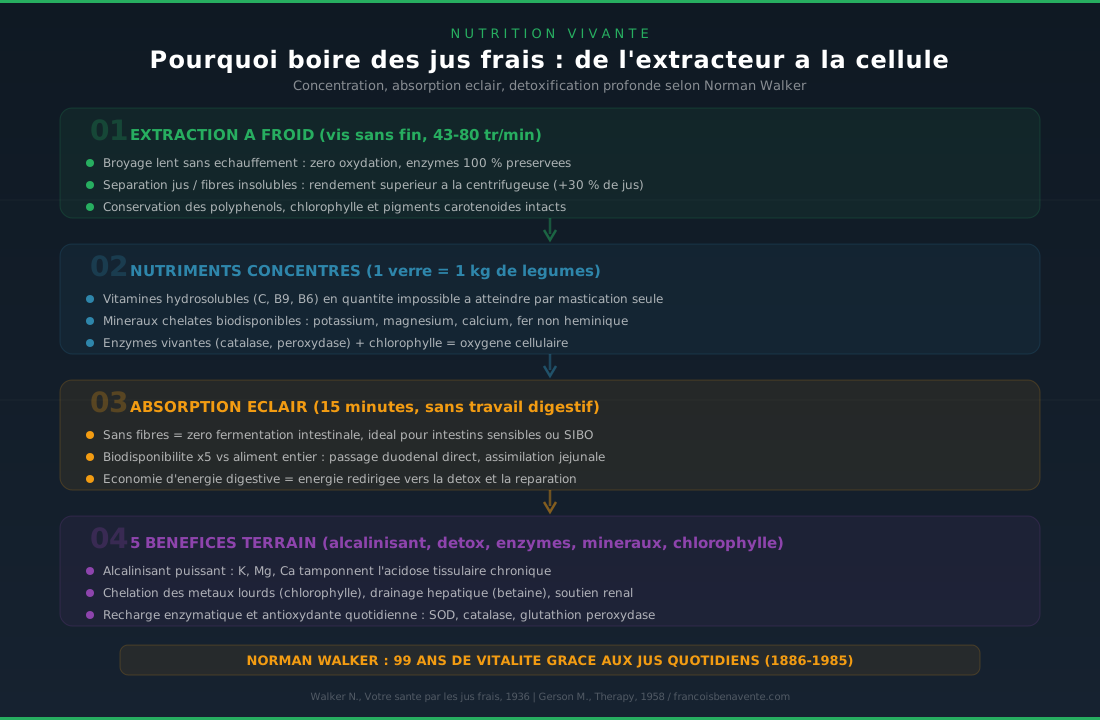
Norman Walker, an American engineer who lived to be a hundred years old, is the pioneer of juice therapy. His journey begins with a serious illness: young, working in London, he develops advanced liver cirrhosis associated with neuritis. Refusing to accept the doctors’ prognosis, he follows the advice of a vegetarian friend: three days of water fasting, then an exclusive diet of raw fruits and vegetables. In six months, no more symptoms. This experience launches him into research that will last his entire life.
It is while staying in a small French village that he makes his founding discovery. Observing a woman peeling carrots in her kitchen, he notices the moisture of the flesh. He grates the carrots, presses them through cloth, and tastes the juice. He finds it “pleasantly invigorating.” Walker had just discovered his elixir of life. He founded the Norwalk Nutritional Chemistry Laboratory in New York in 1910, where he administered fresh juice cures to bedridden patients with unanimous results. Subsequently, the famous Dr. Gerson always kept a Norwalk press in his office.
Walker distinguishes two major categories of juices. Fruit juices are true cellular cleansers: rich in organic acids and enzymes, they dissolve waste, fluidify bodily humors, stimulate emunctories. Vegetable juices are builders and regenerators of the body: rich in organic minerals, chlorophyll, and trace elements, they remineralize, alkalize the terrain, and provide materials for cellular reconstruction. In liquid form, nutrients are absorbed in 15 to 20 minutes without mobilizing the usual digestive resources. Vegetables whose fiber would be too aggressive for delicate intestines can thus return in the glass of the juice user. For Walker, the cornerstone of all healing begins with restoring perfect intestinal health: “Every organ, every gland, every cell of the organism is affected by the condition of the colon.”
Cellular energy: the missing link
Energy production relies on fine interaction between energetic substrates and micronutrients. At the center of this process is the Krebs cycle, a universal metabolic pathway that converts proteins, carbohydrates, and lipids into ATP. This cycle, while robust, depends on precise cofactors: iron, magnesium, potassium, B vitamins (B1, B2, B3, B5, B6, B9, B12), coenzyme Q10, lipoic acid. Without their adequate presence, certain steps slow down or stop, illustrating the law of the limiting factor: the rarest nutrient conditions the efficiency of the entire process.
Mitochondria, the main site of this energy transformation, number approximately 800 units per cell on average, and up to 9,000 in muscle fibers. The quality of their functioning directly influences metabolism, recovery, cognitive function, and digestion. However, cooking at temperatures above 60°C causes partial degradation of B vitamins, limiting their availability. Conversely, raw vegetable juices represent particularly rich sources of these micronutrients in their most bioavailable form.
Magnesium deserves special attention. Involved in more than 300 enzymatic reactions, it is crucial for energy metabolism. Yet, everything that contains chlorophyll contains a magnesium core. Each glass of green juice is therefore a direct source of organic magnesium. Juices also exert a decisive indirect effect on iron: their richness in antioxidants and polyphenols modulates inflammatory mechanisms, limiting the production of hepcidin, the hormone that reduces the availability of circulating iron. By regulating this process, vegetable juices improve iron homeostasis even without being a direct major source of it.
Why the press makes all the difference
There is a fundamental difference between a cold-pressed juice and a centrifuged juice. The centrifuge spins at 10,000 revolutions per minute. This speed generates friction, heat, and massively introduces oxygen into the juice. In bioelectronics, this means your juice is instantly oxidized, pushed toward the devitalizing zone of Vincent’s diagram. Heat-sensitive enzymes are destroyed, vitamins degrade, biophotonic charge collapses. You get a colored, sweet liquid, but biologically impoverished.
The screw press operates at 80 revolutions per minute. No heat, no massive oxidation. The juice retains its active enzymes, intact vitamins, electromagnetic charge. In terms of bioelectronics, cold-pressed juice remains in the reducing zone, the one that sustains life. In terms of Simoneton, it retains its high vibrational frequency. In terms of Walker, it remains a true living food. That is the entire difference between drinking juice and drinking life.
In practice: where to start
If you have never drunk vegetable juice, start with the simplest and most universal: pure carrot juice. This is the foundation of Walker’s therapy, his formula number 1, the one he recommended to all his patients without exception. Rich in beta-carotene, in organic sodium and potassium, mild in taste, it is perfectly tolerated even by the most sensitive intestines. One glass of 35 to 45 cl in the morning on an empty stomach, 20 minutes before breakfast. Observe your reaction for a week, then explore therapeutic combinations: the Potassium formula (carrot, celery, parsley, spinach), the carrot-beet duo for the blood, the carrot-beet-celery trio for the liver, Walker’s citrus juice for immunity.
Three essential rules. First, freshness: a juice should be consumed within 15 minutes of pressing. As Simoneton showed, each minute of waiting decreases the vibrational charge. Second, organic: Vincent demonstrated that industrial fruits and vegetables have inverted bioelectronic properties. Third, consistency: Walker insisted on daily practice. One exceptional juice will change nothing. One juice each morning for three months will transform your terrain.
As Walker summarized it: “Your body is the dwelling in which you live. By analogy, it resembles the building in which you establish your home. Your home requires regular minimal attention on your part. It’s the same for your physical body: every function and activity of your organism, whether daytime, nighttime, physical, mental, or spiritual, depend on the attention you devote to them.” Vegetable juices are this daily attention, simple, measurable, and deeply rooted in the vitalist tradition. Not a trend, not a gadget: a tool for correcting terrain, validated by a hundred years of clinical practice and by the physics of the living.
My recommended press
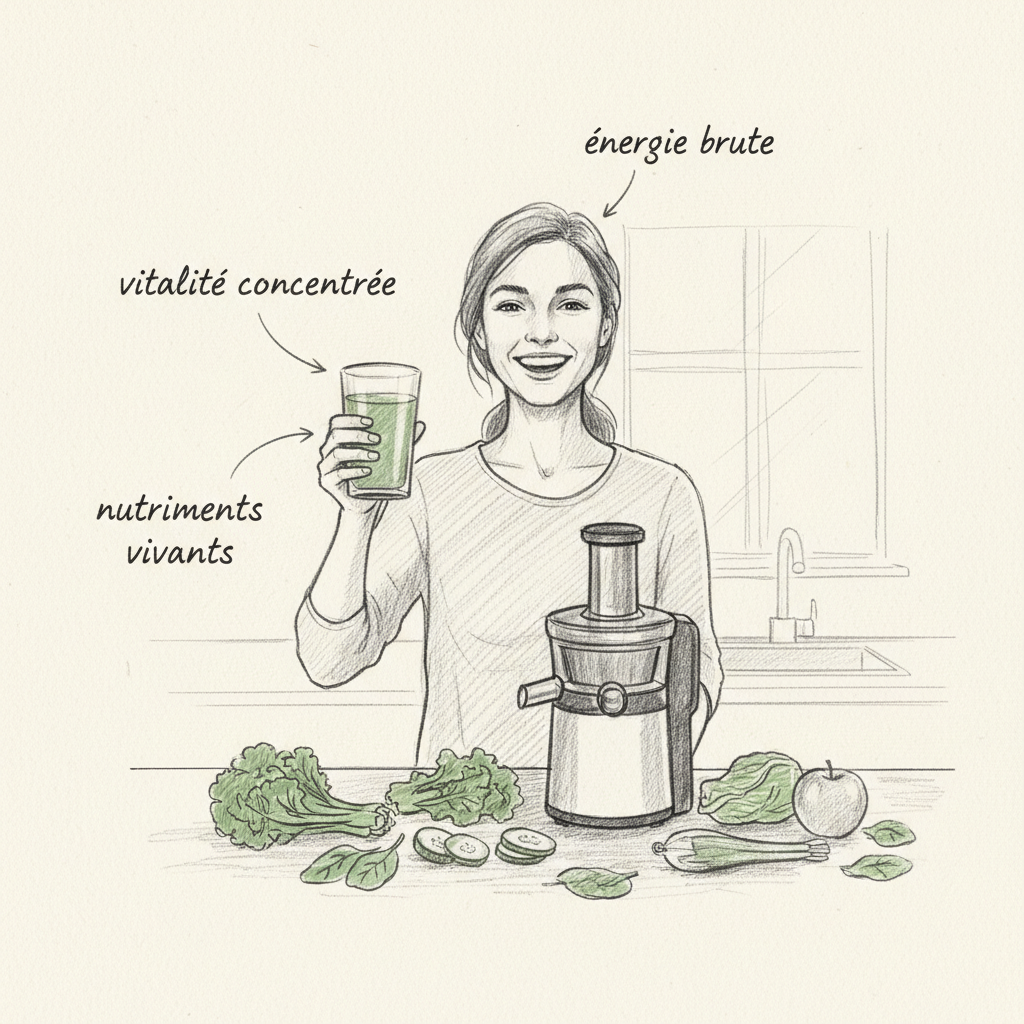
To press therapeutic juices daily, I use the Hurom H310A. Its slow pressing at 80 revolutions per minute preserves the enzymes, vitamins, and biophotonic charge that the centrifuge would destroy. Its compact format makes it easy to install in any kitchen, and its ease of cleaning (less than 2 minutes) makes it a realistic companion for daily practice.
Promo code: francoisbenavente20 for -20% off the entire Hurom site.
Want to assess your status? Take the free vitality toxemia questionnaire in 2 minutes.
To cook healthily, PranaCook offers stainless steel utensils without endocrine disruptors.
Scientific sources
Popp, Fritz-Albert, et al. “Properties of Biophotons and Their Theoretical Implications.” Indian Journal of Experimental Biology 41, no. 5 (2003): 391–402. PubMed 15244259.
Cifra, Michal, and Pavel Pospíšil. “Ultra Weak Photon Emission: A Brief Review.” Journal of Photochemistry and Photobiology B: Biology 139 (2024): 52–68. PMC 10899412.
Aadil, Rana Muhammad, et al. “Effect of Cold-Pressed and Normal Centrifugal Juicing on Quality Attributes of Fresh Juices: Do Cold-Pressed Juices Harbor a Superior Nutritional Quality and Antioxidant Capacity?” Critical Reviews in Food Science and Nutrition 60, no. 18 (2020): 3161–3176. PMC 6587058.
Baik, Hyun Yong, et al. “Comparative Bioavailability of β-Carotene from Raw Carrots and Fresh Carrot Juice in Humans: A Crossover Study.” Nutrition Research and Practice 19, no. 2 (2025): 215–223. PMC 11982686.
Kim, Jung-Yun, et al. “The Effect of Carrot Juice, β-Carotene Supplementation on Lymphocyte DNA Damage, Erythrocyte Antioxidant Enzymes and Plasma Lipid Profiles in Korean Smokers.” Nutrition Research and Practice 5, no. 6 (2011): 540–547. PMC 3259297.
Clifford, Tom, et al. “Nitrate Derived from Beetroot Juice Lowers Blood Pressure in Patients with Arterial Hypertension: A Systematic Review and Meta-Analysis.” Frontiers in Nutrition 9 (2022): 826682. PubMed 35369064.
Siervo, Mario, et al. “Dietary Nitrate from Beetroot Juice for Hypertension: A Systematic Review.” Biomolecules 8, no. 4 (2018): 134. PMC 6316347.
Amir Aslani, Bahareh, and Reza Ghiasvand. “A Randomized Clinical Trial of Beetroot Juice Consumption on Inflammatory Markers and Oxidative Stress in Patients with Type 2 Diabetes.” Complementary Therapies in Medicine 71 (2022): 102891. PubMed 36342289.
Ganz, Tomas. “Hepcidin, a Key Regulator of Iron Metabolism and Mediator of Anemia of Inflammation.” Blood 102, no. 3 (2003): 783–788. PubMed 12663437.
Nemeth, Elizabeta, and Tomas Ganz. “Hepcidin and Iron in Health and Disease.” Annual Review of Medicine 74 (2023): 261–277. PubMed 35905974.
de Baaij, Jeroen H.F., Joost G.J. Hoenderop, and René J.M. Bindels. “Magnesium in Man: Implications for Health and Disease.” Physiological Reviews 95, no. 1 (2015): 1–46. PubMed 29093983.
Martini, Daniela, et al. “Health Effects of 100% Fruit and Vegetable Juices: Evidence from Human Subject Intervention Studies.” Nutrients 15, no. 18 (2023): 3090. PubMed 37655747.
Lee, Sun-Kyoung, et al. “Four Week Supplementation with Mixed Fruit and Vegetable Juice Concentrates Increased Protective Serum Antioxidants and Folate and Decreased Plasma Homocysteine in Japanese Subjects.” Asia Pacific Journal of Clinical Nutrition 16, no. 3 (2007): 411–421. PubMed 17704021.
Lee, Jae-Hee, et al. “Effect of Different Cooking Methods on the Content of Vitamins and True Retention in Selected Vegetables.” Food Science and Biotechnology 27, no. 2 (2018): 333–342. PMC 6049644.
Healthy recipe: Pure carrot juice: Start with the basics: pure carrot juice.






Laisser un commentaire
Sois le premier à commenter cet article.