Hair Loss and Iron: The Silent Deficiency Your Doctor Isn’t Testing For
Nathalie is forty-seven years old and she’s been losing her hair by the handful in the shower for eight months. Her doctor did a blood test, looked at her CBC, and told her everything was normal. Hemoglobin at 12.8 g/dL, red blood cells in perfect range, nothing to report. He advised her to buy iron ampoules at the pharmacy and come back if it didn’t improve. Six months later, Nathalie has spent one hundred and fifty euros on supplements that gave her stomach pain, her hair continues to fall out, and she’s starting to see her scalp appearing in photos.
When she came to consult with me, I asked for a complete iron panel. Not just the CBC. The complete iron panel. Serum iron, ferritin, transferrin, total iron-binding capacity, transferrin saturation coefficient. Her ferritin was at 18 ng/mL. Eighteen. That’s above the 15 threshold that labs display as the lower limit, so technically “normal.” But for a hair follicle that needs iron to divide, for a thyroid that needs iron to manufacture thyroperoxidase, for a brain that needs iron to synthesize dopamine, 18 ng/mL is poverty.
Dr. Thierry Hertoghe, in his Atlas of Hormonal Medicine, emphasizes this crucial distinction between laboratory reference values and optimal functional values. “The norm is not the optimal,” he writes. Reference ranges are calculated on a general population that includes tired, deficient, sick people. Being within the norm simply means you’re as deficient as the majority. It’s not a health objective.
Why ferritin is never tested
This is one of the mysteries of modern medicine. Ferritin is the earliest and most reliable marker of iron deficiency. It reflects deep reserves, those that the body has set aside in the liver, spleen and bone marrow for lean times. When these reserves run out, the body starts to draw on circulating iron to maintain hemoglobin. And it’s only when circulating iron collapses in turn that hemoglobin finally drops and the doctor finally detects “anemia.” In other words, the CBC shows you’re deficient when it’s already too late. Ferritin warns you months, sometimes years before.
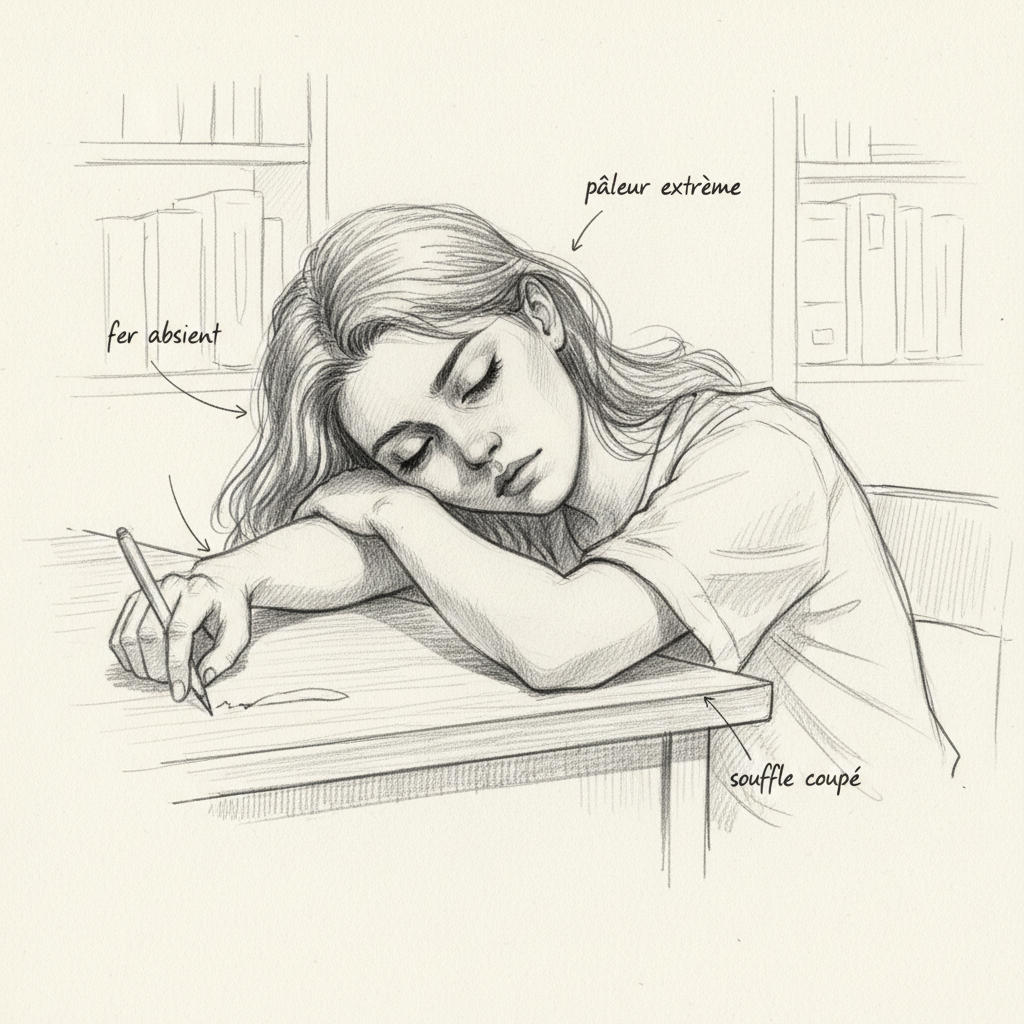
I’ve seen women in consultation with ferritin at 12 ng/mL and perfectly normal hemoglobin. They dragged unexplained fatigue for years, lost their hair, had restless legs at night, slept poorly, had cold extremities all the time. Their doctor had checked everything except ferritin. If you want to understand in depth the mechanisms of anemia and its multiple causes, I wrote a complete article on the subject.
The ferritin, thyroid, hair triangle
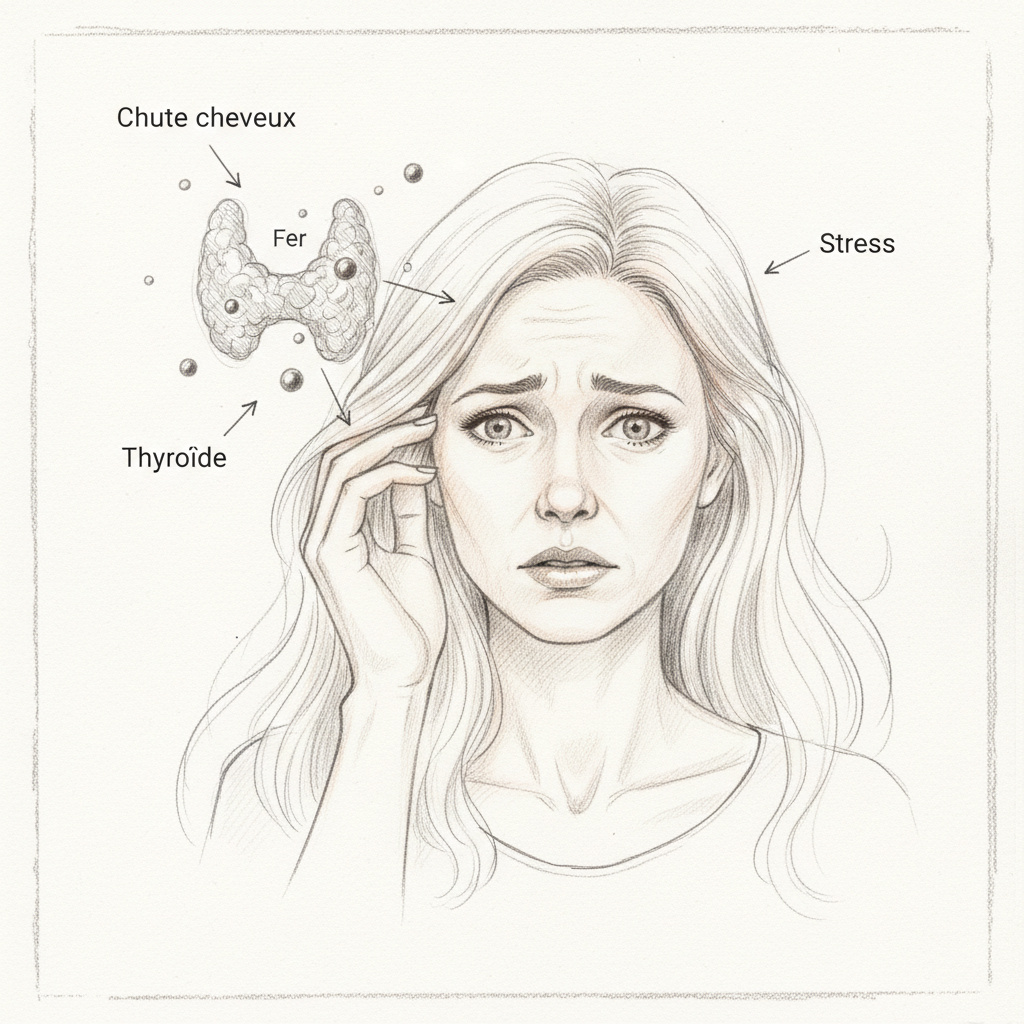
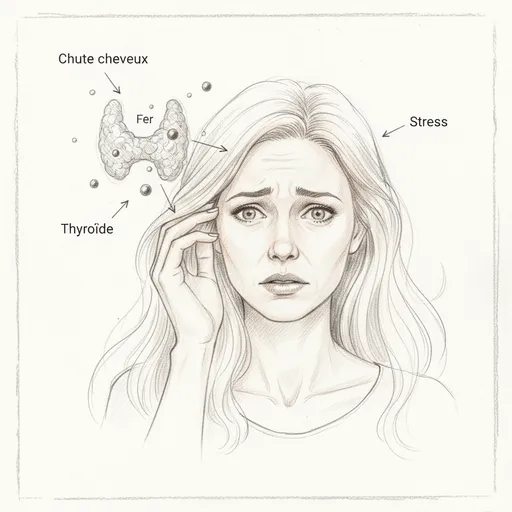
Iron isn’t just useful for transporting oxygen in the blood via hemoglobin. It participates in dozens of enzymatic reactions, three of which are directly linked to hair loss.
First, iron is a cofactor for thyroperoxidase (TPO), the enzyme that allows the thyroid to manufacture its T3 and T4 hormones. Without sufficient iron, thyroid production slows down. And when thyroid hormones drop, the hair follicle enters the rest phase (telogen) prematurely. This is so-called telogen hair loss, where hair falls out by the handful three months after the triggering event. If you want to explore the link between thyroid and micronutrition, with seven essential cofactors, I recommend that article.
Second, iron is necessary for ribonucleotide reductase, an enzyme that participates in cell division. Hair follicle cells are among the fastest dividing in the body (just after intestinal cells). When iron is lacking, the body prioritizes. It cuts off the supply to “non-essential” tissues (hair, nails, skin) to maintain vital organs. Your hair is literally sacrificed first.
Third, iron participates in the synthesis of L-lysine, an amino acid involved in keratin quality. Dr. Philippe Mouton, in his work on the intestinal ecosystem, reminds us that iron assimilation depends entirely on the integrity of the duodenal mucosa. “An inflamed intestine cannot absorb iron properly, even if dietary intake is sufficient.” This observation directly connects intestinal health to scalp health, via iron.
The five deep causes of low ferritin
The first cause, and by far the most frequent in women of childbearing age, is heavy periods. Each milliliter of blood lost carries with it approximately 0.5 mg of iron. Normal periods lose between 30 and 80 mL of blood per cycle, or 15 to 40 mg of iron. Heavy periods (menorrhagia) can lose 150 to 200 mL, or 75 to 100 mg of iron per month. When you know that intestinal absorption of dietary iron caps out at 1 to 2 mg per day at best, you understand that reserves melt faster than they’re rebuilt. Heavy periods are often a sign of estrogen dominance that deserves investigation.
The second cause is hypochlorhydria, meaning lack of acid in the stomach. Dietary iron, especially non-hemic iron from plants, needs a very acidic gastric pH (below 2) to be reduced from its ferric form (Fe3+) to ferrous form (Fe2+) absorbable. If your stomach doesn’t produce enough hydrochloric acid, and this is the case for the majority of thyroid patients, you can eat all the lentils in the world without absorbing much. Proton pump inhibitors (omeprazole, pantoprazole) considerably worsen this problem by suppressing acid production for months, even years.
The third cause is intestinal dysbiosis, and more specifically SIBO (Small Intestinal Bacterial Overgrowth). When bacteria that have no business in the small intestine settle there, they consume dietary iron before your intestinal cells have time to absorb it. Some bacteria, like Helicobacter pylori, are true iron thieves. Studies show that eradication of H. pylori alone is sometimes enough to normalize ferritin without any supplementation.
The fourth cause is silent chronic inflammation. The liver produces a hormone called hepcidin that regulates iron absorption. When inflammation is high (high CRP, even moderately), hepcidin increases and blocks intestinal iron absorption as well as its release by macrophages. It’s an archaic defense mechanism: in an infection situation, the body sequesters iron so it doesn’t give it to pathogenic bacteria. The problem is that low-grade chronic inflammation (intestinal permeability, overweight, oxidative stress) activates the same mechanism constantly. Result: ferritin stays low despite supplementation.
The fifth cause is intense physical exercise. Athletes, especially runners, lose iron through sweat, through micro-hemorrhages related to effort, and through mechanical destruction of red blood cells in the foot arch (march hemolysis). It’s a factor often overlooked in active women who combine intense sport and heavy periods.
The complete iron panel: the five markers to request
I can never say it enough: CBC alone is insufficient. Here are the five markers that make up a complete iron panel, and what each signifies.
Serum iron measures the iron circulating in the blood at that instant. It fluctuates enormously throughout the day (it’s higher in the morning) and depending on meals. Taken in isolation, it doesn’t mean much. Its optimal value is between 80 and 120 micrograms per deciliter.
Ferritin measures deep reserves. It’s the most important marker. Labs often display a low normal at 15 ng/mL, but in functional practice, we aim for between 50 and 100 ng/mL. Below 30, hair loss is almost certain. Below 50, fatigue and cold intolerance are frequent.
Transferrin is the iron transport protein in the blood. When reserves are low, the liver makes more of it to find every available iron atom. High transferrin is therefore an indirect sign of deficiency, even if ferritin still seems “within normal range.”
Total iron-binding capacity (TIBC) measures the total amount of iron that transferrin can carry. It increases in cases of deficiency (the body prepares more “trucks” to transport iron that’s becoming scarce).
Transferrin saturation coefficient (TSC) is the ratio between serum iron and TIBC. It’s the most reliable marker for evaluating iron’s real bioavailability. TSC below 20% confirms deficiency. TSC above 45% should prompt a search for overload.
Intelligent supplementation
Iron should not be supplemented lightly. Too much iron is as dangerous as too little. Excess iron is pro-oxidant; it generates free radicals via the Fenton reaction and can damage the liver, heart, and pancreas. Catherine Kousmine, in Be Well on Your Plate, already warned against blind iron supplementation: “Iron is a double-edged sword. It’s indispensable for life but toxic in excess. Every prescription must be guided by a complete biological assessment.”
Iron bisglycinate is the form I recommend as first choice. It’s a chelated form (iron is bound to two glycine molecules) with three advantages: absorption two to four times higher than ferrous sulfate, excellent digestive tolerance (no constipation, no nausea), and fewer interactions with other nutrients. The usual dose is 14 to 28 mg of elemental iron per day, taken away from meals containing tea, coffee, or dairy (calcium, tannins, and phytates block absorption).
Vitamin C taken at the same time as iron increases its absorption by 30 to 60%. Half a lemon squeezed in a glass of water, or a kiwi, is enough. Vitamin C reduces ferric iron to ferrous iron, the form directly absorbable by enterocytes.
Lactoferrin is a protein from breast milk that transports iron directly into intestinal cells. Recent studies show it’s as effective as ferrous sulfate for raising ferritin, with zero digestive side effects. It has the additional advantage of regulating intestinal inflammation and modulating the microbiota.
But before even thinking about supplementation, you must treat the causes of leakage. Regulate heavy periods (vitex, natural progesterone, correction of estrogen dominance). Restore gastric acidity (betaine HCl if hypochlorhydria confirmed). Treat SIBO or dysbiosis. Reduce inflammation (Seignalet diet, omega-3, curcumin). If ferritin doesn’t rise despite three months of correct supplementation, you must look for silent celiac disease, SIBO, or H. pylori infection.
Zinc is an indispensable companion to iron. These two minerals share the same intestinal absorption pathways and are often deficient simultaneously in thyroid patients. But be careful: taken at the same time, they compete. You must take them apart from each other, ideally iron in the morning and zinc in the evening.
When iron won’t rise
Patricia consulted me after a year of iron supplementation with no result. Her ferritin was stuck at 22 ng/mL despite 28 mg of bisglycinate per day. We dug deeper. Her lactulose breath test came back positive: hydrogen SIBO. Her intestinal bacteria were eating the iron before she could absorb it. We treated the SIBO (oregano, berberine, S. boulardii for six weeks), then resumed supplementation. In three months, her ferritin went to 58 ng/mL. Her hair stopped falling out after four months. At six months, she sent me a photo of her new growth with a message: “I got my 30-year-old hair back.”
This case illustrates a fundamental principle of naturopathy that Marchesseau formulated long before modern science confirmed it: you don’t nourish clogged terrain. Before supplementing, you must cleanse. Before rebuilding, you must clear the way.
The anti-deficiency plate
Dietary iron exists in two forms. Hemic iron, present in red meat, liver, offal, mussels, and clams, is absorbed at about 20 to 25%. Non-hemic iron, present in lentils, spinach, tofu, pumpkin seeds, and raw cacao, is absorbed at only 2 to 5%. This difference explains why vegetarians and vegans are at higher risk of deficiency, even with theoretically sufficient intake.
Veal liver remains the food richest in bioavailable iron, with approximately 7 mg per 100g in hemic form. Mussels follow with 5.8 mg per 100g. Black pudding, often cited, contains approximately 22 mg per 100g but its digestibility varies. For vegetarians, red lentils (3.3 mg per 100g cooked), fermented tofu (5.4 mg), pumpkin seeds (8.8 mg), and raw cacao (13 mg) are the best sources, provided you pair them with vitamin C and soak them (to reduce phytates that block absorption).
Iron and thyroid: the vicious cycle
Here’s what no one explains to you. Iron deficiency causes or worsens hypothyroidism because iron is a cofactor for TPO. And hypothyroidism causes or worsens iron deficiency because thyroid hormones are necessary for gastric acid production and intestinal motility (thus iron absorption). It’s a self-perpetuating vicious circle. You can’t correct one without correcting the other. If you take Levothyrox but your ferritin is at 20, you won’t properly convert your T4 to T3. And if you take iron but your thyroid is running slow, you won’t absorb your iron correctly.
This is why the naturopathic approach emphasizes the whole terrain rather than isolated correction of one parameter. Hertoghe sums it up well: “Hormones function in a network. Correcting a single hormone without considering nutritional cofactors and other hormonal axes amounts to tuning a single instrument in an orchestra.”
The warnings
Iron is a nutrient to monitor, not to take in self-medication. Excess iron (hemochromatosis) is a common genetic disease in France (1 in 200 people of European descent carry the mutation). It causes iron overload toxic to the liver, heart, and pancreas. This is why ferritin must be tested BEFORE any supplementation and monitored every three months during supplementation.
If your ferritin is above 150 ng/mL in women (or 200 in men) without supplementation, consult a doctor to look for hemochromatosis, chronic inflammation, or liver disease. If you take Levothyrox, take your iron at least four hours after your thyroid medication to avoid interaction.
Finally, don’t supplement with iron indefinitely. Iron is not a foundational supplement like magnesium or vitamin D. It’s a temporary correction, to rebuild reserves and treat the cause of the leak. Once ferritin is stabilized between 50 and 80 ng/mL, diet must take over.
Final word
Hair loss is not a cosmetic problem. It’s an alarm signal sent by a body lacking iron, thyroid function, or both. And ferritin is the sentinel that rings the bell first, long before anemia sets in. If your doctor doesn’t test it, ask for it. If it’s below 50, take action. If it won’t rise despite supplementation, look for the intestinal cause.
Robert Masson, in The Dietary Revolution through Eutynotrophia, wrote: “The body never lies. Every symptom is a message. Our job is not to silence the messenger but to understand the message.” Your hair is speaking to you. It’s time to listen.
Want to evaluate your status? Do the free Claeys thyroid questionnaire in 2 minutes.
If you want personalized support, you can book a consultation.
To go further
- Iron: the silent deficiency that exhausts your body
- Anemia: understanding deep causes and acting naturally
- Carnitine and thyroid: the molecule no one tests
- Hypothyroidism is a symptom, not a diagnosis
Want to evaluate your status? Do the free iron deficiency questionnaire in 2 minutes.
Healthy recipe: Carrot-beet juice: Beets support iron: try this juice.
Laisser un commentaire
Sois le premier à commenter cet article.