Catherine, fifty-six years old, had rheumatoid polyarthritis for twelve years. When she first came to my office, she walked with a cane. Her hands were deformed, her knees swollen, and her treatment: methotrexate plus cortisone plus anti-inflammatories: kept her in a state of chronic inflammation that the medications contained without extinguishing it. She told me she had “tried everything.” I asked her if she had tried changing what she put on her plate. She looked at me as if I had just suggested treating a fracture with a poultice.
Six months later, Catherine had reduced her anti-inflammatories by half. Her knees had gone down. Her hands remained deformed (destroyed joints don’t rebuild themselves), but the pain had decreased by eighty percent. She no longer walked with a cane. What had she changed? Her diet. According to the principles of a Montpellier immunologist who died in 2003, whom most of her doctors had never read, and whose theory is nonetheless the most coherent, most documented, and most clinically tested that I know regarding the link between diet and chronic disease.
This man’s name is Jean Seignalet. His book is called Food or the Third Medicine. And if you practice naturopathy without knowing Seignalet, it’s like doing physics without knowing Newton.
Jean Seignalet: the immunologist who understood everything
Jean Seignalet was not a naturopath. He was not a nutritionist. He was not an alternative practitioner seeking fame. He was a high-level scientist, professor of immunology at the Faculty of Medicine in Montpellier, pioneer of kidney transplantation in France, and director for thirty years of the histocompatibility laboratory at Saint-Éloi Hospital. He developed the HLA typing (Human Leukocyte Antigen) techniques that determine compatibility between a transplant donor and recipient. His knowledge of the immune system was that of a terrain practitioner, not a salon theoretician.
This expertise in immunology led him, in the 1980s, to ask the question that would occupy the last twenty years of his life: why does the immune system of certain patients turn against their own organs? And what does diet have to do with it?
The answer he built, tested on more than twenty-five hundred patients and ninety-one diseases, became Food or the Third Medicine: a seven-hundred-page tome that remains, twenty years after his death, the reference work for any practitioner interested in the link between diet and health.
Seignalet is cited one hundred fifty-two times on this site. But no article was dedicated to him. Articles on Hashimoto, on fibromyalgia, on intestinal dysbiosis apply his method to a specific condition. This one presents the man and his complete theory.
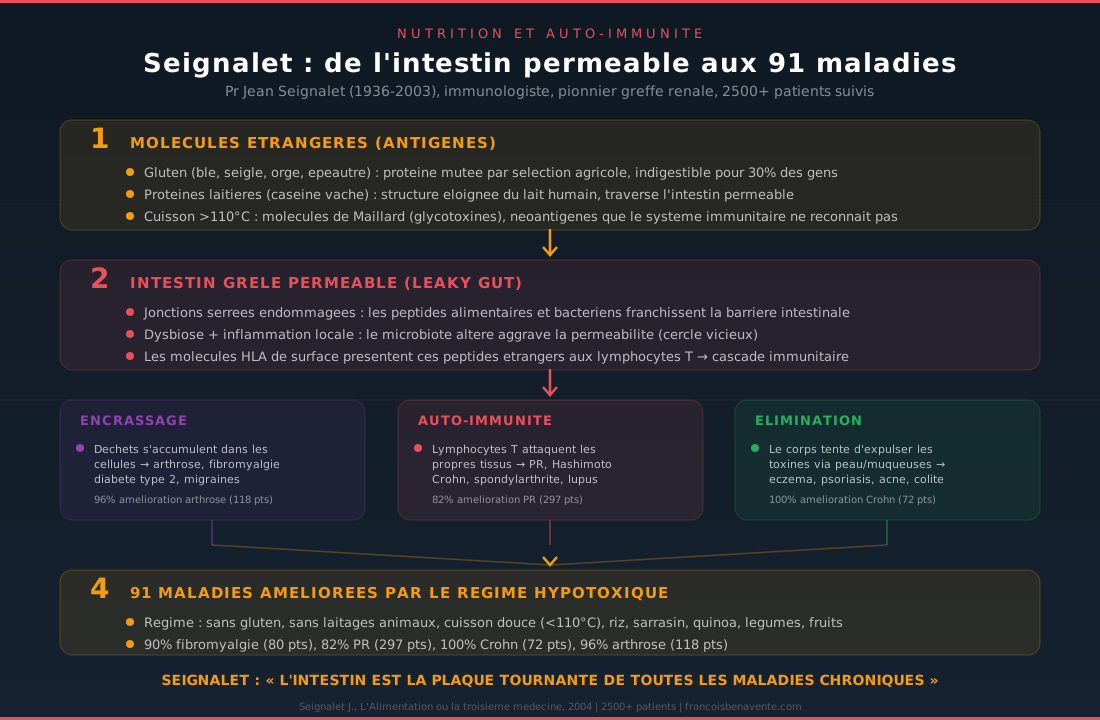
The theory of three disease categories
Seignalet’s genius was to classify chronic diseases not by organ (as conventional medicine does) but by mechanism. He identifies three major categories, all linked to the same starting point: the intestine.
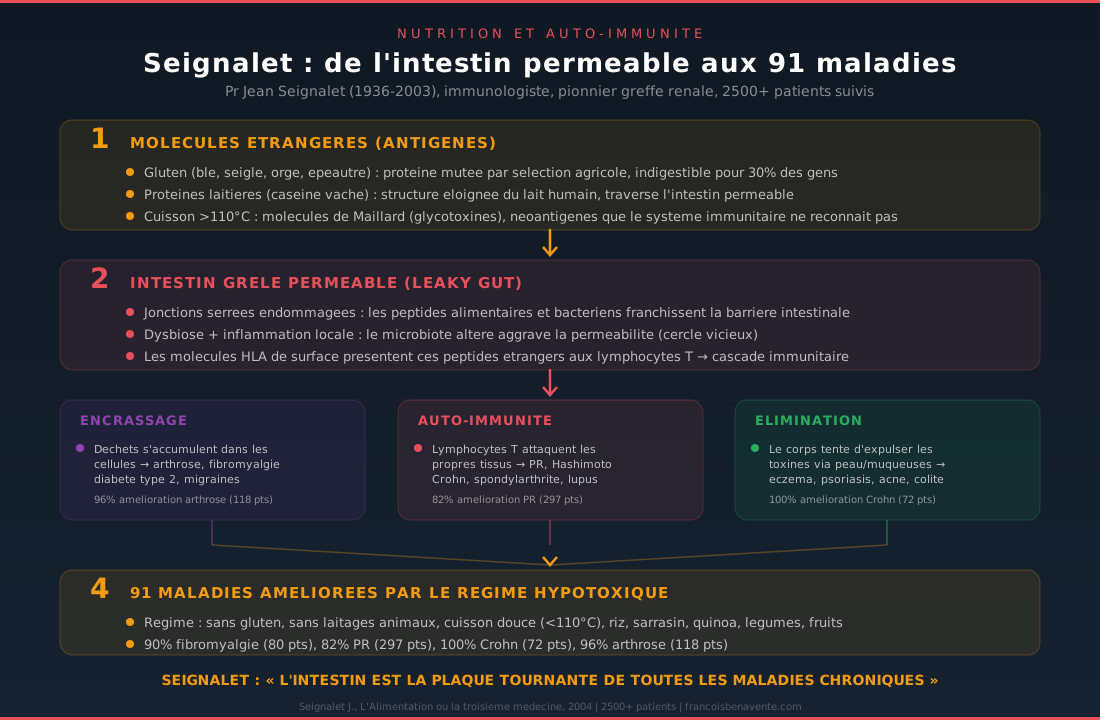
The first category is autoimmune diseases, which Seignalet qualifies as xenoimmune (from Greek xenos, foreign). The mechanism is as follows: an intestine that has become permeable allows food or bacterial peptides to pass through that should never have crossed the intestinal barrier. These peptides travel through the blood, accumulate in a target organ (thyroid, joints, skin, nervous system), and trigger an immune response directed against that organ. HLA molecules on the surface present these foreign peptides to T lymphocytes, which launch the inflammatory cascade.
This is exactly the mechanism I explain in detail in the article on Hashimoto: the xenoimmune cascade in five steps. Seignalet places in this category rheumatoid polyarthritis, ankylosing spondylitis, lupus, multiple sclerosis, type 1 diabetes, Hashimoto’s thyroiditis, celiac disease, vitiligo, psoriasis, Crohn’s disease, ulcerative colitis, and dozens of others.
The second category is that of clogging diseases. Here, macromolecules that cross the intestinal barrier do not trigger an immune response. They accumulate silently in the cells, congest them, and eventually disrupt their function. Seignalet compares this process to an engine clogged by poor-quality fuel. The cells continue to function, but increasingly poorly, until symptoms appear.
He places in this category fibromyalgia (clogging of muscle cells and sensory neurons), osteoarthritis (cartilage clogging), type 2 diabetes (clogging of pancreatic beta cells), migraine (clogging of vascular neurons), Parkinson’s disease, certain forms of depression, and accelerated cellular aging.
The third category is that of elimination diseases. When the body is saturated with waste it can no longer eliminate through normal pathways (liver, kidneys, intestine), it attempts to expel them through unusual routes: the skin (eczema, acne, psoriasis), respiratory mucosa (rhinitis, sinusitis, chronic bronchitis), digestive mucosa (colitis), urinary mucosa (recurrent cystitis). Seignalet directly joins here the notion of toxemia that Pierre-Valentin Marchesseau placed at the center of naturopathy: disease is an attempt to eliminate accumulated waste.
These three categories are not watertight. The same patient can simultaneously present signs of autoimmunity, clogging, and elimination. It’s even common in practice: a Hashimoto patient (autoimmune) with fibromyalgia (clogging) and eczema (elimination). Seignalet explains that the starting point is the same in all three cases: a permeable intestine that allows antigenic molecules to pass through: and that the destination depends on genetic terrain (HLA genes) and the nature of macromolecules involved.
The hypotoxic diet: return to ancestral eating
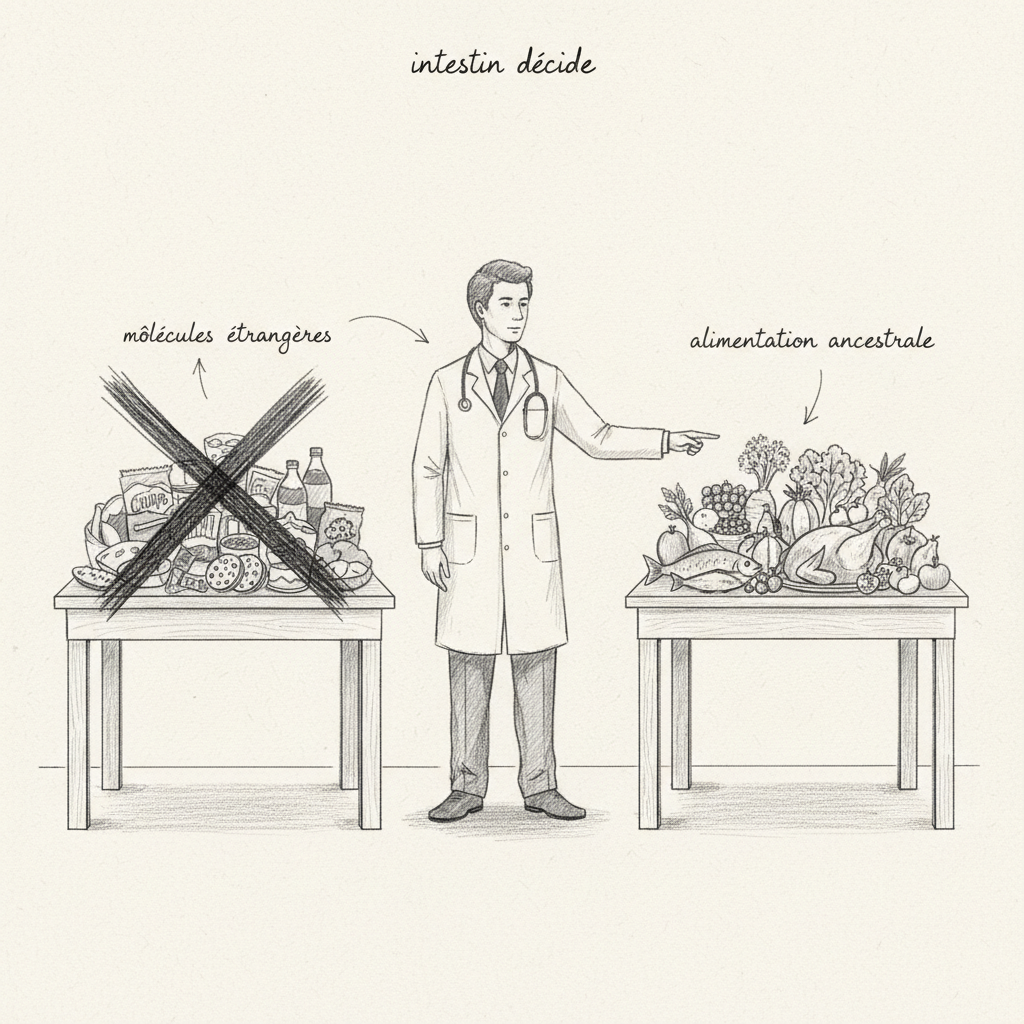
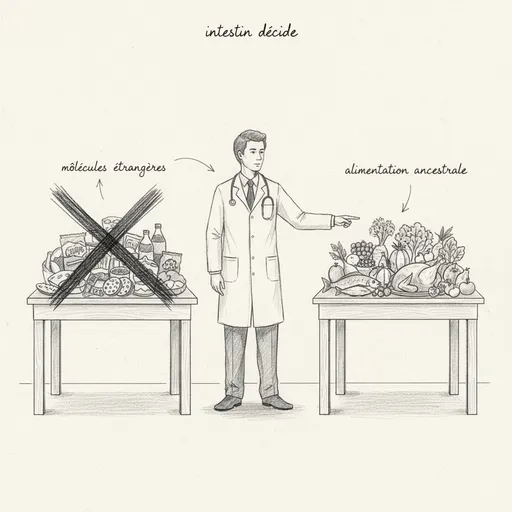
The treatment Seignalet proposes has impeccable logic: if the problem comes from food molecules crossing a permeable intestine, the solution is twofold. First, eliminate foods that provide these antigenic molecules. Second, repair the intestine to restore its barrier function.
The hypotoxic diet (which Seignalet also calls “ancestral diet” or “original-type diet”) eliminates three categories of foods.
Mutated grains constitute the first elimination. Modern wheat, corn, rye, barley, oats, and large spelt have undergone thousands of hybridizations and mutations since the Neolithic. Their proteins (including gluten) are structurally different from those our ancestors consumed. The human digestive system has not had time to adapt to these modifications: ten thousand years is a second on the evolutionary scale. Authorized grains are those that have not been mutated: rice, buckwheat, quinoa, millet, sesame.
Animal dairy products constitute the second elimination. Casein, beta-lactoglobulin, and other cow’s milk proteins are powerful antigens for the human intestine. Seignalet recalls a simple biological fact: cow’s milk is designed to grow a forty-kilogram calf to three hundred kilograms in one year. Its protein composition is radically different from human milk. The Tyzbir study (1981) that Dr. Hertoghe cites extensively confirms the impact: casein lowers serum T3 by sixty-two to sixty-nine percent.
Gentle cooking constitutes the third pillar. Above 110°C, Maillard reactions between sugars and proteins generate complex molecules (advanced glycation products, or AGE) that the body doesn’t know how to metabolize. These molecules become additional antigens that clog the intestine and overload the immune system. Seignalet recommends steaming, braising, poaching, and as much raw food as possible. Frying, grilling, roasting, and high-temperature oven cooking are eliminated.
Clinical results: numbers that speak
What distinguishes Seignalet from most defenders of therapeutic eating is the rigor of his clinical documentation. He did not publish a randomized double-blind trial (how do you create a placebo for a diet?), but he systematically followed each patient, recorded results, documented relapses, and published figures with remarkable transparency.
For fibromyalgia: eighty patients followed. Fifty-five complete remissions, seventeen significant improvements. That is ninety percent positive results. The response time ranges from four to sixteen months. This result is all the more striking as fibromyalgia is considered incurable by conventional medicine, which offers only symptom management (painkillers, antidepressants, physical therapy).
For rheumatoid polyarthritis: two hundred ninety-seven patients followed. Two hundred forty-three remissions or significant improvements. That is eighty-two percent positive results. Catherine is part of these statistics.
For Crohn’s disease: seventy-two patients followed. Seventy-two remissions. One hundred percent. This figure has been contested, but Seignalet defends it with clinical data: each patient was followed for at least one year, with endoscopic control.
For osteoarthritis: one hundred eighteen patients followed. One hundred thirteen improvements. Ninety-six percent.
For type 2 diabetes: twenty-five patients followed. Twenty-four improvements. Ninety-six percent.
For migraine: fifty-seven patients followed. Fifty improvements. Eighty-eight percent.
And for Hashimoto? Fifteen patients followed. “Inconsistent and moderate” results. Seignalet acknowledges this with disarming honesty: “When patients come to consult me, generally most of the thyroid gland cells are already destroyed. Now, while the diet is often capable of extinguishing the autoimmune disease, it cannot resurrect dead cells.” This is precisely the limitation that led Izabella Wentz to develop a complementary, personalized protocol using IgG that achieves forty percent remission in over three thousand participants. Wentz does not contradict Seignalet. She complements him.
The concept of immune memory: why dietary cheating kills the protocol
A fundamental aspect of Seignalet’s theory that many patients underestimate is the role of immune memory. Immunoglobulin G (IgG) retains memory of a food antigen for four to five weeks. Concretely, this means that a single dietary deviation (a croissant, a pizza, a glass of milk) restarts antibody production and reinitializes the inflammatory process. Four weeks of strict diet erased by one meal.
This is the primary reason so many patients fail. They do the diet “ninety percent.” They allow themselves exceptions on weekends, at family meals, on vacation. And these exceptions, even spaced out, are enough to maintain the active immune cascade. Seignalet himself had noticed this: his failures were almost exclusively patients who had not strictly followed the diet.
This immunological fact also explains the gap between Seignalet’s twenty-five percent remission rate and Wentz’s forty percent for Hashimoto. Seventy-five percent of patients who attempt strict Seignalet abandon it: not because the diet doesn’t work, but because the social constraint is too heavy. Wentz solved this problem by personalizing elimination through IgG: only truly problematic foods for each individual are removed, which reduces restriction and improves adherence.
Seignalet and naturopathy: the foundation of everything
Seignalet was not a naturopath. He never used that term. But his theory is the scientific foundation of what Marchesseau called toxemia: the accumulation of waste in the body as the primary cause of disease. Marchesseau formulated it in vitalist terms (vital force, humoralism, temperaments). Seignalet formulates it in immunological terms (HLA, antigenic peptides, IgG, cytokines). The two say the same thing with different words: chronic disease comes from what you put in your body.
This is why Seignalet is the foundation of everything in modern naturopathy. When I receive a patient in consultation, whatever their condition, the first question is always dietary. Not because diet resolves everything, but because without dietary correction, nothing else works sustainably. You can take all the supplements in the world, do all the detox cures, correct all your micronutrient deficiencies: if you continue to nourish your intestine with antigens that make it permeable, the inflammatory cascade continues.
Kousmine laid the foundations with her six pillars. Hertoghe added the hormonal and micronutritional dimension. Wentz brought personalization through IgG. But the theoretical framework, the understanding of the mechanism, that’s Seignalet. Without him, the others build on sand.
Recognized limitations
Seignalet was an honest scientist. He documented his failures with the same rigor as his successes. Hashimoto: inconsistent results when thyroid cells are already destroyed. Type 1 diabetes: the diet cannot regenerate pancreatic beta cells once destroyed. Multiple sclerosis: positive results on flare-ups but not on established lesions.
The principle is always the same: the diet can extinguish the inflammatory process and prevent further destruction, but it cannot rebuild what has already been destroyed. Hence the vital importance of acting early. The earlier you intervene in the autoimmune process, the more functional tissue you preserve. Waiting for the diagnosis to be “confirmed” by conventional medicine often means waiting for destruction to be advanced enough to be visible. And at that stage, part of the journey is irreversible.
The other limitation is methodological. Seignalet did not publish randomized controlled trials. His results are systematic clinical observations, not level 1 evidence in the sense of evidence-based medicine. This criticism is legitimate. But it overlooks a practical fact: you cannot do a double-blind trial with a diet (the patient knows what they eat). And Seignalet’s observations on more than twenty-five hundred patients, with follow-ups of several years, constitute a clinical body of work that few practitioners can claim.
Why you must know Seignalet
If you have an autoimmune disease, a chronic inflammatory disease, fibromyalgia, recurrent migraine, Crohn’s disease, polyarthritis, chronic eczema: read Seignalet. Not a summary. Not an article. The entire book. Seven hundred pages that will change your understanding of your disease and the options available to you.
If you are a health practitioner: naturopath, nutritionist, curious doctor: read Seignalet. His immunological rigor gives the link between diet and health a scientific basis that vague discourse about “eating healthy” will never provide.
And if you want to go further than Seignalet, explore the complements others have brought: Wentz’s IgG personalization, Hertoghe’s optimal hormonal ranges, the intestinal repair in 4R, the anti-antibody protocol, and understanding of oxidative stress that accelerates cellular clogging. Dr. Jacqueline Lagacé also extended Seignalet’s work in Silencing 100 Diseases with the Hypotoxic Diet, an accessible work that simplifies and updates the data.
To go further
- Kousmine: the 6 pillars and the intestine as motor of disease
- Hashimoto: the forgotten causes your doctor doesn’t seek
- Marchesseau: the vitality equation and orthodox naturopathy
- Graves’ disease: preventing relapse after Neomercazole
Sources
- Seignalet, Jean. Food or the Third Medicine. 5th edition. François-Xavier de Guibert, 2004.
- Lagacé, Jacqueline. How I Overcame Pain and Chronic Inflammation through Diet. Fides, 2011.
- Magnien, Christine. Silencing 100 Diseases with the Seignalet Diet. Thierry Souccar Éditions, 2015.
- Marchesseau, Pierre-Valentin. The Laws of Nature and Health. Les Éditions de la Vie Claire.
If you want to implement the Seignalet diet adapted to your situation, with a micronutritional assessment and a personalized intestinal repair protocol, you can book a consultation appointment.
Healthy recipe: Buckwheat crepes without gluten: Buckwheat is at the heart of the Seignalet method.



Laisser un commentaire
Sois le premier à commenter cet article.