When Izabella Wentz found herself sitting in her endocrinologist’s office in 2009, she was not an ordinary patient. She was a Doctor of Pharmacy. She knew how to read a clinical study, interpret thyroid results, understand the pharmacokinetics of Levothyroxine that had just been prescribed to her. And yet, despite her expertise, she experienced exactly what millions of Hashimoto’s patients do: a late diagnosis, a pill, and the sentence that closes all doors: “Your antibodies are stable, don’t worry.”
Except Izabella did not resign herself. Where most patients accept the inevitability of chronic disease, she did what her pharmaceutical training allowed her to do: she combed through the scientific literature. For years. Systematically. Every mechanism, every study, every protocol. She tested on herself before testing on others. And what emerged changed the management of Hashimoto’s for tens of thousands of patients worldwide.
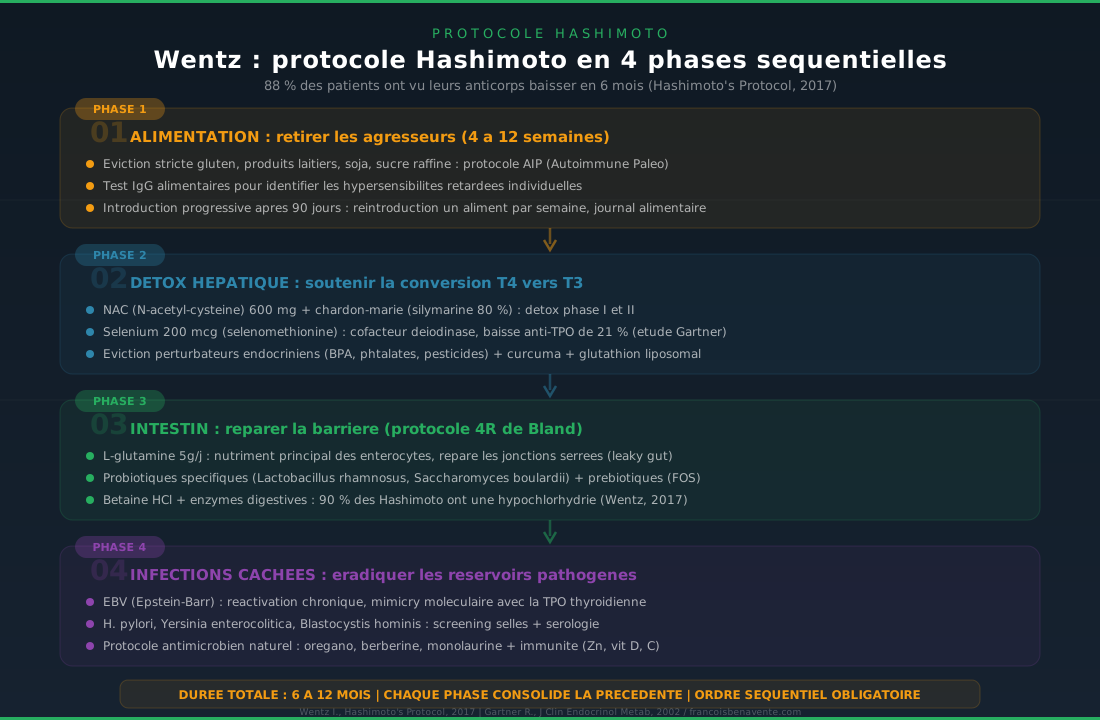
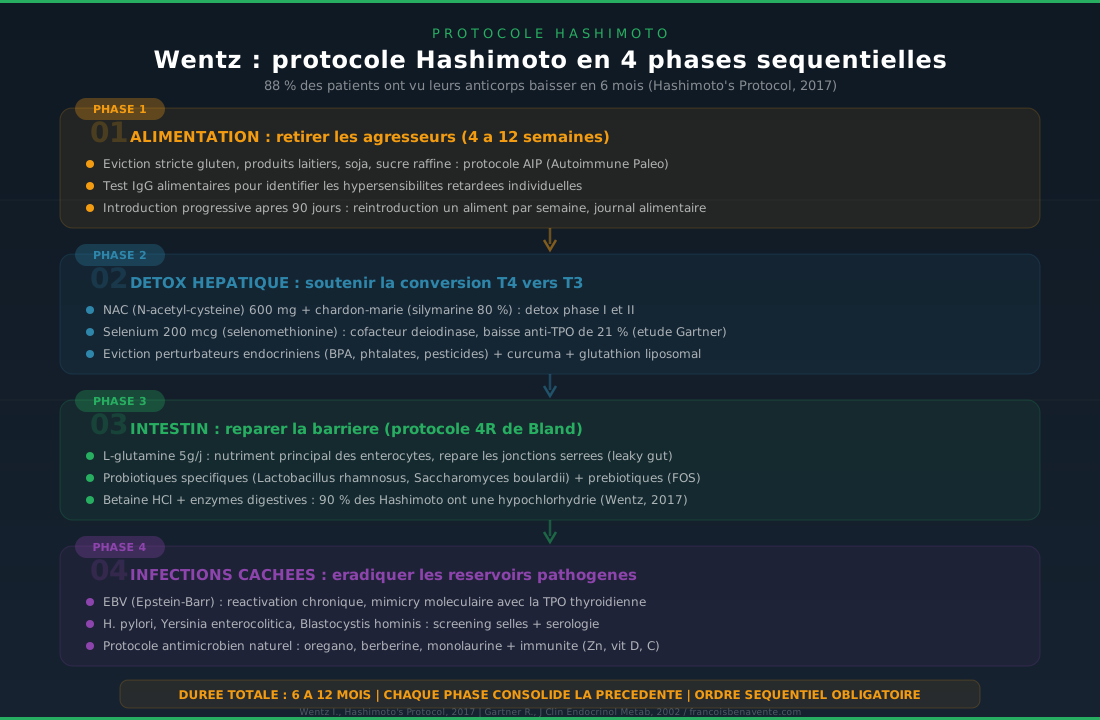
I’m not presenting you with the details of her four-phase dietary protocol here: that’s the subject of my article on the Wentz diet. What I want to tell you is who this woman is, why her method works better than others, and what her overall philosophy of autoimmune healing is.
From patient to researcher: a journey of methodical determination
Izabella Wentz’s story is that of a woman who refuses helplessness. Diagnosed with Hashimoto’s at twenty-seven, she first trusts the system. Levothyroxine, dosage adjustment, TSH monitoring. Like everyone else. And like everyone else, she discovers that the pill doesn’t solve much. Fatigue persists. Brain fog sets in. Weight gain accumulates. Antibodies don’t budge.
The difference is that she knows elevated antibodies mean thyroid destruction continues. She knows that Levothyroxine replaces T4 but does not treat the autoimmune process. And she knows that the question no one asks: “Why is my immune system attacking my thyroid?”: is the only one that matters.
She starts with Seignalet. The low-toxicity diet, avoidance of gluten and dairy. Results are partial. She digs deeper. She discovers that Seignalet tested his diet on only fifteen Hashimoto’s women, with results he himself qualifies as “inconsistent and moderate.” She searches for why. And she finds: the Seignalet diet is universal (same avoidance for everyone) while food reactivity is individual. A patient reactive to eggs and yeast but not gluten will eliminate the wrong food and keep the good one. The opposite of what should be done.
From this observation, her method is born: personalization through IgG testing. Not a list of forbidden foods identical for everyone, but an immunological analysis that identifies the specific culprits for each individual. This idea, which seems obvious in hindsight, increased the remission rate by 1.6-fold: from twenty-five percent in Seignalet to forty percent in Wentz, across more than three thousand participants.
Ten strategic principles that change everything
What gives the Wentz method its strength is not just the dietary protocol. It’s a philosophy of autoimmune healing based on ten principles that I’ve observed confirmed in consultation for years.
First principle: personalize before restricting. IgG analysis of the twenty-five main food allergens (approximately ninety euros, not reimbursed, Bioavenir or Lims laboratories in France) identifies the real culprits. Blindly eliminating gluten and dairy in everyone creates unnecessary restriction in patients who don’t react to these foods and misses the real culprits (eggs, corn, yeast, soy) in others.
Second principle: immune memory is unforgiving. IgGs have a half-life of twenty-one days. A single deviation resets the counter to zero. A croissant, a beer, a gratin: four to five weeks of diet erased. It’s harsh, but that’s immunological reality. It’s also the main reason seventy-five percent of Seignalet patients quit: they do the diet “ninety percent” while allowing themselves exceptions on weekends, and those exceptions are enough to keep the autoimmune cascade active.
Third principle: don’t start if you’re not ready. It’s better to wait another month and commit fully than to start knowing that a trip, a wedding, or a move will sabotage the critical phase. Total commitment for fourteen weeks is infinitely more effective than half-commitment for six months.
Fourth principle: not all milk is created equal. A1 casein (Holstein cows) releases BCM-7, an opioid peptide that increases intestinal mucus by four hundred seventeen percent and weakens T1 lymphocytes. A2 casein (Jersey cows, goat, sheep) does not pose this problem. This distinction makes the protocol livable for those who suffer from total dairy prohibition.
Fifth principle: ancient grains are not modern grains. One hundred percent spelt, Russello, Poulard, Bordeaux Red have not undergone the hybridization that multiplied the antigenic load of modern wheat. The Wentz protocol allows them after the reintroduction phase, making daily life infinitely more manageable than strict Seignalet.
Sixth principle: the liver-adrenals-gut trilogy is non-negotiable. Wentz insists that no dietary protocol can work if these three organs are dysfunctional. The liver must be supported for T4 to T3 conversion and detoxification of estrogens. The adrenals must be rebuilt before touching the thyroid. The gut must be repaired to break Seignalet’s xenoimmune cascade.
Seventh principle: selenium before iodine. Always. Selenium protects the thyroid against oxidative stress generated by thyroid hormone production. Introducing iodine without sufficient selenium is like setting fire to a building without a fire extinguisher. Wentz completely aligns here with Dr. Hertoghe and the anti-antibody protocol that I detail in the dedicated article.
Eighth principle: measure to know. Each phase of the protocol is bounded by blood work. Anti-TPO, anti-Tg, free T3, free T4, reverse T3. Without measurement, it’s impossible to know if the protocol is working. Subjective feeling is not enough. Antibodies are the ultimate judge.
Ninth principle: reintroduction is as important as elimination. One food every four days, symptom journal, rigorous observation. This four-day interval corresponds to the time needed for a delayed IgG reaction to manifest. Reintroducing too quickly masks reactions and distorts the entire protocol.
Tenth principle: maintenance is for life. This is the point most patients don’t want to hear. Hashimoto’s remission does not mean cure. It means control. IgGs can reactivate. Your constitution can degrade again under stress, infection, or pregnancy. Wentz recommends one month of strict pause annually (return to elimination phase), blood work every six months, and permanent vigilance on warning signs (unexplained fatigue, brain fog, dry skin, constipation).
Wentz, Seignalet, Hertoghe: three complementary visions
In consultation, I don’t choose between Wentz, Seignalet, and Hertoghe. I combine them. Each brings a puzzle piece the others don’t have.
Seignalet brings the fundamental theory: the xenoimmune mechanism, the five-step cascade from gut to thyroid, the concept of elimination and congestion disease. Without Seignalet, we wouldn’t understand why the gut is the key. His results on fibromyalgia (ninety percent improvement) and congestion diseases remain unmatched. But for Hashimoto’s specifically, his results were limited: fifteen patients, “inconsistent and moderate” results.
Wentz brings personalization and methodological rigor. IgG analysis, chronological phases, biological follow-up markers, the notion of long-term maintenance. She’s the one who transformed a brilliant theory (Seignalet) into an applicable and measurable protocol. Forty percent remission across three thousand participants is a clinical result Seignalet could never document at that scale.
Hertoghe brings the hormonal and micronutritional dimension. Optimal standards for free T4 (1.3 ng/dL), seven thyroid cofactors (iron, selenium, zinc, iodine, vitamin A, copper, inositol), food chronobiology, the anti-antibody protocol (vitamin D 10-20,000 IU/day, selenium 200-400 mcg/day, inositol 1,200 mg/day). Wentz barely mentions micronutrition in her protocols. Hertoghe barely mentions food IgG. Together, they cover the entire spectrum.
In my practice, the typical sequence for a Hashimoto’s patient is as follows. First, the Seignalet framework: understand the mechanism, accept that the gut is the key, accept that Levothyroxine alone is not enough. Next, Wentz’s tools: IgG analysis, phase protocol, reintroduction journal. In parallel, Hertoghe’s standards: complete thyroid assessment with optimal standards, anti-antibody protocol, correction of micronutritional deficiencies, adrenal management as priority.
What Wentz teaches us about healing
Beyond the technical protocol, Wentz embodies something deeper. She embodies the patient who refuses to resign. Who uses her expertise to understand her own disease. Who tests on herself before recommending to others. And who honestly accepts her method’s limitations: forty percent remission is remarkable, but it’s also sixty percent who don’t fully achieve it.
This honesty is rare in the natural health world, where many methods claim one hundred percent cure rates. Wentz doesn’t claim to cure Hashimoto’s. She claims to extinguish the autoimmune process in a significant proportion of patients, provided they commit fully and measure results objectively. That’s exactly the stance I adopt in consultation: I don’t promise cure, I propose an evidence-based protocol, and I measure results with blood work.
If you have Hashimoto’s and have never heard of Wentz, start by understanding the forgotten causes of your disease (the Seignalet mechanism), then read the four-phase protocol, and ask your doctor for a complete thyroid assessment with Hertoghe’s standards. If you want to understand why your adrenals must be treated before your thyroid, or why your liver plays a central role in T4 to T3 conversion, the articles are there.
To go further
- Kousmine: the 6 pillars and the gut as motor of disease
- Hashimoto: the forgotten causes your doctor isn’t looking for
- Marchesseau: the vitality equation and orthodox naturopathy
- Basedow: preventing relapse after Neomercazole
Want to assess your status? Take the free Claeys thyroid questionnaire in 2 minutes.
Sources
- Wentz, Izabella. Hashimoto’s Protocol: A 90-Day Plan for Reversing Thyroid Symptoms and Getting Your Life Back. HarperOne, 2017.
- Wentz, Izabella. Hashimoto’s Thyroiditis: Lifestyle Interventions for Finding and Treating the Root Cause. Wentz LLC, 2013.
- Seignalet, Jean. L’Alimentation ou la troisième médecine. François-Xavier de Guibert, 2004.
- Hertoghe, Thierry. The Hormone Handbook. International Medical Books, 2006.
If you want personalized support to implement the Wentz protocol adapted to your profile, you can book a consultation.
Healthy recipe: Homemade Kimchi: Ferments are essential in the Wentz protocol.




Laisser un commentaire
Sois le premier à commenter cet article.