In the mid-1950s, in a working-class neighborhood of Boston, a woman in her fifties opened the doors to a health center of a new kind. The patients who presented themselves were not ordinary people. They were the medically wandering sick, cancer patients in terminal phase whom official medicine had sent home with a prescription for morphine and a sympathetic look. Diabetics on insulin for twenty years. Arthritics deformed by anti-inflammatory drugs. Depressives whom electroshock therapy had not healed. All had in common that they had knocked on every door, and every door had closed behind them. The woman who welcomes them is named Ann Wigmore. She does not promise them healing. She proposes that they eat herbs. Sprouts. Sprouted seeds. Pressed wheat grass. Her medical colleagues think she is crazy. But patients who spend three weeks in her center leave transformed. Some heal. All feel better. And the story of living food begins.
“The food you eat can be either the safest and most powerful form of medicine or the slowest form of poison.” Ann Wigmore
From Kaunas to Boston: the journey of a visionary
Ann Wigmore was born in 1909 in Kaunas, Lithuania. Her childhood was marked by poverty and war. Her grandmother, a village healer, transmitted to her ancestral knowledge about wild plants and medicinal herbs. It was this grandmother who healed wounded soldiers with poultices of fresh grass, who nourished malnourished children with wild sprouts, who taught little Ann that the earth produces everything the body needs to heal. This oral, peasant, instinctive transmission would mark Wigmore’s entire trajectory.
Emigrated to the United States with her family, Ann went through difficult years. Her health deteriorated. She was diagnosed with colon cancer. Doctors proposed surgery. She refused. She remembered her grandmother and her herbs. She began experimenting. She ground wheat grass and drank its green juice. She sprouted seeds. She ate raw. And she healed. Or at least, that is what she claims, and the doctors who followed her could only observe the disappearance of the tumor. It is not scientific proof in the strict sense. But it is the starting point of a lifetime of research and experimentation that would revolutionize our understanding of living food.
In the 1950s, she met Viktoras Kulvinskas, a Lithuanian scientist who had emigrated like her, author of the famous work Sprout for the Love of Everybody. Together, they founded the first Hippocrates Health Institute in Boston. The name is no accident: they place themselves in the direct line of Hippocrates, the father of medicine, who taught that food is the first medicine. In the 1980s, Wigmore opened a second center in Puerto Rico, in a tropical climate that allowed her to grow sprouts and wheat grass year-round. Her work expanded. Her books sold. Thousands of patients passed through her centers. And science, slowly, began to validate what Wigmore had been teaching empirically for decades.
Sprouting: externalized digestion
To understand why sprouted seeds are so powerful, you must understand what happens inside the seed when it sprouts. And for that, you must go back to the most fundamental mechanism of the plant kingdom: dormancy and awakening.
A dry seed is a living organism in a state of suspension. It contains all the genetic material necessary to produce an entire plant: roots, stem, leaves, flowers, fruits. It also contains all the nutritional reserves to feed the early stages of growth: starches, lipids, proteins. But these reserves are locked. Enzyme inhibitor proteins protect the seed during winter, preventing premature sprouting. These inhibitors are the reason why raw, unsoaked seeds are often difficult to digest. Phytates, oxalates, tannins and trypsin inhibitors are all defense mechanisms that render nutrients inaccessible.
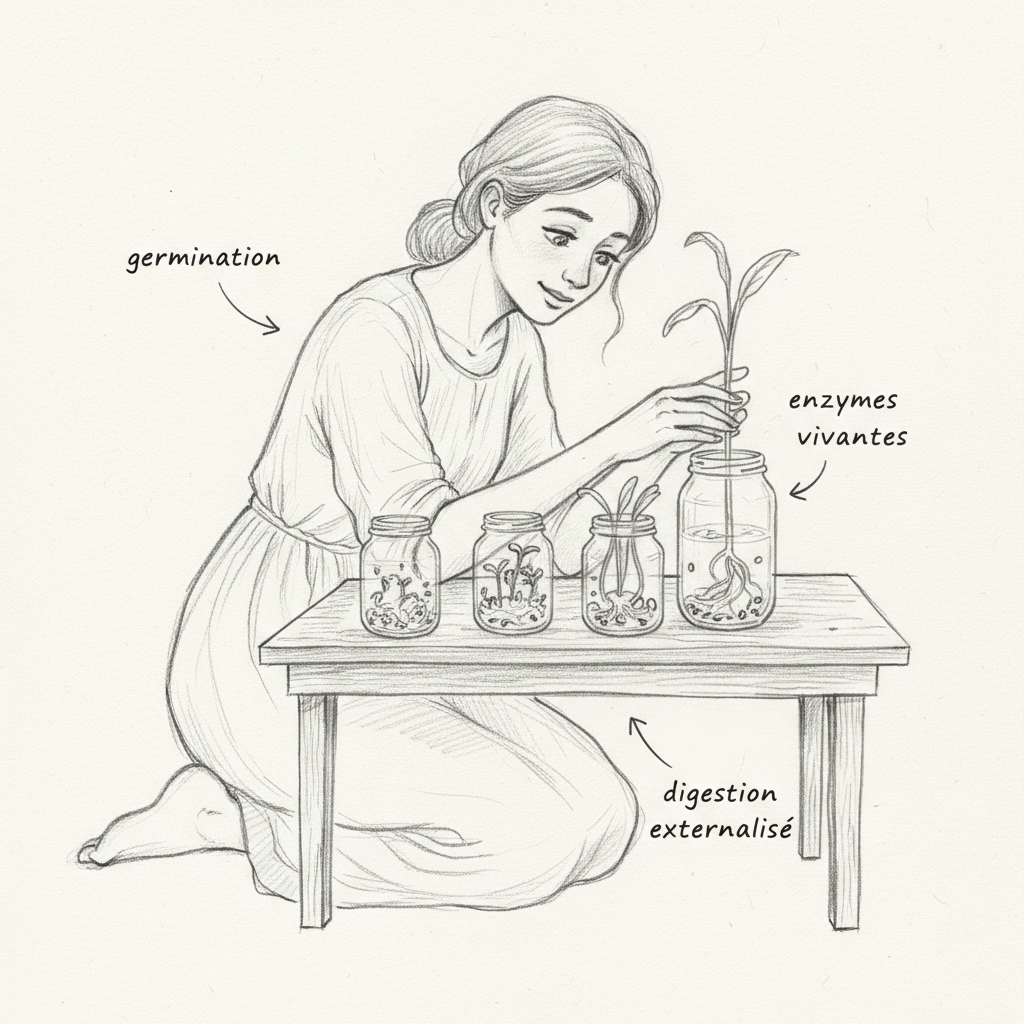
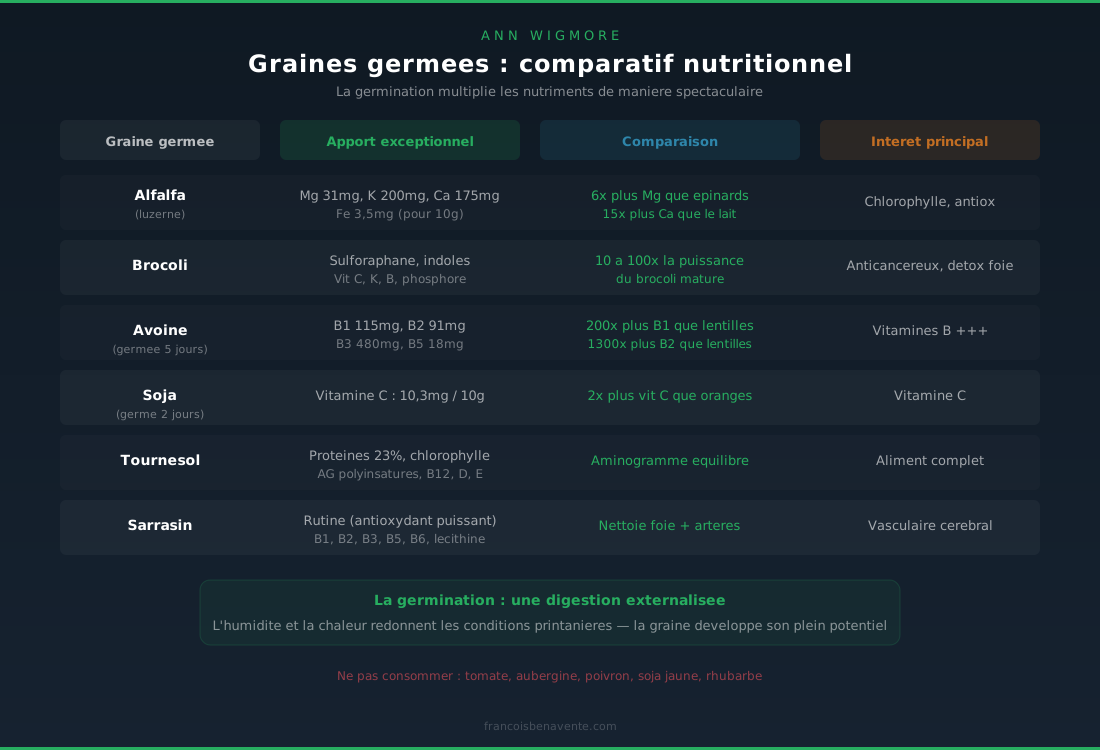
When spring conditions return, that is, when the seed regains moisture and mild temperature (generally between 18 and 25 degrees Celsius), an extraordinary biochemical process is triggered. Enzyme inhibitors are neutralized. Endogenous enzymes activate. Lipases break down fats into fatty acids. Proteases break down proteins into amino acids. Amylases break down starches into simple sugars. Within hours, the seed transforms its raw reserves into immediately assimilable nutrients. This is exactly what your digestive system does when you eat. Except the seed does it all by itself, even before arriving in your mouth. This is what Wigmore called externalized digestion: the seed pre-digests its own nutrients for you.
The result is spectacular. Nutrients multiply in breathtaking fashion. Vitamins, minerals, enzymes and antioxidants literally explode during the first days of sprouting. And these are not approximate figures. These are measured, reproducible data, documented by biochemical analyses.
The numbers that change everything
Wigmore and Kulvinskas compiled nutritional data that, when read for the first time, seem too good to be true. Yet they have been confirmed by independent laboratories.
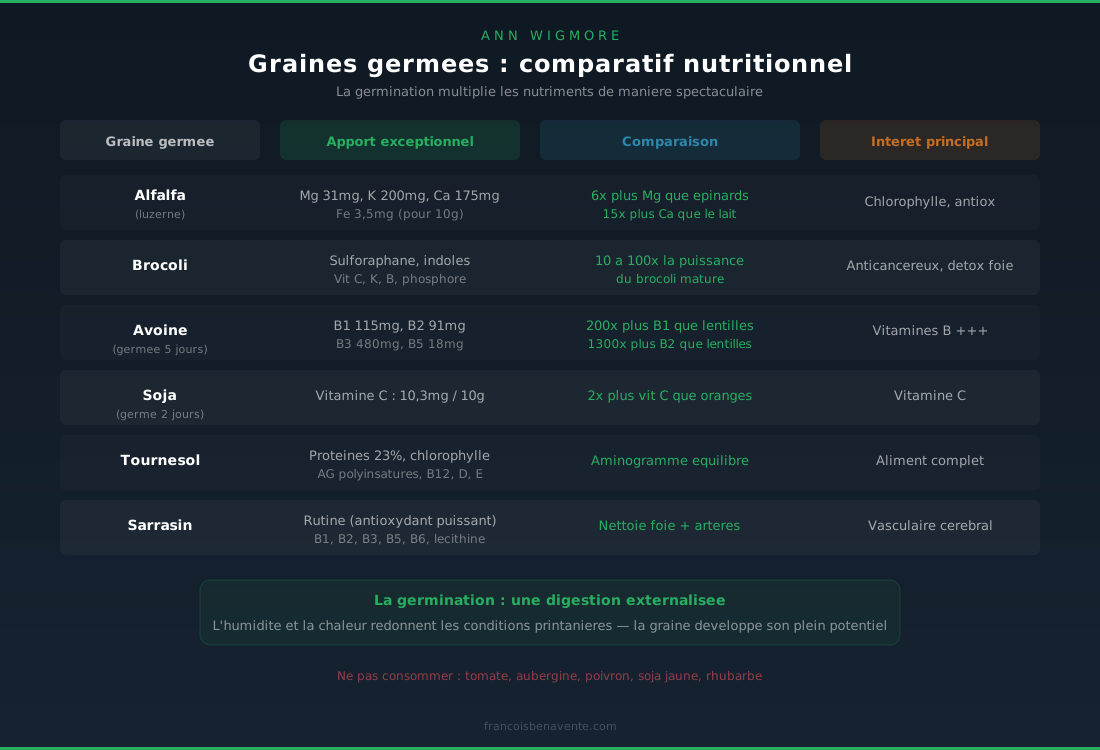
Alfalfa sprouted for three days contains six times more magnesium than fresh spinach and fifteen times more calcium than cow’s milk. It is a mineral bomb in a tiny format. Alfalfa is also an exceptional source of chlorophyll, vitamin K and saponins, these plant molecules that help reduce cholesterol and modulate inflammation. Three days of sprouting. A glass jar. Water. That is all you need.
Sprouted soy for two days contains twice as much vitamin C as fresh oranges. Dry soy seed contains almost no vitamin C. In forty-eight hours of sprouting, the enzymatic machinery synthesizes vitamin C from its precursors. It is a biosynthesis process that the dry seed does not carry out, and only sprouting triggers.
Sprouted oats for five days contain two hundred times more vitamin B1 (thiamine) and thirteen hundred times more vitamin B2 (riboflavin) than dry lentils. These figures are vertiginous. Thiamine is essential for energy metabolism and nervous system function. Riboflavin participates in oxidation-reduction reactions and fatty acid metabolism. Five days of sprouting transform an oat kernel into a concentrate of B vitamins.
Broccoli sprouts contain ten to a hundred times the anticancer potency of mature broccoli. This discovery, confirmed by the work of Paul Talalay at Johns Hopkins University in the 1990s, made headlines worldwide. The compound responsible is sulforaphane, a powerful isothiocyanate that activates phase II detoxification enzymes in the liver, neutralizes free radicals and inhibits cancer cell proliferation. Three grams of three-day-old broccoli sprouts contain as much sulforaphane as half a kilogram of mature broccoli. Wigmore knew this empirically. Science confirmed it forty years later.
The question of enzymes
The heart of Wigmore’s thinking is the question of enzymes. Enzymes are catalytic proteins that accelerate all biochemical reactions in the body. Without enzymes, nothing works. No digestion, no metabolism, no cell repair, no hormone synthesis, no immunity. The body produces its own enzymes (endogenous enzymes), but this production capacity is not unlimited. Wigmore, influenced by Dr. Edward Howell’s work on food enzymes, maintained that every human being is born with a limited enzyme capital. At each meal devoid of living enzymes (that is, each completely cooked meal), the body must draw from its reserves to produce the digestive enzymes necessary. Over the years, these reserves become depleted, digestion becomes laborious, nutrients are poorly assimilated, and chronic diseases appear.
Sprouted seeds are the most direct solution to this problem. They provide living, active, ready-to-use enzymes. Lipases that break down fats. Proteases that break down proteins. Amylases that break down starches. These exogenous enzymes work in the stomach and small intestine, facilitating digestion and sparing endogenous enzyme capital. It is a nutritional contribution that no capsule dietary supplement can match, because enzymes are fragile proteins that survive neither the manufacturing heat, nor prolonged storage, nor encapsulation.
But there is an absolute condition: these enzymes are destroyed above forty-five degrees Celsius. This is the critical threshold. Beyond this temperature, the three-dimensional structure of the enzyme denatures and it loses all catalytic activity. This is why Wigmore insisted on consuming sprouted seeds raw. Cooking them, even lightly, amounts to destroying their main nutritional advantage. It is like buying a diamond and throwing it in the fire.
This principle directly joins what Kousmine taught about the importance of raw foods (minimum ten percent per meal) and what Marchesseau classified as “specific foods” in his bromatology: living, enzymatically active foods are the basis of physiological nutrition for human beings.
The panorama of sprouted seeds
Wigmore studied and popularized more than fifteen varieties of sprouted seeds, each with its specific properties. Here are the main ones, as she described them in her works and courses.
Alfalfa is the queen of sprouts. It grows easily in three to five days and provides a complete spectrum of minerals, vitamins and chlorophyll. It is the most versatile sprout, suitable for everyone and consumable in generous quantities. It pairs with everything: salads, sandwiches, juices, smoothies.
Sprouted amaranth is rich in complete proteins and iron. It is one of the rare plants that provides a nearly complete amino acid profile, with exceptional lysine content. Pre-Columbian civilizations cultivated it as a sacred food. Its sprouting makes it even more assimilable.
Sprouted basil develops concentrated aromas and brings natural essential oils with antibacterial and anti-inflammatory properties. Its sprouting is slower (eight to ten days) but the result is remarkable in terms of flavor and nutritional density.
Sprouted beet provides betalains, those red-purple pigments that are powerful antioxidants and inflammation modulators. It also provides iron, folate and manganese. Its earthy and sweet flavor makes it an interesting addition to salads.
Sprouted broccoli is, as we have seen, the star of the sprouting world for its sulforaphane content. Three days are enough to obtain sprouts rich in anticarcinogenic compounds. It is the sprout I most often recommend in consultation, particularly for people with a family history of cancer or who seek to support their liver detoxification.
Sprouted red cabbage brings a fascinating molecule: S-methylmethionine (SMM), sometimes called “vitamin U” (for “ulcer”). This substance has demonstrated protective properties on the gastric and intestinal lining. It accelerates the healing of gastric and duodenal ulcers. Sprouted red cabbage is therefore particularly indicated for individuals prone to gastritis or ulcers.
Sprouted coriander is known for its ability to chelate heavy metals, particularly mercury and lead. It also provides vitamins A, C and K, as well as antioxidant flavonoids. Its flavor is intense, almost lemony.
Sprouted kale concentrates the benefits of mature kale in miniature form: calcium, vitamin K, vitamin C, beta-carotene, sulforaphane. A few sprouts on a salad bring more micronutrients than an entire portion of cooked vegetable.
Sprouted corn transforms its starches into simple sugars and its proteins into free amino acids, becoming a sweet and digestible food that even the most fragile stomachs tolerate. Its sprouting also releases carotenoids (zeaxanthin, lutein) that protect the retina.
Sprouted mustard is pungent, stimulating, and rich in sulfur compounds that support liver phase II detoxification. It awakens appetite and stimulates digestive secretions.
Sprouted barley is an exceptional source of beta-glucans, these soluble fibers that feed the intestinal microbiota and modulate blood sugar. Its sprouting makes it tender and slightly sweet.
Sprouted yellow and green peas provide quality plant proteins, vitamin C and fiber. Their sweet and crunchy flavor makes them pleasant to snack on as they are or to add to salads.
Sprouted radish is one of the fastest to grow (three to four days) and one of the most flavorful. Its peppery and pungent taste comes from isothiocyanates, those same sulfur compounds found in broccoli. It stimulates digestion and bile secretions.
Sprouted buckwheat is a special case. It contains rutin, a flavonoid that strengthens the walls of blood capillaries and improves microcirculation, particularly cerebral. Rutin is used in phytotherapy for vascular fragility, varicose veins and hemorrhoids. Sprouted buckwheat cleanses the liver, supports arteries and provides complete gluten-free proteins.
Sprouted sunflower is what Wigmore considered the complete food par excellence. With twenty-three percent protein and a remarkably balanced amino acid profile, sunflower sprouts provide essential fatty acids (omega-6), vitamin E, zinc, magnesium, iron and selenium. If you were to keep only one sprout, it would be this one.
Seeds never to sprout
Wigmore also insisted on contraindications. Some plants produce toxic substances that are not eliminated by sprouting, and their sprouted seeds should never be consumed.
Tomato, eggplant and pepper belong to the nightshade family and contain solanine, a glycoalkaloid toxic to the nervous system. Sprouting does not destroy solanine. Eating sprouted tomato or eggplant seeds can cause nausea, vomiting, abdominal pain and neurological disorders.
Yellow soy (not to be confused with mung bean, often sold as “soy sprouts”) contains high concentrations of phytoestrogens, trypsin inhibitors and lectins that sprouting only imperfectly neutralizes. Wigmore preferred mung bean sprouts, much safer.
Rhubarb contains oxalic acid in dangerous concentration in its leaves and seeds. Sprouting does not sufficiently reduce this concentration. Excess oxalic acid can cause kidney stones and interfere with calcium and iron absorption.
Sprouting in naturopathic practice
As a naturopath, I consider sprouted seeds to be one of the most powerful and most accessible tools in my practice. Not a dietary supplement. Not an exotic superfood imported from the other side of the world. A glass jar, organic seeds, water, and three to five days of patience. The cost is negligible. Implementation is simple. Results are measurable.
When a patient comes to me with chronic fatigue, deficiencies in B vitamins or zinc, sluggish digestion, dull skin, a gray complexion, I often start there. Add a handful of sprouts to each meal. Not in replacement of anything. As an addition. On the salad, in the sandwich, on the hummus, in the smoothie. It is a simple gesture that brings a concentrate of enzymes, vitamins, minerals and chlorophyll of which most modern bodies are sorely deprived.
Sprouting fits perfectly into the teaching of the foundations of naturopathy. It respects the Hippocratic principle of food as the first medicine. It joins Marchesseau’s bromatology which placed sprouted seeds in the category of specific foods. It complements Kousmine’s nutritional pillars by providing the living enzymes the body needs. It provides the zinc, magnesium, folates and B vitamins that serotonin requires for its synthesis. Everything fits together. Everything converges.
From Wigmore to Pythagoras: the circle is complete
Ann Wigmore died in 1994 in a fire at her Boston institute. A tragic end for a woman who had devoted her life to nourishing others. But her work survives. The Hippocrates Health Institute still exists today, now led by Brian Clement in Florida. Her books continue to train practitioners and living food enthusiasts around the world.
Looking at the complete arc of naturopathy’s history, one cannot help but be struck by the coherence of the transmission. Pythagoras, in the sixth century before our era, taught that plant-based food is the nutrition of the wise man. Hippocrates, one hundred fifty years later, made it the first medicine. Paracelsus added vital force to it. Kneipp water. Kuhne baths. Carton French synthesis. Lindlahr American structure. Marchesseau the equation of vitality. Kousmine the scientific proof. Jensen iridology and skin. And Wigmore the sprouted seed, this promise of life concentrated in a few millimeters of green sprout.
“Nature, in its wisdom, has put in the seed everything the plant needs to be born and grow. When you sprout that seed, you release that wisdom and you eat it.” Ann Wigmore
From Pythagoras to Wigmore, the circle is complete. The message has not changed in twenty-five centuries. Living, natural, unprocessed food is the foundation of health. Sprouted seeds are its purest and most accessible expression. A jar, water, seeds, and the patience of three days. That is all you need to begin transforming your health. The rest is just talk.
It is this radical simplicity that is the strength of naturopathy. And it is this simplicity that I strive to transmit to each patient, each article, each consultation. Because health is not found in a box of capsules or in a prescription. It is found on your plate, in your jar of sprouts, in your morning dry brushing, in your daily walk, in the quality of your sleep and in the peace of your mind. The fathers of naturopathy told us this. All we have to do is listen to them.
To go further
- Bernard Jensen: iridology and dry brushing, skin as an emunctory
- Kneipp: the abbot of cold and the roots of naturopathic hydrotherapy
- Kousmine: the 6 pillars and the intestine as the motor of disease
- Lindlahr: catharsis and Nature Cure, pillars of American naturopathy
Healthy recipe: Carrot-alfalfa juice: Ann Wigmore cultivated alfalfa sprouts.




Laisser un commentaire
Sois le premier à commenter cet article.