Sandrine arrives at my practice with a plastic bag containing twelve supplement bottles. Multivitamins, omega-3, probiotics, vitamin D, zinc, selenium, coenzyme Q10, curcumine, ashwagandha, collagen, vitamin C and iron. Twelve supplements taken daily for a year on the advice of various therapists and Instagram. She spends one hundred eighty euros per month. And she still feels just as bad. Migraines two to three times a week, chronic constipation for years, insomnia with awakenings at 3am, noise sensitivity that makes her irritable with her children, and morning fatigue that doesn’t pass despite eight hours in bed.
I took time to read each label, calculate dosages, verify forms. Then I did something that completely destabilized her: I asked her to stop all twelve. All of them. And to keep only one supplement. Magnesium citrate, 400 mg at bedtime.
Three weeks later, Sandrine called me back. No more migraines. Daily bowel movements for the first time in five years. Falling asleep in twenty minutes instead of one hour. Nighttime awakenings cut in half. And a sentence that struck me: “I don’t yell at my children in the morning anymore.”
The Forgotten Mineral
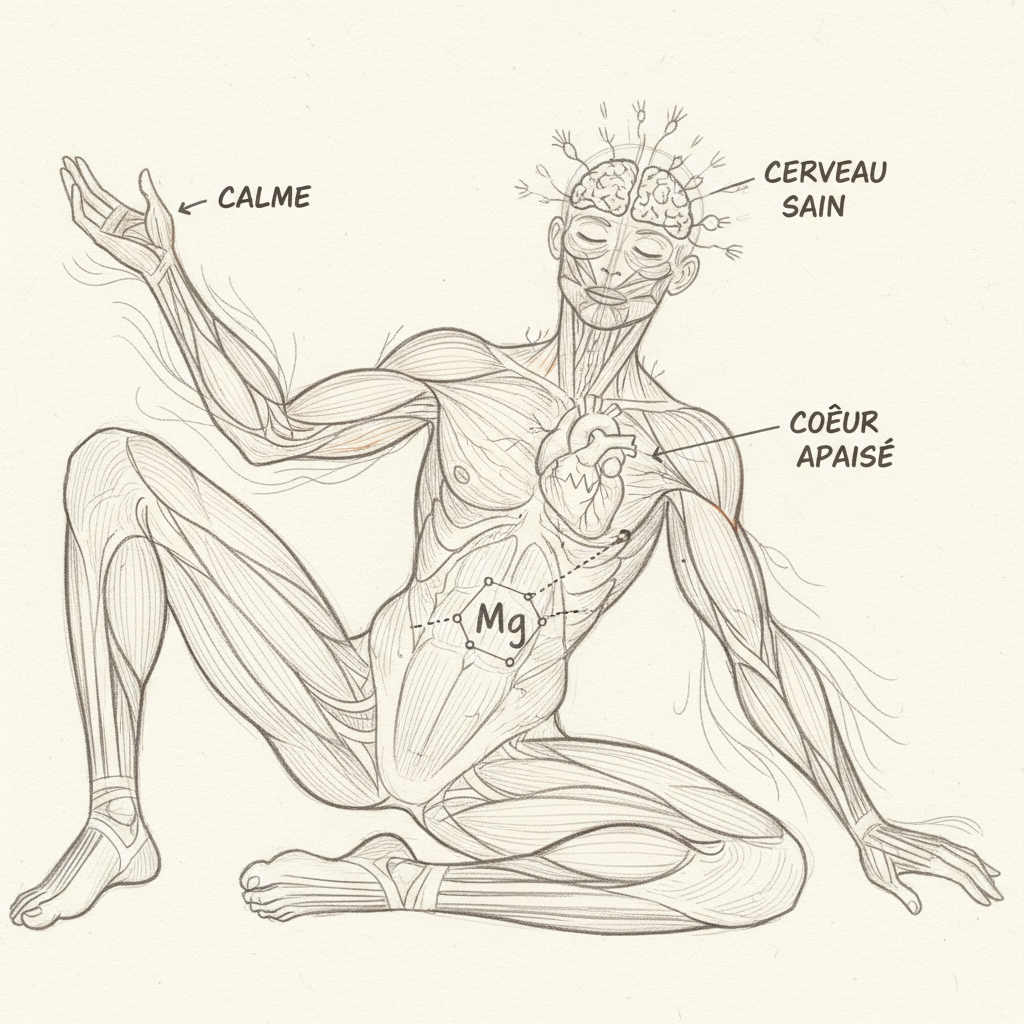
Magnesium is involved in more than three hundred enzymatic reactions. Three hundred. It is the most requested cofactor of the human body. It participates in cellular energy production (ATP), protein synthesis, nerve transmission, muscle contraction, blood sugar regulation, DNA synthesis, and the production of about thirty hormones including thyroid hormones.
Jean-Paul Curtay, in his book Okinawa: A Global Program for Better Living, describes magnesium as the “anti-stress mineral par excellence.” He reminds us that chronic stress depletes magnesium reserves (cortisol increases renal excretion of magnesium), and that magnesium deficiency amplifies the stress response (by reducing GABA and increasing excitatory glutamate). It is a vicious circle that Curtay calls the “magnesium-stress circle” and which he considers one of the central mechanisms of modern chronic fatigue.
In France, SU.VI.MAX surveys show that 75% of the population has magnesium intake below recommended nutritional intake. And these recommended intakes (360 mg per day for a woman) are themselves probably underestimated for stressed people, athletes, or those with chronic diseases.
Magnesium and Thyroid: The Link No One Makes
If you consult for a thyroid problem, your endocrinologist will measure your TSH, perhaps your free T4, and adjust your Levothyrox. They won’t measure your magnesium. That’s a mistake.
Magnesium intervenes at least at four levels in thyroid function. First, it is a cofactor of type 2 deiodinase, the enzyme that converts T4 (inactive) to T3 (active) in peripheral tissues. Without sufficient magnesium, you can have perfect T4 and low T3. Your “official” blood work will be normal, but you’ll be hypothyroid at the cellular level. If you want to understand the seven cofactors of thyroid conversion, I discuss this in detail in my article on thyroid and micronutrition.
Second, magnesium stabilizes the HPA axis (hypothalamus-pituitary-adrenals). When this axis is upregulated by stress, chronically elevated cortisol inhibits pituitary TSH and blocks T4→T3 conversion. Magnesium, by calming the HPA axis, indirectly allows the thyroid to function better.
Third, magnesium modulates inflammation. Chronic inflammation is one of the drivers of Hashimoto’s thyroiditis. Studies show that magnesium supplementation reduces CRP (C-reactive protein) and pro-inflammatory cytokines IL-6 and TNF-alpha. If you want to understand the autoimmune mechanism of Hashimoto and its root causes, this is an essential complement to that article.
Fourth, magnesium supports DHEA, an adrenal hormone precursor to sex hormones and immune modulator. DHEA is often collapsed in chronically fatigued thyroid patients. Increasing magnesium can raise DHEA naturally, without hormonal supplementation.
Constipation: Signal Number One
If I had to remember a single clinical sign of magnesium deficiency, it would be constipation. And here’s why I take this signal very seriously in naturopathy: a constipated patient cannot detoxify. The liver dumps its waste into bile, bile flows into the intestine, and if the intestine is sluggish, this waste is reabsorbed by the colon lining. This is what naturopathy calls self-intoxication, and it’s exactly the concept of toxemia that Marchesseau placed at the center of his philosophy: “All disease is the consequence of bodily sludge buildup.” If transit is blocked, sludge buildup amplifies, day after day.
This is why I always ensure transit functions correctly BEFORE prescribing a detoxification protocol or antimicrobial treatment. Giving oregano or berberine to a constipated patient means killing pathogenic bacteria without being able to eliminate them. Toxins released by bacterial death (Herxheimer reaction) will stagnate in a lazy colon and cause symptoms far worse than the original problem. Magnesium citrate is my first prescription in almost all protocols, precisely because it opens the exit door.
The Glycinate vs Citrate Controversy
This question comes up constantly in consultation and on social media. Magnesium glycinate is often presented as the “superior” form because it’s bound to glycine, a calming amino acid. In theory, it’s appealing. In practice, I’ve observed that some patients react poorly to glycinate with worsening anxiety, joint pain, or even panic attacks.
Three mechanisms can explain this paradoxical reaction. The first is oxalate sensitivity. Glycine can be converted to oxalate (oxalic acid) in certain people, and oxalates cause joint pain, kidney stones, and anxiety. The second is glutamate intolerance. Glycine is an amino acid that also acts on NMDA glutamate receptors. In people with excess glutamate (often linked to B6 deficiency), glycinate can paradoxically overstimulate the nervous system instead of calming it. The third is precisely P5P deficiency (active form of B6). P5P is necessary for converting glutamate to GABA. Without sufficient P5P, glutamate accumulates and glycine amplifies excitation instead of calming it.
For thyroid patients, who often have sluggish transit and B6 conversion problems, citrate remains my first-choice form. It combines magnesium’s relaxing effect with a mild intestinal osmotic effect that regulates transit without causing diarrhea (at usual doses of 300 to 400 mg).
Epsom Salt Baths: The Skin Route
Epsom salt (magnesium sulfate) is a therapeutic tool I prescribe systematically alongside oral supplementation. Magnesium crosses the skin barrier and reaches the bloodstream in about twenty minutes. This is particularly useful for patients who tolerate oral magnesium poorly (diarrhea even at low doses), those with intestinal absorption problems, and those suffering from localized muscle or joint pain.
The protocol is simple: two to three handfuls of Epsom salt in a warm bath (37 to 38 degrees Celsius), for twenty to thirty minutes, two to three times per week. The effect on tension headaches and neck pain is often dramatic from the first bath. Salmanoff, the father of capillary therapy, already recommended baths rich in minerals for their ability to open capillaries and facilitate tissue exchange. Epsom baths fit perfectly within this tradition.
A Magnesium-Rich Diet
The foods richest in magnesium are oleaginous seeds and nuts (almonds 270 mg/100g, cashews 260 mg, Brazil nuts 376 mg), raw cacao (500 mg/100g), leafy green vegetables (spinach 79 mg, chard 81 mg), legumes (white beans 140 mg, lentils 36 mg), whole grains (buckwheat 231 mg, oats 177 mg) and certain mineral waters (Hépar 110 mg/L, Contrex 74 mg/L, Rozana 160 mg/L).
The problem is that intensive agriculture has depleted soil magnesium by 20 to 30% in fifty years. A spinach grown in 1950 contained much more magnesium than a spinach in 2026. This is why even with a “balanced” diet, supplementation is often necessary, at least during periods of stress, illness, or pregnancy.
Magnesium in the Global Thyroid Protocol
I never prescribe magnesium in isolation. It’s part of an anti-inflammatory nutrition protocol that also includes zinc (cofactor of T4→T3 conversion), selenium (thyroid protector against oxidative stress), iron (TPO cofactor), and vitamin D (immune modulator). These five micronutrients form what I call the “thyroid foundation.” Magnesium is its base because it conditions the absorption and utilization of all the others.
For patients who also suffer from sleep disorders, I often add magnesium threonate in the evening (200 mg), the only form that crosses the blood-brain barrier and has shown improvement in deep sleep and memory in clinical trials. Citrate at dinner for transit and threonate at bedtime for the brain form a remarkably effective duo.
Warning
Magnesium is generally very well tolerated. The main “limit” is diarrhea that occurs when the dose is too high for your intestine. This is a signal to respect: lower the dose by 100 mg and increase gradually. People under treatment for kidney insufficiency should consult their doctor before any supplementation since kidneys are responsible for magnesium elimination.
Drug interactions are rare but real. Magnesium can reduce the absorption of antibiotics in the tetracycline and quinolone families (take two hours apart). It can also potentiate the effect of muscle relaxants. And like all minerals, take your magnesium away from (at least two hours) your Levothyrox.
What I Learned From Sandrine
Sandrine’s case taught me something important about naturopathic practice. Sometimes adding isn’t the solution. Sometimes you need to remove. Remove the noise to hear the signal. Her twelve supplements created metabolic cacophony where nothing worked correctly because everything blocked each other mutually (the iron blocked the zinc, calcium blocked magnesium, probiotics fed the SIBO). One single well-chosen mineral, at the right dose, in the right form, at the right time, did more than twelve capsules taken at random.
Kousmine wrote in Be Well on Your Plate: “Simplicity is the sign of truth in medicine as in philosophy.” It is also, I believe, the sign of good naturopathy. Not the kind that piles up protocols, but the kind that identifies the missing link and corrects it with precision. For Sandrine, that link was called magnesium. For you, it might be the same. Or it might be something else. But if you’re constipated, if you wake up at 3am, if your eyelid twitches and noise drives you crazy, I know where to start.
Want to evaluate your status? Take the magnesium questionnaire free in 2 minutes.
If you want personalized support, you can book a consultation.
To Learn More
- Stress, cortisol and thyroid: why order really matters
- Magnesium: the mineral that 75% of French people don’t have in sufficient quantity
- Vitamin B5 (pantothenic acid): the vitamin of your adrenals and coenzyme A
- Graves’ disease and stress: the thyroid of emotion
Want to evaluate your status? Take the thyroid Claeys questionnaire free in 2 minutes.
Want to evaluate your status? Take the Hertoghe melatonin questionnaire free in 2 minutes.
Healthy Recipe: Green Detox Smoothie: Spinach + banana = magnesium for your thyroid.





Laisser un commentaire
Sois le premier à commenter cet article.