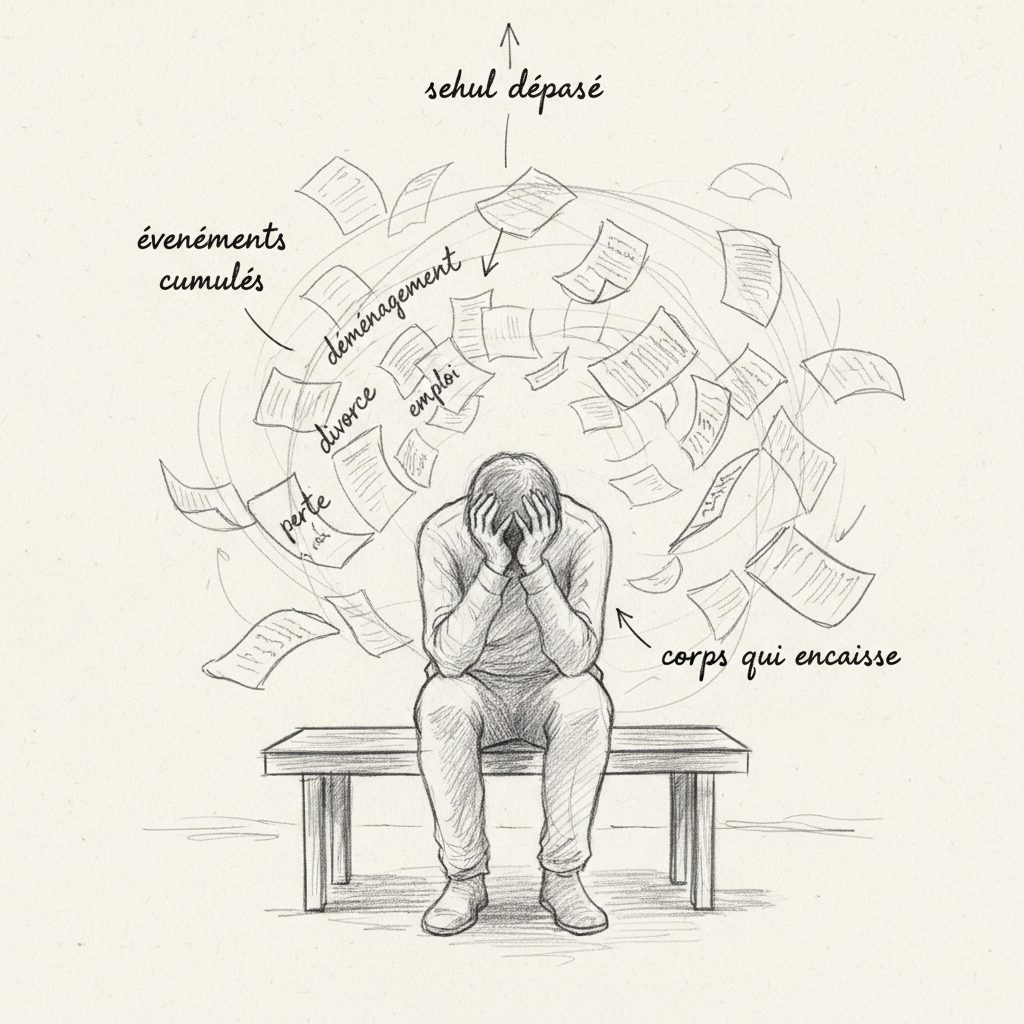
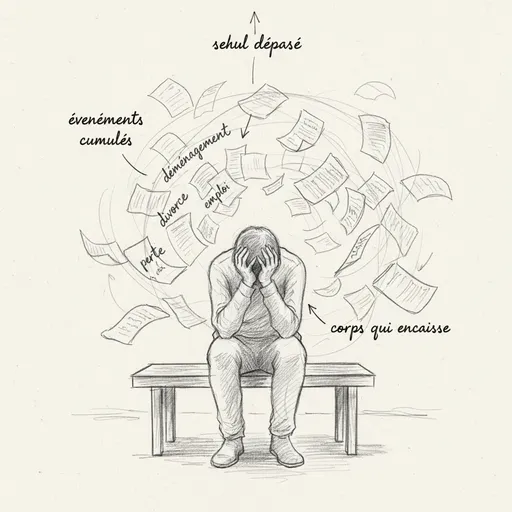
Carole had a record-breaking year. In January, her father passed away. In March, she divorced. In May, she moved. In July, she changed jobs. In September, her son left for university. In November, she was hospitalized for acute autoimmune thyroiditis. Her endocrinologist told her it was “idiopathic.” In naturopathy, we would say it was predictable.
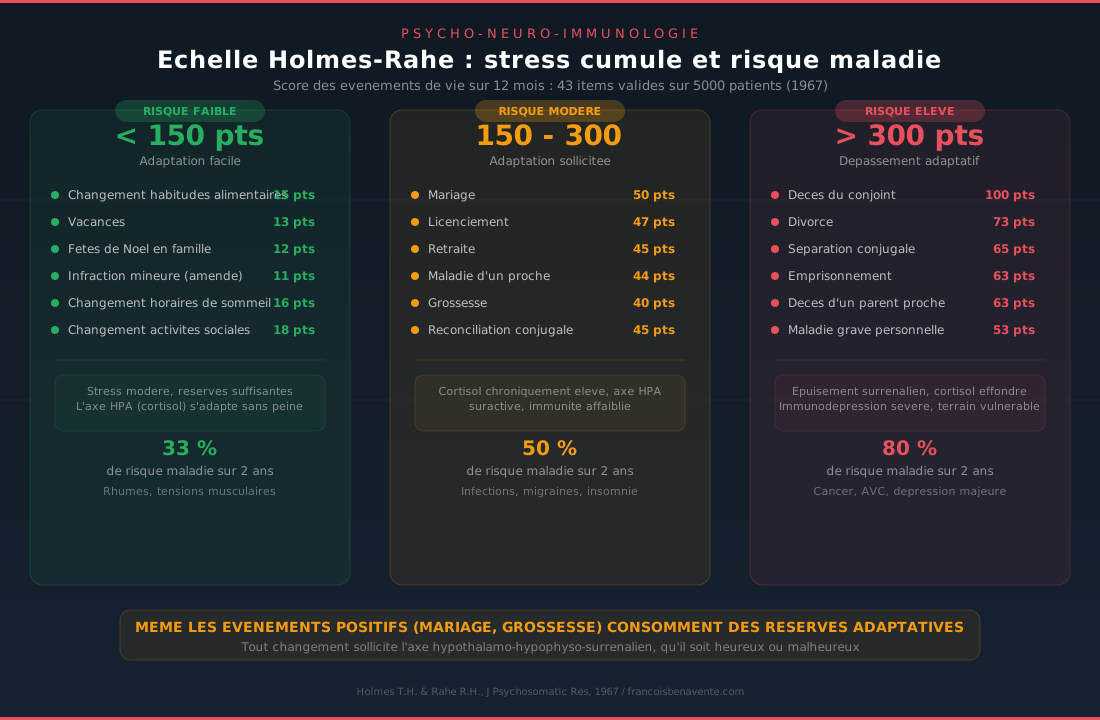
In 1967, psychiatrists Thomas Holmes and Richard Rahe published a landmark study in the Journal of Psychosomatic Research: they demonstrated that the accumulation of stressful life events in the preceding twelve months is a reliable predictor of the onset of serious illness in the following two years. Not a vague correlation: a quantifiable dose-response relationship. The higher the score, the greater the risk of becoming ill.
The social stress scale
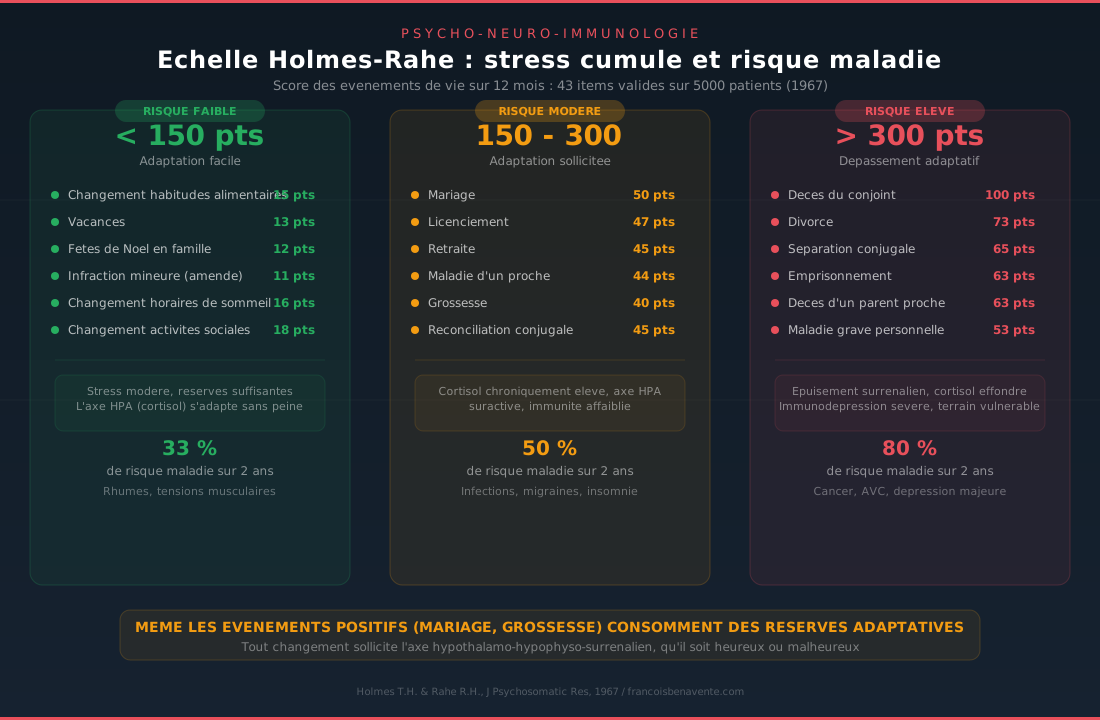
Holmes and Rahe assigned a score of life change units (LCU) to 43 major events. The death of a spouse is at the top with 100 points. Divorce follows with 73 points. Marital separation with 65. Imprisonment with 63. Death of a close family member with 63. Serious injury or illness with 53. Marriage with 50.
Professional events carry heavy weight: job loss (47), retirement (45), job change (36), conflict with boss (23). Financial events too: change in financial status (38), major loan (31). Family events: pregnancy (40), new family member (39), child leaving home (29).
What makes this scale powerful is the accumulation. A single event, even a serious one, is manageable. But when you stack a bereavement, a divorce, a move, and a job change in the same year, the total exceeds the body’s capacity to adapt. The scale defines three risk zones: 0-149 points (low risk, 30 percent chance of illness), 150-299 points (moderate risk, 50 percent), 300 points and above (high risk, 80 percent).
The biological mechanism
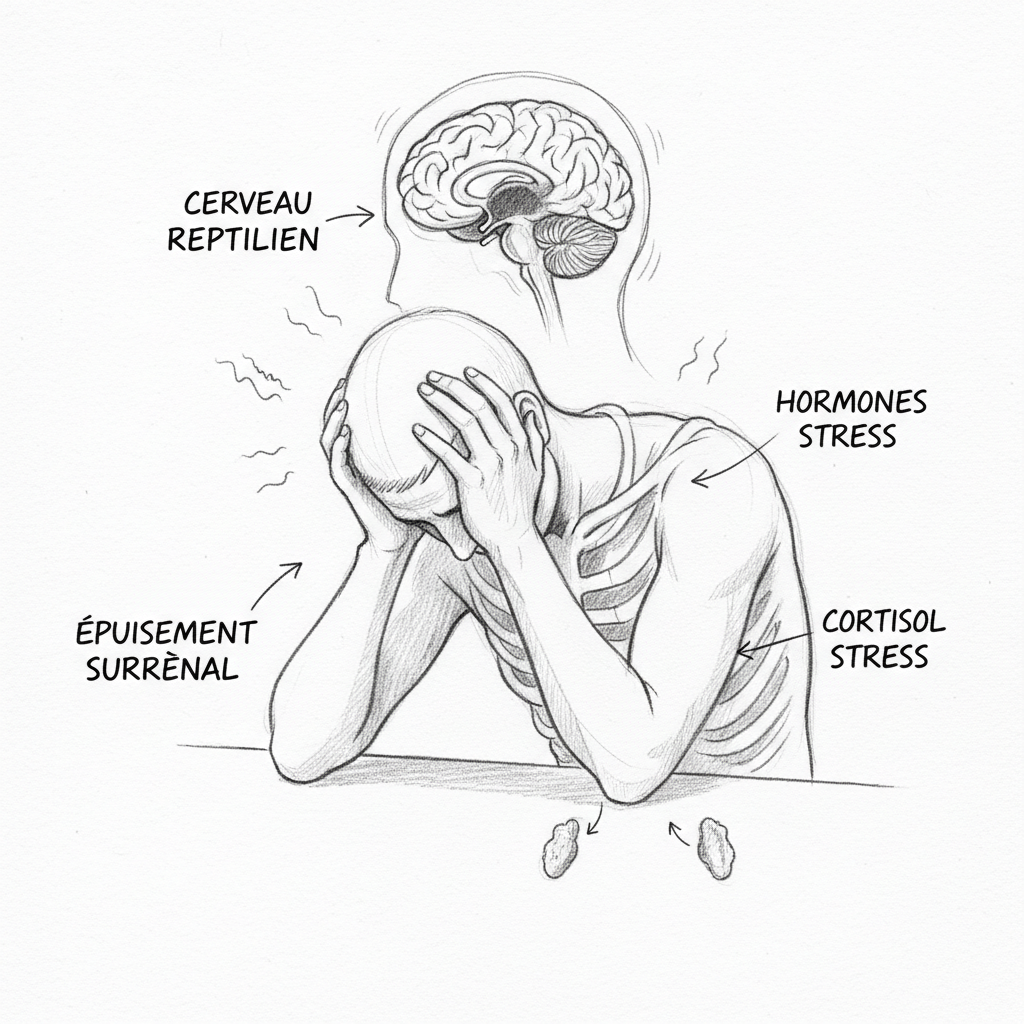
Each life event activates the hypothalamic-pituitary-adrenal axis (HPA). The hypothalamus releases CRH, the pituitary secretes ACTH, the adrenals produce cortisol. Cortisol mobilizes energy, suppresses inflammation, maintains alertness. This is the normal adaptive response.
The problem is that this response has a cost. Each HPA axis activation consumes raw materials: pregnenolone (the hormonal precursor), vitamin C (the most concentrated nutrient in the adrenals), vitamin B5, magnesium, zinc. When events accumulate, the adrenals gradually become exhausted: this is the progression from stage 1 (alarm) to stage 2 (resistance) to stage 3 (exhaustion).
In parallel, chronically elevated cortisol suppresses cellular immunity (T lymphocytes, NK cells). DHEA drops (pregnenolone theft). The thyroid slows down (cortisol inhibits T4→T3 conversion). The intestinal microbiota degrades (cortisol increases intestinal permeability). Chronic low-grade inflammation sets in. And the terrain becomes favorable for autoimmune diseases, infections, cancers, and cardiovascular disease.
Carole’s case is textbook. Her Holmes-Rahe score for the year: death of a parent (63) + divorce (73) + move (20) + job change (36) + son leaving (29) = 221 points. Moderate to high risk zone. Her thyroiditis was not “idiopathic”: it was the predictable biological consequence of adaptive overload.
What to do when your score is high
Take the Holmes-Rahe test to calculate your score.
If your score is above 150, you are in a zone of vulnerability. The strategy is not to eliminate events: you cannot prevent a bereavement or divorce: but to support the biological systems that absorb the shock.
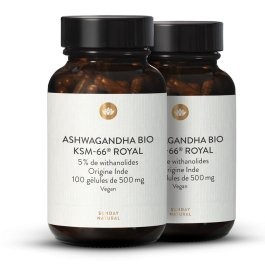
Adrenal support is the absolute priority. Vitamin C at high dose (2 to 3 grams per day in divided doses). Vitamin B5 (500 mg per day). Magnesium bisglycinate (400 mg per day). Adaptogenic herbs: ashwagandha (300 to 600 mg of KSM-66 extract, the most studied for cortisol), rhodiola (200 to 400 mg), eleuthero.
Immune support: vitamin D (4000 IU per day), zinc (15 mg), selenium (100 micrograms), vitamin A (5000 IU as retinol), probiotics (Lactobacillus and Bifidobacterium strains).
Nervous system support: magnesium (GABAergic action), L-theanine (200 mg), passionflower, valerian. Sleep is non-negotiable: it is during sleep that the adrenals regenerate and the immune system recharges.
Reducing other stressors is strategic. When you are going through a period of high score, it is NOT the time to start a draconian diet, an intense exercise program, an aggressive detox, or prolonged fasting. Each of these activities is additional stress on the body. This is the time for gentleness, rest, and rebuilding. Marchesseau’s three naturopathic cures place revitalization before detoxification: and that is exactly what a body under stress overload needs.
Carole started an intensive adrenal protocol (vitamin C 3 g, B5, magnesium, ashwagandha) upon leaving the hospital, alongside endocrinological treatment. Within six months, her anti-TPO antibodies had dropped by half. Her endocrinologist was surprised. I was not: when you treat the terrain, the disease retreats.
If you want personalized support, you can book a consultation.
To go further
- Graves’ disease and stress: the thyroid of emotion
- Burnout: when your reptilian brain takes control
- DHEA: the forgotten hormone of your vitality and immunity
- Adrenal exhaustion: the 3 stages nobody explains to you
Want to assess your status? Take the free Hertoghe cortisol questionnaire in 2 minutes.
Sources
- Holmes, Thomas H., et Rahe, Richard H. “The social readjustment rating scale.” Journal of Psychosomatic Research 11.2 (1967): 213-218.
- Wilson, James L. Adrenal Fatigue: The 21st Century Stress Syndrome. Smart Publications, 2001.
- Curtay, Jean-Paul. Nutrithérapie : bases scientifiques et pratique médicale. Testez Éditions, 2016.
If you want personalized support, you can book a consultation.
Healthy recipe: Digestive infusion: Calming herbs help during periods of stress.

Laisser un commentaire
Sois le premier à commenter cet article.