Hippocrates and the Four Pillars: The Foundations of Naturopathy Buried Under Micronutrients
Social media highlights micronutrition at the expense of the four founding pillars of our discipline. You hear about zinc, magnesium, vitamin D, serotonin. All of that is true, all of it is useful, and I speak about it abundantly myself on my account and on this site. But if you don’t know Hippocrates, if you’ve never taken the time to understand where naturopathy really comes from, then you’re building on sand. You’re stacking dietary supplements on terrain you don’t know how to read.
I realized this in consultation. A fifty-three-year-old man, a senior executive, arrived with a list of twenty-two supplements he takes every morning. Zinc, magnesium, omega-3s, coenzyme Q10, vitamin D, methylated B12, selenium, chromium, ashwagandha, melatonin. Twenty-two capsules. I asked him if he slept well. “Not really.” Whether he moves. “I don’t have time.” Whether he eats vegetables. “Frozen ones, sometimes.” His temperament is clearly bilious, his nervous system under high tension, his emunctories saturated. None of his supplements could compensate for what his lifestyle was stealing from him every day. This is exactly what Hippocrates knew twenty-five centuries ago, and what we have conveniently forgotten.
“Vital force is the most powerful force of cohesion and action of everything that exists. Only reason can conceive of it.” Hippocrates, cited by Paul Carton
The Man Behind the Legend
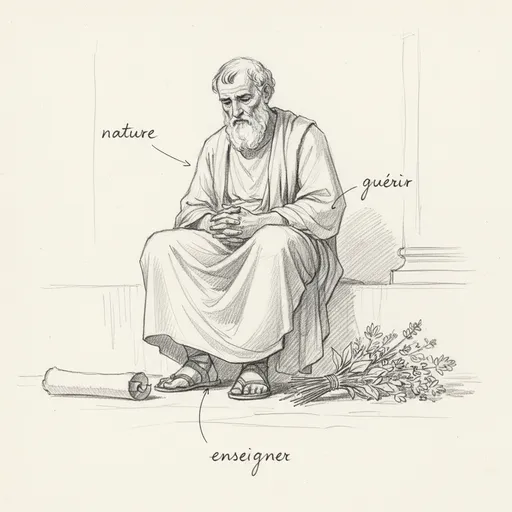
Hippocrates was born around 460 BCE on the island of Cos in the Aegean Sea. A seventeenth-degree descendant of Asclepius, the Greek god of medicine, he carried in his blood a lineage of healers and priest-physicians. Nicknamed the “prince of physicians,” he dedicated his entire life to observing the human body, understanding its regulatory mechanisms, and laying the foundations of a rational medicine, freed from superstitions and invocations to the gods. Before him, illness was divine punishment. With him, it became an imbalance of terrain. This shift is the birth of everything we practice today.
I warn you, this chapter is one of the densest I’ve published on this site. Hippocrates is a monument. His work, the Corpus Hippocraticum, represents approximately 1200 pages of medical texts, some of which were probably written by his disciples and his sons, Thessalus and Draco. But the essential thinking is coherent and remarkably modern. He speaks in it of nutrition, climate, air, water, sleep, temperaments, healing crises, vital force. He describes mechanisms that modern science is only now rediscovering.
The anecdote that sums up the man: when the plague struck Athens around 430 BCE, Hippocrates ordered aromatic fires lit throughout the city. Fumigations of antiseptic plants, thyme, rosemary, resins. The plague retreated. It wasn’t magic. It was empirical aromatherapy, twenty-five centuries before the term was invented. Later, the Persian king Artaxerxes I offered him glory and riches to come care for his people. Hippocrates refused. He replied that he could not serve the enemies of Greece. Ethics came before money. Some modern doctors would do well to reread that page.
Daniel Kieffer, in his Historical Encyclopedia of Naturopathy, devotes an entire chapter to Hippocrates and the legacy he transmitted through the centuries. It’s a work I recommend to all my students at Naturaneo, because you cannot practice naturopathy without understanding where it comes from.
The 15 Quotes That Founded Naturopathy
Hippocrates left hundreds of sayings, aphorisms, treatises. Some became the pillars of our practice. I’m not going to list them like a catalog. I’m going to explain why the most important ones concretely change the way a naturopath works.
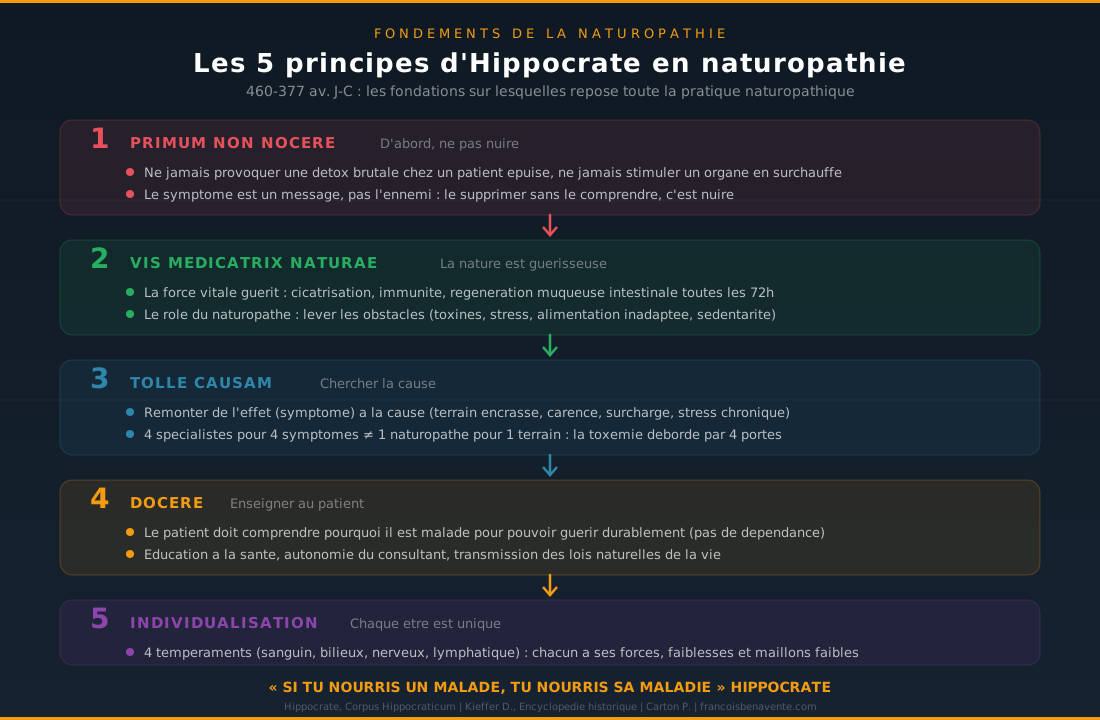
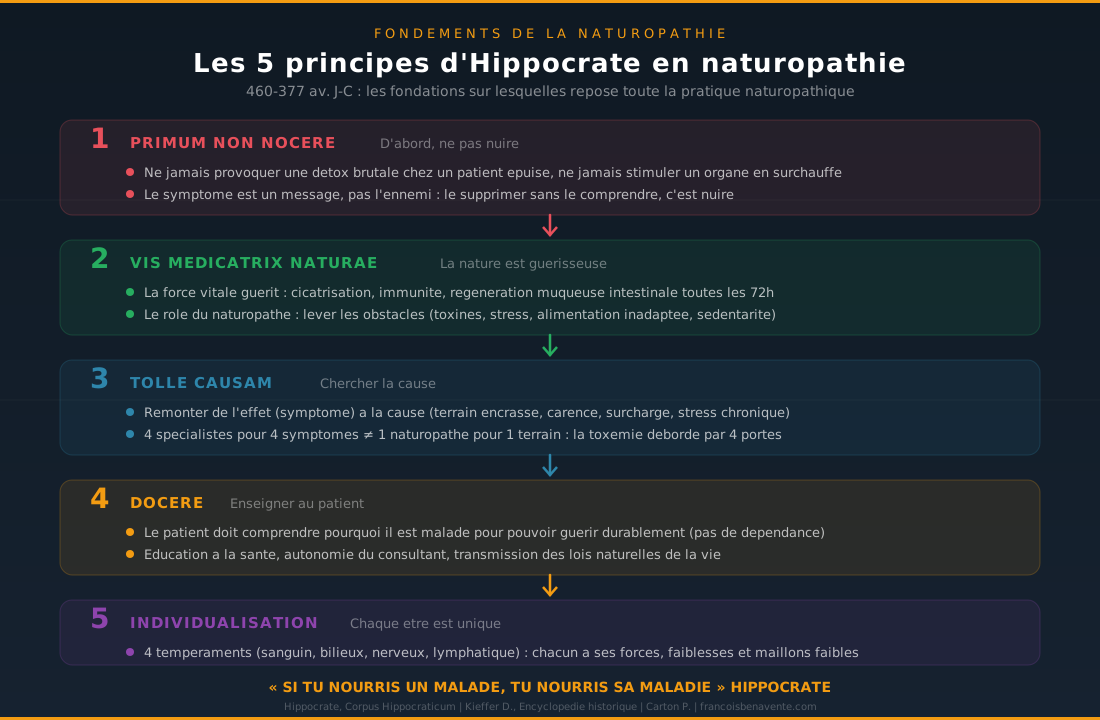
Primum non nocere, “First, do no harm.” This is the first principle. Before prescribing anything, the practitioner must ensure that their intervention will not cause more damage than the imbalance they seek to correct. In naturopathy, this means you never provoke brutal detoxification in an exhausted patient, you never stimulate an organ already overheated, you never suppress a symptom without understanding what it serves. The symptom is a message. To suppress it without listening to it is to cause harm. Marchesseau said the same thing twenty-five centuries later: the symptom is the organism’s attempt at healing, not the disease itself.
Vis medicatrix naturae, “Nature is the healer.” Your body possesses within itself the capacity to repair itself, to regenerate, to regain its balance. It is neither the doctor nor the naturopath who heals. It is vital force. Our role is to clear the path for it. Remove obstacles (toxins, stress, inadequate nutrition, sedentary behavior) and provide raw materials (nutrients, rest, movement, sunlight). Paul Carton, who transmitted this Hippocratic vision to the twentieth century, wrote that “vital force is the most powerful force of cohesion and action of everything that exists, and that only reason can conceive of it.” It’s not measurable in the laboratory. It’s not chemical. It’s what makes a wound heal, a bone knit, a cold resolve in five days without medication.
Let your food be your medicine and your medicine your food. This is probably the most well-known quote, and the most misused. You see it printed on organic tote bags and herbal tea mugs. But its depth is immense. Hippocrates wasn’t simply saying “eat well.” He was asserting that nutrition is the first therapeutic tool. Bromatology, this science of nutrition adapted to each individual according to their temperament, terrain, and vital state, is pure Hippocrates. It’s the foundation of everything I explain in the article on anti-inflammatory nutrition, and it’s the first lever I activate at every consultation.
All disease begins in the intestine. Twenty-five centuries before science discovered the microbiota, before studies on intestinal permeability, before the gut-brain axis was demonstrated, Hippocrates had seen correctly. He had understood through clinical observation that the quality of digestion determined the health of the entire organism. If the intestine malfunctions, foods are poorly broken down, toxins accumulate in the humors, blood, lymph, and organs downstream, the liver, kidneys, skin become overloaded. This is exactly the mechanism that Seignalet described in the twentieth century, and that I detail in the article on intestinal dysbiosis. Modern science confirms this intuition: 70% of the immune system resides in the intestine, serotonin is produced there 95% of the time, and the microbiota influences mood, immunity, and metabolism.
Tolle causam, “Seek the cause.” A naturopath doesn’t treat the symptom. He seeks the cause of the cause of the cause. You have painful periods? It’s not a deficiency in ibuprofen. It might be an excess of inflammatory prostaglandins, itself linked to an estrogen-progesterone imbalance, itself linked to an overloaded liver that no longer properly conjugates estrogens, itself linked to a diet too rich in xenobiotics. This is causalism, and it’s Hippocratic to the core.
Docere, “Teach.” The naturopath is not a prescriber. He is a health educator. His work consists of making the patient autonomous, of transmitting to them the keys to understanding their own body. Hippocrates didn’t give magical potions. He explained to the patient how to live to avoid getting sick again. Marchesseau took this principle word for word in his definition of naturopathy.
Man must harmonize spirit and body. This is holism ahead of its time. Hippocrates never separated the physical from the psychic. For him, an emotional disturbance could cause an organic illness, and vice versa. He observed that anger overheated the bilious temperament, sadness weakened the melancholic, fear froze the lymphatic. This integrated vision is what distinguishes naturopathy from conventional medicine, where the body is divided into watertight specialties. The cardiologist looks at the heart, the gastroenterologist looks at the intestine, the endocrinologist looks at the thyroid. No one looks at the whole man.
The other quotes from the corpus are equally powerful. “Walking is the best remedy for man” anticipates what movement science demonstrates today. “It is nature that cures the sick” reformulates vitalism. “Art is long, life is short, opportunity is fleeting, experience is deceptive, judgment is difficult” reminds every practitioner of the humility they should cultivate. And “If you are not your own doctor, you are a fool” places you face to face with your responsibility. Fifteen quotes, fifteen foundations. And the totality of modern naturopathy rests on them.
The Four Temperaments: The First Tool of the Naturopath
Hippocrates observed that human beings didn’t resemble each other. Not just physically. In their reactions to cold, heat, stress, food, exertion. He formalized this observation into four fundamental temperaments, each linked to a humor, a dominant organ, a season, and an element.
The sanguine is governed by blood, the liver, spring, the air element. He’s the bon vivant, the sociable one, the expansive one. He’s warm, he laughs loudly, he digests quickly, he recovers quickly from a cold and gets sick again just as quickly because he doesn’t know how to slow down. His strong point: energy. His weak point: excess. The bilious is governed by yellow bile, the gallbladder, summer, fire. He’s the chief, the entrepreneur, the productively choleric one. His digestion is powerful, his metabolism fast, his will implacable. But when he collapses, it’s brutal. The nervous or melancholic is governed by black bile, the spleen, autumn, earth. He’s the intellectual, the introvert, the perfectionist. His digestion is slow and capricious, his sleep fragile, his nervous system hypersensitive. It’s often in him that the serotonin deficit manifests most strongly. The lymphatic finally is governed by phlegm, the brain, winter, water. He’s calm, stable, slow. His digestion is lazy, his lymphatic circulation stagnates, he gains weight easily and loses it with difficulty. But his resistance is remarkable, and his patience is a considerable therapeutic asset.
Don’t see temperaments as precise boxes, but rather as sliders. Each individual possesses all four temperaments in varying proportions, with one or two dominants that orient their strengths and weaknesses. In consultation, I use them as a complementary reading grid. My professor Alain Rousseaux said something I never forgot: “It’s always the strong element of the weak system that gives way first.” A dominant nervous temperament with a sub-sanguine temperament will exhaust its sanguine component first, because it’s the only vital energy he possesses, and he burns it like a match in the wind.
The Hippocratic therapeutic strategy is twofold. First, relieve the strong systems, those overheating, consuming too much energy, monopolizing the organism’s resources. Second, strengthen the weak systems, those exhausting silently and that will eventually give way if we don’t support them. It’s of impeccable logic, and yet most modern approaches simply fill deficiencies without looking at the patient’s overall architecture.
I always use Marchesseau as first choice, because his morphopsychological grid is more detailed and more operational in practice. But Hippocrates comes as second filter. Marchesseau gives relief, Hippocrates gives depth. The two complement each other. If you want to understand Marchesseau’s vision and the ten techniques he codified, I invite you to read the foundations of naturopathy that I published on this site.
The Four Pillars That Naturopathy Forgot
I’ll be direct. Most of the content on natural health you find on the Internet, including mine sometimes, focuses on micronutrition. Zinc, magnesium, vitamin D, omega-3s, carnitine. All of that is fundamental. But it’s only a fraction of naturopathy. The four pillars inherited from Hippocrates are infinitely vaster, and it will take me at least twenty-five years to sharpen my thinking of these four pillars too often abandoned for lack of global vision.
Hygienism is the first pillar. It consists of respecting the natural laws of life. Nutrition adapted to your temperament and vitality. Daily movement, not three times a week at the gym, but every day, walking, breathing, stretching. Sufficient and restorative sleep, whose mechanisms I detailed in the article on sleeping naturally well. Pure air, quality water, sunlight. Hygienism is the foundation. If this foundation is shaky, no supplement, no plant, no technique can compensate. The senior executive I mentioned earlier with his twenty-two capsules understood it the day he replaced three supplements with thirty minutes of daily walking and seven hours of non-negotiable sleep. Within six weeks, his inflammatory markers had dropped more sharply than in a year of supplementation.
Humoralism is the second pillar. It’s the doctrine of humors, those bodily fluids whose quality determines health or illness. Hippocrates distinguished four humors: blood, yellow bile (chole), black bile (atrabile), and phlegm (pituita). Modern medicine abandoned this vocabulary, but the concept remains extraordinarily relevant. Replace “humors” with “internal environment” and you find Salmanoff and his capillotherapy, Claude Bernard and his terrain, Marchesseau and his toxemia. When the liquids in your body are overloaded with acids, metabolic waste, xenobiotics, and inflammatory residue, your cells bathe in a marsh. Your 100,000 kilometers of capillaries gradually clog. Your emunctory organs, the liver, kidneys, lungs, skin, intestine, struggle to eliminate. This is the soil of all chronic diseases, from fibromyalgia to endometriosis, from Hashimoto to PCOS.
Vitalism is the third pillar. It’s the most difficult concept to explain to a mind shaped by materialist science, and yet it’s the most important. Vital force is this non-measurable energy that animates every living cell, that orchestrates wound healing, regeneration, homeostasis, immune response, stress adaptation. It’s neither chemical nor physical. It’s what distinguishes a living organism from a corpse that possesses exactly the same molecules. Hippocrates placed it at the center of his medicine. Carton transmitted it. Marchesseau codified it. And every time a naturopath tells you “only the body heals, I only accompany it,” he reformulates Hippocrates without knowing it. The practitioner’s role is not to force healing. It’s to lift obstacles and provide conditions for vital force to do its work.
“Don’t kill the mosquitoes, drain the swamp.” Pierre-Valentin Marchesseau
Holism is the fourth pillar. The human being is an indivisible whole. Body, soul, spirit, environment. You can’t treat an hypothyroidism without looking at chronic stress that exhausts your adrenals. You can’t treat depression without checking the intestine’s state. You can’t support anemia without questioning eating habits, the menstrual cycle, digestive function, and emotional burden. Hippocrates knew this. He observed the patient holistically: his posture, his skin, his eyes, his voice, his breath, his nutrition, his lifestyle, his temperament, his emotions. He didn’t treat an organ. He accompanied a human being. And that’s exactly what modern medicine lost by specializing.
From Hippocrates to Marchesseau: The Lineage
The transmission wasn’t linear. There were centuries of oblivion, stakes, prohibitions. But the thread was never completely cut.
After Hippocrates, it was Galen in the 2nd century who took up and systematized temperaments. Then Paracelsus in the 16th century, that iconoclastic Swiss physician who publicly burned the works of Galen and Avicenna to assert that nature was the only true doctor. Paracelsus said: “The physician can only act by lifting the obstacles to natural healing.” That’s pure Hippocrates reworded. He added an alchemical and spiritual dimension that Marchesseau would later take up under the term “vitalism.”
In the twentieth century, the lineage becomes clearer. Paul Carton, French physician, published in 1920 his Treatise on Medicine, Nutrition, and Naturist Hygiene. It’s a monumental work that puts Hippocrates back at the center of medical reflection. Carton insists on vegetarian nutrition, fasting, hydrotherapy, gymnastics, contact with nature. He denounces medicinal poisoning and systematic vaccination. His positions earned him hostility from official medicine, but his influence on francophone naturopathy is considerable.
Pierre-Valentin Marchesseau comes after Carton. A biologist by training, he codified naturopathy in 1935 in the form of ten natural health techniques, divided into four major (bromatology, physical exercise, psychology, hydrology) and six minor (phytology, chirology, actinology, pneumology, magnetology, reflexology). This codification I detail in the foundations of naturopathy. What’s striking is that each of these ten techniques finds its root in the Corpus Hippocraticum. Hippocrates spoke of nutrition, baths, massages, walks, sun, rest, plants. Marchesseau organized into a system what Hippocrates practiced by intuition and observation. Then Catherine Kousmine, Robert Masson, André Passebecq, each in their own way, enriched this inheritance with modern science data, nutritional biochemistry, immunology, endocrinology.
What I find fascinating is that the most recent scientific discoveries only confirm what Hippocrates had posited empirically. The intestinal microbiota confirms that “all disease begins in the intestine.” Epigenetics confirms that lifestyle modulates gene expression. Psychoneuroimmunology confirms that mind and body are inseparable. Chronobiology confirms that respecting natural rhythms is fundamental for health. Hippocrates had no microscope, no genetic sequencer, no MRI. He had his eyes, his hands, his observational sense, and an intellectual rigor that many modern researchers would envy.
Why This Vision Changes Everything in Consultation
When a patient enters my office, I don’t think first in terms of molecules. I think in terms of terrain, temperament, humors, vital force. It’s the Hippocratic reading that allows me to prioritize. An exhausted nervous person with an overloaded liver and leaky intestine won’t receive the same protocol as a plethoric sanguine person who eats too much, sleeps too little, and whose blood is acidic. Micronutrition comes after. It comes to fill the deficits that terrain has created. But if you don’t correct terrain first, you’ll spend your life filling holes that keep digging themselves again.
This is why I always start with fundamentals: nutrition, sleep, movement, stress management, cleansing of emunctories. And supplements come second, targeted, personalized, dosed according to the patient’s temperament and vitality. Gentle cooking before enzymes in capsule form. The plate before the supplement. Lifestyle before the molecule.
Hippocrates said nothing different.
Disclaimer
This article is a tribute to the founder of our discipline and an invitation to deepen his principles. It does not replace medical follow-up in any way. The four Hippocratic temperaments are an understanding tool, not a diagnosis. If you suffer from a chronic pathology, whether it’s an autoimmune disease, hormonal disorder, or inflammatory syndrome, consult your doctor and consider complementary naturopathic support. Naturopathy never substitutes for medicine. It complements it.
Return to Sources to Go Further
Hippocrates died around 377 BCE, in Larissa, Thessaly. He was about eighty-three, a remarkable age for the time. It’s said that until the end, he continued teaching and receiving patients. He never stopped observing, questioning, transmitting.
If you want to understand what naturopathy can bring you, start with the pillars before molecules. Start with Hippocrates before micronutrition. Return to basics. And if you want to deepen your understanding of this discipline, you can read the foundations of naturopathy on this site, or find me in my online training where I teach these principles in their entirety.
“If you are not your own doctor, you are a fool.” Hippocrates
It’s the phrase I leave with every patient at the end of consultation. Not to guilt-trip them, but to make them responsible. Your health belongs to you. Hippocrates knew it. Marchesseau knew it. Time you knew it too.
To Go Further
- Hippocrates: the 5 pillars and 4 temperaments of naturopathy
- Paul Carton: the naturist doctor who inspired Marchesseau
- Vincent’s Bioelectronics: the science of terrain
- Kneipp, Salmanoff and hydrology: the healing power of water
References
Hippocrates, Corpus Hippocraticum, texts gathered and commented by Emile Littré, J.B. Baillière, 1839-1861, 10 volumes.
Kieffer Daniel, Historical Encyclopedia of Naturopathy, Jouvence Editions, 2019.
Carton Paul, Treatise on Medicine, Nutrition and Naturist Hygiene, Le François Bookstore, 1920.
Marchesseau Pierre-Valentin, Daily Psycho-Naturopathy, photocopied course, School of Naturopathy, Paris.
Yano J.M., Yu K., Donaldson G.P. et al., “Indigenous bacteria from the gut microbiota regulate host serotonin biosynthesis”, Cell, 2015, vol. 161, no 2, p. 264-276. DOI: 10.1016/j.cell.2015.02.047.
Seignalet Jean, Nutrition or the Third Medicine, The Eye Editions, 5th edition, 2004.


Laisser un commentaire
Sois le premier à commenter cet article.