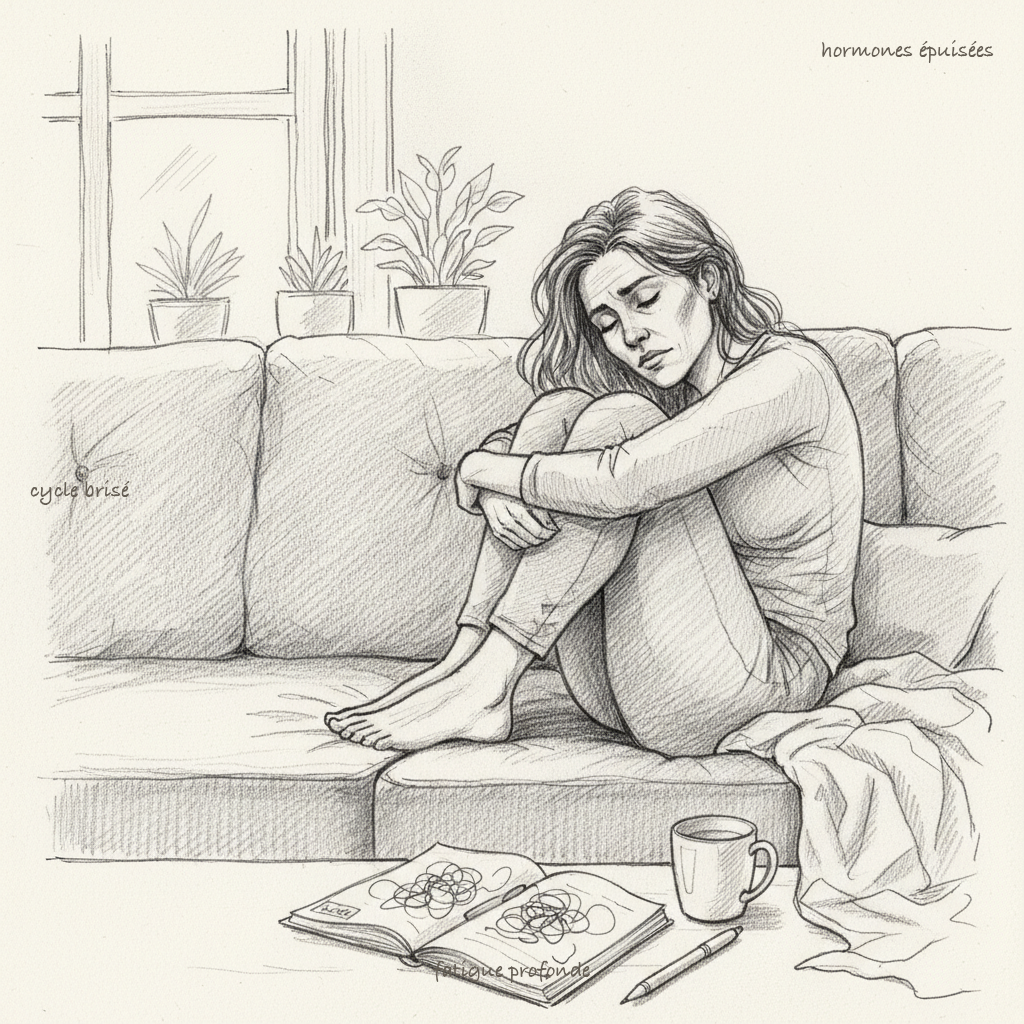
Nathalie is forty-two years old. When she sat down across from me, she placed a paper bag on my desk containing six months of prescriptions. Antidepressants. Anxiolytics. Magnesium from the pharmacy (the least absorbable form, of course). Progestin pill to “regulate her cycles”. And a proposal for a hormonal IUD to “calm the pain”. Six specialists in two years. Gynecologist, endocrinologist, rheumatologist, psychiatrist, gastroenterologist, sleep physician. Each one had treated their piece of the puzzle without ever looking at the complete picture.
Her symptoms: permanent fatigue for three years, worse in the premenstrual phase. Heavy and painful periods that had worsened over time. Premenstrual syndrome lasting ten days (instead of two or three). Insomnia in the second half of the cycle. Eight kilos gained in two years, concentrated on the belly and hips. Diffuse hair loss. Zero libido. Irritability bordering on anger, to the point that her children had learned to “not talk to mom after four o’clock”.
No one had ever explained to her that all these symptoms told the same story. A story of exhausted adrenals that had diverted her entire hormonal machinery. If you want to first understand the three stages of adrenal exhaustion, start with this article. Here, we will explore why women pay a heavier price than men, and why your gynecologist never talks to you about your adrenals.
The pregnenolone theft, female version
I detailed the pregnenolone theft mechanism in my article on cortisol and thyroid. But in women, this mechanism takes on a particular dimension that I will develop here.
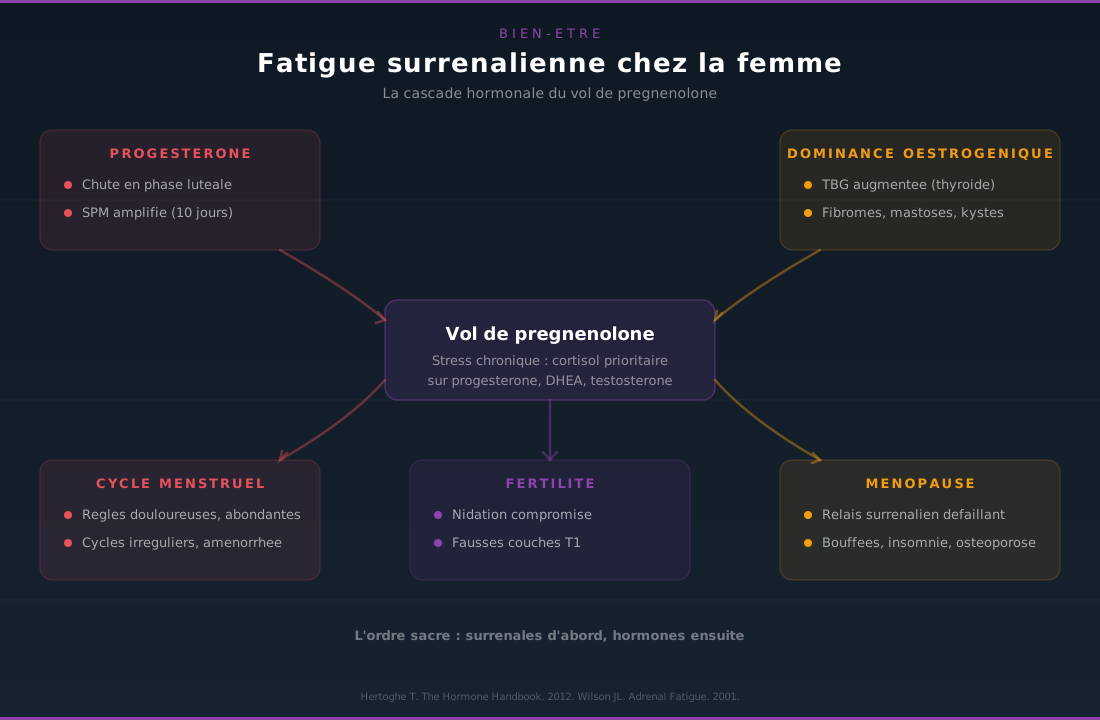
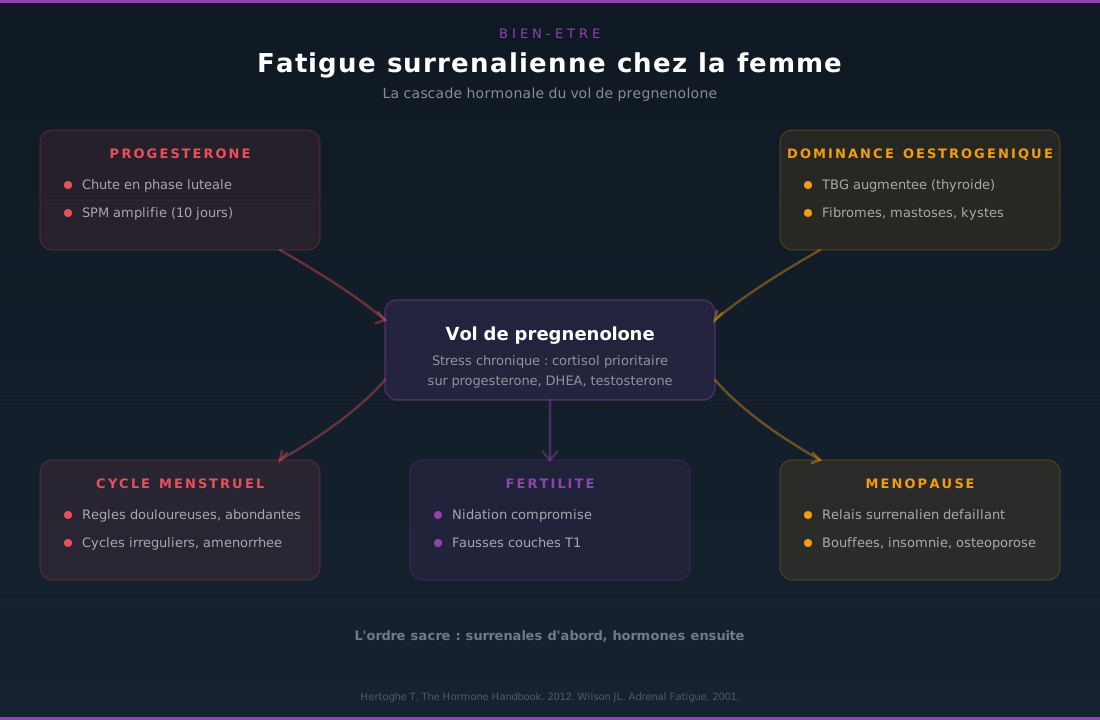
Pregnenolone is produced from cholesterol in the mitochondria. It is the mother molecule of all steroid hormones. Under normal circumstances, it is distributed among several synthesis pathways: cortisol, aldosterone, DHEA, testosterone, progesterone, estrogens. Under chronic stress, the body operates a merciless triage. It redirects massive amounts of pregnenolone toward cortisol production. This is a survival decision. Cortisol is the danger hormone. For your body, staying alive is more urgent than maintaining a regular menstrual cycle.
In men, this redistribution primarily affects testosterone and DHEA. This is annoying (loss of muscle mass, fatigue, decreased libido), but the consequences remain relatively linear. In women, it is a hormonal earthquake. Because the first victim of pregnenolone theft is progesterone. And progesterone is not just one hormone among others. It is the hormone that orchestrates the entire second half of the menstrual cycle, the luteal phase. Without sufficient progesterone, the luteal phase shortens, the endometrium develops poorly, premenstrual syndrome amplifies, periods become painful and heavy.
Dr. Hertoghe teaches in his training that progesterone is “the hormone of serenity”. It is a natural anxiolytic (it binds to GABA-A receptors in the brain, exactly like benzodiazepines). It promotes deep sleep. It regulates water retention. It moderates the proliferative effect of estrogens on the uterus and breasts. When pregnenolone theft causes it to drop, all these functions collapse. Anxiety rises. Sleep degrades. Water retention swells the body. Estrogens, without counterbalance, become dominant.
Relative estrogen dominance
This is a key concept I use daily in practice. Estrogen dominance does not mean your estrogens are too high in absolute value. It means the progesterone/estrogen ratio is unbalanced. You can have normal, even low estrogens, and be in estrogen dominance if your progesterone is collapsed. It is the ratio that matters, not isolated values.
The consequences of this dominance are cascading. Excess estrogen increases TBG (thyroid binding globulin), the transport protein for thyroid hormones. More TBG means more T3 and T4 sequestered, bound to this transport protein, unavailable to cells. Result: symptoms of hypothyroidism (fatigue, feeling cold, weight gain, hair loss) with a sometimes “normal” thyroid panel. I developed this mechanism in my article on thyroid and estrogens. Estrogens also stimulate hepatic production of SHBG (sex hormone binding globulin), which sequesters free testosterone. Less free testosterone means less energy, less muscle mass, less libido.
Estrogens not counterbalanced by progesterone promote uterine cell proliferation (fibroids, hyperplasia), breast (mastosis, cysts) and endometrial. If you suffer from endometriosis or PCOS, the adrenal component is almost always at play. Adrenal fatigue is not the sole cause of these pathologies, but it is the ground that nourishes them.
The menstrual cycle as an adrenal barometer
Your menstrual cycle is the best indicator of your adrenal health. Better than any blood test. Because the female cycle is the result of the balance between three hormonal axes: the HPG axis (hypothalamic-pituitary-gonadal, which pilots the ovaries), the HPA axis (hypothalamic-pituitary-adrenal, which pilots the adrenals) and the HPT axis (hypothalamic-pituitary-thyroid, which pilots the thyroid). These three axes share the same conductor: the hypothalamus. When one goes wrong, the others follow.
In adrenal fatigue stage 1, elevated cortisol partially inhibits hypothalamic GnRH. The consequence is subtle: a slight shortening of the luteal phase (less than eleven days instead of fourteen), a more marked premenstrual syndrome than before, sometimes delayed ovulation. Many women at this stage do not notice it, or attribute these changes to “aging”.
In stage 2, disturbances become obvious. Cycles lengthen or shorten unpredictably. Premenstrual syndrome lasts a week or more. Periods become painful when they were not before (or worsen if they already were). Bleeding is more heavy. Spotting (brownish discharge between periods) appears. Water retention in the luteal phase can reach two kilos. Sleep specifically degrades in the week before periods, when progesterone should be at its maximum but no longer is.
In stage 3, some women completely lose their periods (functional hypothalamic amenorrhea). The body considers reproduction is no longer a priority. This is, once again, a survival decision: why make a baby when you don’t even have enough energy for yourself? Other women develop erratic bleeding, cycles of twenty days followed by cycles of fifty days, reflecting internal hormonal chaos.
Nathalie, my patient from the beginning of this article, had ten-day premenstrual syndrome, seven-day periods and cramps that doubled her over for forty-eight hours. Counting it up, she spent nineteen days a month suffering, against nine days of relative calm. Two thirds of her life were governed by a hormonal imbalance that no one had connected to her adrenals.
Menopause, the adrenal stress test
There is a moment in a woman’s life when the adrenals become absolutely crucial: menopause. When the ovaries stop producing estrogens and progesterone, the adrenals take over. Not by directly producing estrogens, but by producing DHEA, which is converted to estrogens (estrone, primarily) in peripheral tissues (adipose tissue, skin, bone).
This relay is of paramount importance. Women whose adrenals are in good health at menopause cross this transition with moderate or even absent symptoms. Hot flashes are manageable. Sleep remains adequate. Mood is stable. Energy is maintained. On the other hand, women who arrive at menopause with already exhausted adrenals experience a double collapse: the ovaries stop AND the adrenals cannot compensate. Hot flashes are violent. Insomnia becomes chronic. Fatigue is crushing. Anxiety and depression settle in. Osteoporosis progresses faster (DHEA is protective of bone).
This is why I often say in consultation that preparing for menopause begins ten years before. If you are thirty-eight or forty years old and you feel your adrenals flagging, this is the time to act. Not at fifty, when your ovaries will have shut down and your adrenals will be incapable of stepping up.
Fertility sabotaged in silence
A topic we talk about too little. The number of consultations for unexplained infertility keeps increasing in France. Gynecological workups are normal. The partner’s sperm analysis is correct. Ovulation occurs. And yet, pregnancy does not come, or does not stick (repeated miscarriages in the first trimester).
Progesterone is the hormone of implantation and pregnancy maintenance. When pregnenolone theft causes it to drop, the endometrium does not properly prepare to receive the embryo. And even if implantation occurs, insufficient progesterone levels in the first trimester increase the risk of early miscarriage. Chronically elevated cortisol also directly inhibits GnRH, disrupting the precise timing of ovulation. A shift of a few hours can be enough to make fertilization impossible.
I am not saying all infertility is adrenal. That would be reductive. But I am saying that in an infertility workup, the adrenals should be systematically evaluated. A four-point salivary cortisol test and a blood DHEA-S test. It is simple, inexpensive, and it can change everything. Cortisol is actually part of the periconception workup I recommend to every woman planning pregnancy.
The female-specific protocol
Managing adrenal fatigue in women requires adjustments that the “standard” protocol does not provide.
The first pillar is support for the luteal phase. Chasteberry (Vitex agnus-castus), at a dose of twenty milligrams per day in the morning, stimulates progesterone production via the pituitary. This is the plant I use most often in first-line treatment in women with adrenal fatigue and cycle disorders. Expect three complete cycles to see the effects. Evening primrose (evening primrose seed oil, one thousand milligrams per day in the second half of the cycle) provides gamma-linolenic acid (GLA) which promotes the synthesis of anti-inflammatory prostaglandins.
The second pillar is hepatic support. The liver metabolizes estrogens. When it is overloaded (alcohol, medications, pesticides, endocrine disruptors), used estrogens are not properly eliminated and recirculate, worsening estrogen dominance. Milk thistle (silymarin, two hundred milligrams twice daily), artichoke (cynarin), and cruciferous vegetables (broccoli, cauliflower, cabbage) containing DIM (diindolylmethane) promote estrogen detoxification. I detailed the endocrine disruptors to avoid in your daily environment.
The third pillar is targeted micronutrition. Magnesium bisglycinate (three to four hundred milligrams per day) remains the foundation. Zinc (fifteen to thirty milligrams per day) is essential for progesterone synthesis. Vitamin B6 in P5P form (pyridoxal-5-phosphate, fifty milligrams per day) supports progesterone and serotonin production (serotonin typically drops in the premenstrual phase in women with estrogen dominance). Iron must be monitored, especially if periods are heavy: iron-deficiency anemia significantly worsens adrenal fatigue.
The fourth pillar is stress management adapted to your cycle. In the follicular phase (from day one of your period to ovulation), the body tolerates effort and stress better. This is the time for projects, important appointments, more sustained physical activity. In the luteal phase (from ovulation to periods), progesterone calls for calm, rest, withdrawal. Pushing during this phase means going against your biology. Women who synchronize their lifestyle with their cycle (a concept called “cycle syncing”) observe a significant improvement in their adrenal symptoms, sometimes before even starting any supplementation.
What I observed in Nathalie
Her morning salivary cortisol was 6.3 nanomoles per liter (collapsed). Her DHEA-S was low. Her progesterone in mid-luteal phase was 3.2 nanograms per milliliter (normal being between 5 and 20). She was in stage 3 of adrenal fatigue with massive estrogen dominance.
Her protocol was as follows. Phase 1 (first two months): magnesium bisglycinate four hundred milligrams per day, vitamin C one gram morning and evening, B complex with B6 P5P, ashwagandha two hundred milligrams in the evening, licorice two hundred milligrams in the morning. Gradual elimination of coffee (replaced with matcha, which contains calming L-theanine). Bedtime no later than 10:30 pm. Phase 2 (months 3 to 5): addition of chasteberry twenty milligrams in the morning, evening primrose oil in the second half of the cycle, milk thistle for hepatic support. Introduction of cycle syncing: physical activity only in the follicular phase, yoga and walking in the luteal phase.
By the fourth month, her periods became less painful. Her premenstrual syndrome went from ten days to four. By the fifth month, she lost three kilos without changing her diet (water retention had decreased and abdominal storage regressed). By the sixth month, her libido returned. And by the ninth month, when we retested her hormonal panel, her progesterone in the luteal phase was 11.8 nanograms per milliliter. Her DHEA-S had increased by thirty-five percent.
No one had ever told her that her adrenals were the keystone of all her symptoms. Not her gynecologist. Not her endocrinologist. Not her psychiatrist. Six specialists, six pieces of the puzzle, and no one to assemble the picture.
Paul Carton wrote: “Disease is never local, it is always general.” In the woman with adrenal fatigue, this truth takes on its full meaning. It is not a problem with periods, a thyroid problem, a sleep problem and a mood problem. It is one and the same problem: adrenals that no longer function, and a woman’s body that pays the price at every level.
Want to assess your status? Take the free Hertoghe cortisol questionnaire in 2 minutes.
If you want personalized support, you can book a consultation.
To go further
- Basedow and stress: the thyroid of emotion
- Burn-out: when your reptilian brain takes control
- DHEA: the forgotten hormone of your vitality and immunity
- Adrenal exhaustion: the 3 stages nobody explains to you
Sources
- Hertoghe, Thierry. The Hormone Handbook. 2nd ed. International Medical Books, 2012.
- Marchesseau, Pierre-Valentin. Naturopathy booklets (1950-1980).
- Wilson, James L. Adrenal Fatigue: The 21st Century Stress Syndrome. Smart Publications, 2001.
- Carton, Paul. The Laws of Healthy Living. 1920.
You can book a consultation for a complete hormonal and adrenal workup. I practice in Paris and via video throughout France.

Laisser un commentaire
Sois le premier à commenter cet article.